



 Chat with AI
Exam 12: Production and Growth

Exam 1: Ten Principles of Economics438 Questions
Exam 2: Thinking Like an Economist620 Questions
Exam 3: Interdependence and the Gains From Trade527 Questions
Exam 4: The Market Forces of Supply and Demand700 Questions
Exam 5: Elasticity and Its Application598 Questions
Exam 6: Supply, Demand, and Government Policies648 Questions
Exam 7: Consumers, Producers, and the Efficiency of Markets547 Questions
Exam 8: Application: the Costs of Taxation514 Questions
Exam 9: Application: International Trade496 Questions
Exam 10: Measuring a Nations Income522 Questions
Exam 11: Measuring the Cost of Living545 Questions
Exam 12: Production and Growth507 Questions
Exam 13: Saving, Investment, and the Financial System567 Questions
Exam 14: The Basic Tools of Finance513 Questions
Exam 15: Unemployment699 Questions
Exam 16: The Monetary System517 Questions
Exam 17: Money Growth and Inflation487 Questions
Exam 18: Open-Economy Macroeconomics: Basic Concepts522 Questions
Exam 19: A Macroeconomic Theory of the Open Economy484 Questions
Exam 20: Aggregate Demand and Aggregate Supply563 Questions
Exam 21: The Influence of Monetary and Fiscal Policy on Aggregate Demand511 Questions
Exam 22: The Short-Run Trade-Off Between Inflation and Unemployment516 Questions
Exam 23: Six Debates Over Macroeconomic Policy372 Questions
Select questions type


Because of its effect on the amount of capital per worker, in the short term an increase in the working population is likely to
(Multiple Choice)
4.9/5  (61)
(61) Explain the distinction between technological knowledge and human capital.
(Essay)
4.7/5 (79)
(79) In 2010, the imaginary nation of Mainland had a population of 6,000 and real GDP of 120,000. In 2011 the population was 6,200 and real GDP of 128,960. Over the year in question, real GDP per person in Mainland grew by
(Multiple Choice)
4.8/5 (82)
(82) If a production function has constant returns to scale, then if all inputs double so does production.
(True/False)
4.9/5 (81)
(81) Because of , an increase in the saving rate leads to higher growth of income and productivity only for a while.
(Essay)
4.8/5 (82)
(82) Which of the following lists contains, in this order, natural resources, physical capital, and human capital?
(Multiple Choice)
4.8/5 (83)
(83) A country experiencing a growth rate of 12% per year can go from being one of the poorest to one of the richest in how many generations?
(Multiple Choice)
4.8/5 (74)
(74) Janet is a farmer. Which of the following are included in her human capital?
(Multiple Choice)
4.8/5 (78)
(78) Which of the following measures how the level of well-being in a country has changed over time?
(Multiple Choice)
4.9/5 (77)
(77) Which of the following is an example of a produced factor of production?
(Multiple Choice)
4.9/5 (78)
(78) Which of the following would, by itself, reveal the most about a country's standard of living?
(Multiple Choice)
4.7/5 (79)
(79) In the production function  , which symbol reflects the state of technology?
 (Multiple Choice)
4.9/5 (75)
(75) All else equal, if there are diminishing returns and constant returns to scale, then what happens to productivity if capital and labor both increase but capital increases by more?
(Multiple Choice)
4.8/5 (79)
(79) Some data that at first might seem puzzling: The share of GDP devoted to investment was similar for the United States and South Korea from 1960-1991. However, during these same years South Korea had a 6 percent growth rate of average annual income per person, while the United States had only a 2 percent growth rate. If the saving rates were the same, why were the growth rates so different?
(Essay)
5.0/5 (85)
(85) Figure 25-1 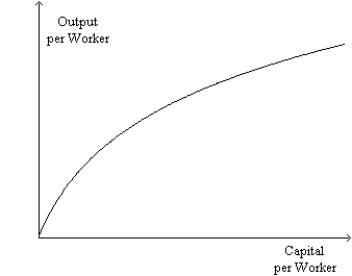 -Refer to Figure 21-1. "When the amount of capital per worker increases by one unit, a poor country experiences a greater benefit than does a rich country." Does the figure illustrate this notion? Briefly explain.
 (Essay)
4.8/5 (84)
(84) One can argue that the average American today is "richer" than the richest American 100 years ago, given that 100 years ago,
(Multiple Choice)
4.8/5 (65)
(65) If a country has a higher level of productivity than another, then it also has a higher level of real GDP.
(True/False)
4.9/5 (84)
(84) 
Filters
- Essay(0)
- Multiple Choice(0)
- Short Answer(0)
- True False(0)
- Matching(0)