



 Chat with AI
Exam 12: Production and Growth

Exam 1: Ten Principles of Economics438 Questions
Exam 2: Thinking Like an Economist620 Questions
Exam 3: Interdependence and the Gains From Trade527 Questions
Exam 4: The Market Forces of Supply and Demand700 Questions
Exam 5: Elasticity and Its Application598 Questions
Exam 6: Supply, Demand, and Government Policies648 Questions
Exam 7: Consumers, Producers, and the Efficiency of Markets547 Questions
Exam 8: Application: the Costs of Taxation514 Questions
Exam 9: Application: International Trade496 Questions
Exam 10: Measuring a Nations Income522 Questions
Exam 11: Measuring the Cost of Living545 Questions
Exam 12: Production and Growth507 Questions
Exam 13: Saving, Investment, and the Financial System567 Questions
Exam 14: The Basic Tools of Finance513 Questions
Exam 15: Unemployment699 Questions
Exam 16: The Monetary System517 Questions
Exam 17: Money Growth and Inflation487 Questions
Exam 18: Open-Economy Macroeconomics: Basic Concepts522 Questions
Exam 19: A Macroeconomic Theory of the Open Economy484 Questions
Exam 20: Aggregate Demand and Aggregate Supply563 Questions
Exam 21: The Influence of Monetary and Fiscal Policy on Aggregate Demand511 Questions
Exam 22: The Short-Run Trade-Off Between Inflation and Unemployment516 Questions
Exam 23: Six Debates Over Macroeconomic Policy372 Questions
Select questions type


Senator Smith says that in order to help poor countries develop, the United States should: 1. Prevent U.S. corporations from investing in poor countries because they take profits that the poor countries should have; 2. Not import goods from poor countries that use child labor; 3. Work to promote political stability in poor countries; and 4. Reduce poor countries' reliance on market forces in their economies. How many of these ideas are likely to help poor countries grow?
(Multiple Choice)
4.9/5  (88)
(88) In which of the following cases can we be certain that a natural resource has become scarcer?
(Multiple Choice)
4.9/5 (84)
(84) In the equation for the production function Y/L represents
(Multiple Choice)
4.9/5 (85)
(85) Suppose a U.S. automaker builds and operates a new factory in Italy. Future production from such an investment will
(Multiple Choice)
4.9/5 (77)
(77) Suppose there are constant returns to scale. Now suppose that over time a country doubles its workers, its natural resources, its physical capital, and its human capital, but its technology is unchanged. Which of the following would double?
(Multiple Choice)
4.7/5 (97)
(97) Country A has real GDP per person of 100,000 while country B has real GDP per person of 200,000. All else constant, country A will eventually have a higher standard of living than country B if
(Multiple Choice)
4.7/5 (73)
(73) On a production function, as capital per worker increases, output per worker
(Multiple Choice)
4.9/5 (77)
(77) Table 25-1.
Athens and Troy both produce only ribs and baked potatoes.
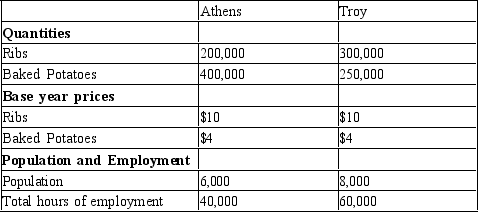 -Refer to Table 25-1. Which of the following is correct?
 (Multiple Choice)
4.9/5 (86)
(86) In some countries in Sub-Saharan Africa real GDP per person has been stagnant for many years.
(True/False)
4.7/5 (78)
(78) You bake cookies. One day you double the time you spend, double the number of chocolate chips, flour, eggs, and all your other inputs, and bake twice as many cookies. Your cookie production function has
(Multiple Choice)
4.9/5 (66)
(66) A country's standard of living depends on its ability to produce goods and services.
(True/False)
4.8/5 (76)
(76) Which of the following best states economists' understanding of the facts concerning the relationship between natural resources and economic growth?
(Multiple Choice)
4.8/5 (80)
(80) Daniel owns a coffee kiosk. All of his employees work 8 hours per day. In 2011, he employed 6 people who produced a total of 912 cups of coffee each day. In 2012, he hired a seventh employee and production increased to 1008 cups of coffee each day. In Daniel's kiosk, productivity
(Multiple Choice)
4.8/5 (73)
(73) 
Filters
- Essay(0)
- Multiple Choice(0)
- Short Answer(0)
- True False(0)
- Matching(0)