



 Chat with AI
Exam 24: The Influence of Monetary and Fiscal Policy on Aggregate Demand

Exam 1: Ten Principles of Economics438 Questions
Exam 2: Thinking Like an Economist620 Questions
Exam 3: Interdependence and the Gains From Trade527 Questions
Exam 4: The Market Forces of Supply and Demand700 Questions
Exam 5: Elasticity and Its Application598 Questions
Exam 6: Supply, Demand, and Government Policies648 Questions
Exam 7: Consumers, Producers, and the Efficiency of Markets550 Questions
Exam 8: Application: The Costs of Taxation514 Questions
Exam 9: Application: International Trade496 Questions
Exam 10: Externalities522 Questions
Exam 11: Public Goods and Common Resources434 Questions
Exam 12: The Costs of Production420 Questions
Exam 13: Firms in Competitive Markets543 Questions
Exam 14: Monopoly637 Questions
Exam 15: Measuring a Nations Income522 Questions
Exam 16: Measuring the Cost of Living545 Questions
Exam 17: Production and Growth507 Questions
Exam 18: Saving, Investment, and the Financial System567 Questions
Exam 19: The Basic Tools of Finance513 Questions
Exam 20: Unemployment699 Questions
Exam 21: The Monetary System518 Questions
Exam 22: Money Growth and Inflation487 Questions
Exam 23: Aggregate Demand and Aggregate Supply563 Questions
Exam 24: The Influence of Monetary and Fiscal Policy on Aggregate Demand512 Questions
Select questions type


Figure 34-3 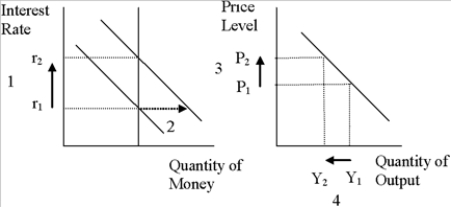 -Refer to Figure 34-3. For an economy such as the United States, what component of the demand for goods and services is most responsible for the decrease in output from Y1 to Y2?
 (Multiple Choice)
4.8/5  (76)
(76) Figure 34-2. On the left-hand graph, MS represents the supply of money and MD represents the demand for money; on the right-hand graph, AD represents aggregate demand. The usual quantities are measured along the axes of both graphs.
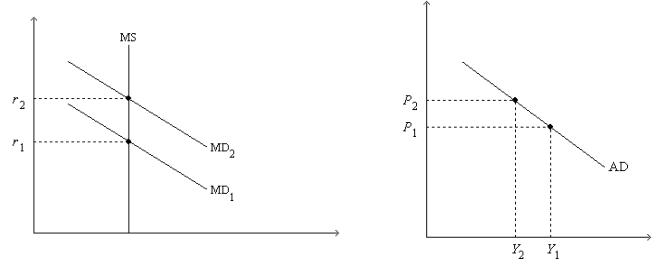 -Refer to Figure 34-2. If the money-supply curve MS on the left-hand graph were to shift to the left, this would
 (Multiple Choice)
4.8/5 (77)
(77) A severe problem that many economists have with the active use of monetary policy and fiscal policy to stabilize the economy is that, while those policies obviously work well in practice, they are not well understood on a theoretical level.
(True/False)
5.0/5 (93)
(93) In 1961, President John F. Kennedy, acting upon advice from his economists, proposed tax cuts. The advice he received
(Multiple Choice)
4.9/5 (82)
(82) Figure 34-11 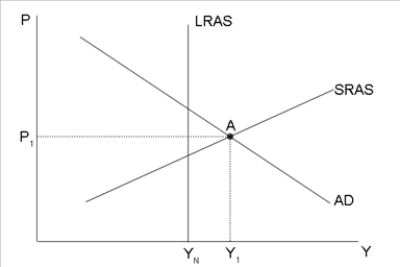 -Refer to Figure 34-11. The economy is currently at point A. To stabilize output, the president and Congress can reduce __________ and/or increase _____.
 (Short Answer)
4.8/5 (77)
(77) If the inflation rate is zero, then the nominal and real interest rate are the same.
(True/False)
4.9/5 (73)
(73) As the MPC gets close to 1, the value of the multiplier approaches
(Multiple Choice)
4.8/5 (85)
(85) According to the theory of liquidity preference, money demand
(Multiple Choice)
4.9/5 (79)
(79) Suppose there was a large increase in net exports. If the Fed wanted to stabilize output, it could
(Multiple Choice)
4.7/5 (78)
(78) To stabilize output, the Federal Reserve will the money supply when aggregate demand falls.
(Short Answer)
4.8/5 (84)
(84) In a certain economy, when income is $1000, consumer spending is $800. The value of the multiplier for this economy is 2.5. It follows that, when income is $1020, consumer spending is
(Multiple Choice)
5.0/5 (86)
(86) An open-market purchase by the Federal Reserve creates an excess _____ of money. This causes interest rates to _____ and investment to _____. The change in investment causes aggregate demand to shift to the _____.
(Short Answer)
4.8/5 (70)
(70) In the graph of the money market, the money supply curve is
(Multiple Choice)
4.7/5 (78)
(78) Suppose a wave of optimism causes firms to increase investment. To stabilize output and employment, the Federal Reserve will .
(Short Answer)
4.7/5 (79)
(79) When the Fed increases the money supply, the interest rate decreases. This decrease in the interest rate increases consumption and investment demand, so the aggregate-demand curve shifts to the right.
(True/False)
4.7/5 (84)
(84) An increase in households' desired money holding causes an) _____ in interest rates. This causes an) _____ in investment spending and aggregate demand.
(Short Answer)
4.9/5 (70)
(70) 
Filters
- Essay(0)
- Multiple Choice(0)
- Short Answer(0)
- True False(0)
- Matching(0)