



 Chat with AI
Exam 20: Unemployment

Exam 1: Ten Principles of Economics438 Questions
Exam 2: Thinking Like an Economist620 Questions
Exam 3: Interdependence and the Gains From Trade527 Questions
Exam 4: The Market Forces of Supply and Demand700 Questions
Exam 5: Elasticity and Its Application598 Questions
Exam 6: Supply, Demand, and Government Policies648 Questions
Exam 7: Consumers, Producers, and the Efficiency of Markets550 Questions
Exam 8: Application: The Costs of Taxation514 Questions
Exam 9: Application: International Trade496 Questions
Exam 10: Externalities522 Questions
Exam 11: Public Goods and Common Resources434 Questions
Exam 12: The Costs of Production420 Questions
Exam 13: Firms in Competitive Markets543 Questions
Exam 14: Monopoly637 Questions
Exam 15: Measuring a Nations Income522 Questions
Exam 16: Measuring the Cost of Living545 Questions
Exam 17: Production and Growth507 Questions
Exam 18: Saving, Investment, and the Financial System567 Questions
Exam 19: The Basic Tools of Finance513 Questions
Exam 20: Unemployment699 Questions
Exam 21: The Monetary System518 Questions
Exam 22: Money Growth and Inflation487 Questions
Exam 23: Aggregate Demand and Aggregate Supply563 Questions
Exam 24: The Influence of Monetary and Fiscal Policy on Aggregate Demand512 Questions
Select questions type


The amount of unemployment that an economy normally experiences is called the
(Multiple Choice)
4.8/5  (89)
(89) The unemployment that results from the quantity of labor supplied exceeding the quantity demanded is called frictional unemployment.
(True/False)
4.9/5 (82)
(82) Unemployment insurance is designed to offer workers full protection against job loss.
(True/False)
4.8/5 (93)
(93) Buddy is the owner of a firm that bottles beer in St. Louis, Missouri. There are many other such firms in the area. Buddy decides that if he pays his workers a wage higher than the going market wage, his profits will increase. Which of the following is a likely explanation for his decision?
(Multiple Choice)
4.9/5 (77)
(77) Adults who were waiting to be recalled to a job from which they had been laid off are included in the Bureau of Labor Statistics' "employed" category.
(True/False)
4.8/5 (87)
(87) The Bureau of Labor Statistics' U1 measure of joblessness is smaller than its U6 measure of joblessness.
(True/False)
4.9/5 (61)
(61) Figure 28-5 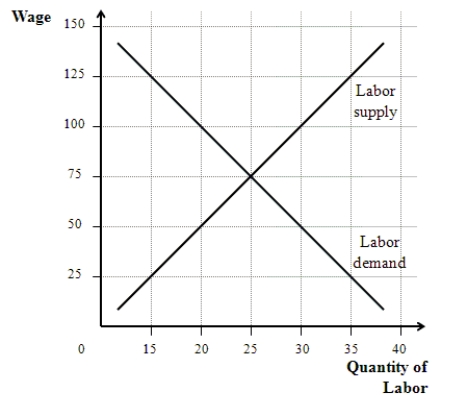 -Refer to Figure 28-5. If the minimum wage is set at $125, then
 (Multiple Choice)
4.9/5 (75)
(75) Policies that reduce the time it takes unemployed workers to find new jobs
(Multiple Choice)
4.9/5 (83)
(83) According to the theory of efficiency wages, firms operate more efficiently if wages are below the equilibrium level.
(True/False)
4.9/5 (77)
(77) Table 28-3
2009 Labor Data for Baltivia
 -Refer to Table 28-3. What was Baltivia's laborforce participation rate in 2009?
 (Multiple Choice)
4.8/5 (90)
(90) Critics of government-run employment agencies and public training programs argue that the private market is better at matching workers and jobs than the government is.
(True/False)
4.7/5 (86)
(86) For the Bureau of Labor Statistics to place someone in the "unemployed" category, that person must
(Multiple Choice)
4.9/5 (78)
(78) The unemployment that results from the quantity of labor supplied exceeding the quantity demanded is called structural unemployment.
(True/False)
4.9/5 (76)
(76) Table 28-11
2010 Labor Data for Tajnia
 -Refer to Table 28-11. The total adult population of Tajnia in 2010 is 30,000.
 (True/False)
4.9/5 (85)
(85) Figure 28-3  -Refer to Figure 28-3. If the government imposes a minimum wage of $4, then employment will decrease by
 (Multiple Choice)
4.8/5 (74)
(74) Which of the following is not a cause of frictional unemployment?
(Multiple Choice)
4.9/5 (79)
(79) Both fulltime and parttime workers are included in the Bureau of Labor Statistics' "employed" category.
(True/False)
4.9/5 (74)
(74) 
Filters
- Essay(0)
- Multiple Choice(0)
- Short Answer(0)
- True False(0)
- Matching(0)