



 Chat with AI
Exam 19: The Basic Tools of Finance

Exam 1: Ten Principles of Economics438 Questions
Exam 2: Thinking Like an Economist620 Questions
Exam 3: Interdependence and the Gains From Trade527 Questions
Exam 4: The Market Forces of Supply and Demand700 Questions
Exam 5: Elasticity and Its Application598 Questions
Exam 6: Supply, Demand, and Government Policies648 Questions
Exam 7: Consumers, Producers, and the Efficiency of Markets550 Questions
Exam 8: Application: The Costs of Taxation514 Questions
Exam 9: Application: International Trade496 Questions
Exam 10: Externalities522 Questions
Exam 11: Public Goods and Common Resources434 Questions
Exam 12: The Costs of Production420 Questions
Exam 13: Firms in Competitive Markets543 Questions
Exam 14: Monopoly637 Questions
Exam 15: Measuring a Nations Income522 Questions
Exam 16: Measuring the Cost of Living545 Questions
Exam 17: Production and Growth507 Questions
Exam 18: Saving, Investment, and the Financial System567 Questions
Exam 19: The Basic Tools of Finance513 Questions
Exam 20: Unemployment699 Questions
Exam 21: The Monetary System518 Questions
Exam 22: Money Growth and Inflation487 Questions
Exam 23: Aggregate Demand and Aggregate Supply563 Questions
Exam 24: The Influence of Monetary and Fiscal Policy on Aggregate Demand512 Questions
Select questions type


Figure 27-5. The figure shows a utility function for Dexter.  -Refer to Figure 27-5. Suppose Dexter begins with $1,300 in wealth. Starting from there,
 (Multiple Choice)
4.7/5  (81)
(81) Figure 27-4. The figure shows a utility function for Alex.  -Refer to Figure 27-4. From the appearance of Alex's utility function, we know that
 (Multiple Choice)
4.8/5 (82)
(82) Risk-averse individuals like good things more than they dislike comparable bad things.
(True/False)
4.9/5 (78)
(78) Which of the following is correct if the interest rate is 6 percent?
(Multiple Choice)
4.9/5 (71)
(71) Risk-averse people will choose different asset portfolios than people who are not risk averse. Over a long period of time, we would expect that
(Multiple Choice)
4.9/5 (88)
(88) In the 15 years ending June 2010, most active portfolio managers failed to beat the market.
(True/False)
4.9/5 (86)
(86) What is the future value of $375 at an interest rate of 3 percent one year from today?
(Multiple Choice)
4.8/5 (73)
(73) Suppose the interest rate is 8 percent. Consider three payment options:
1) $200 today.
2) $220 one year from today.
3) $240 two years from today.
Which of the following is correct?
(Multiple Choice)
4.8/5 (82)
(82) Abby buys health insurance because she knows that she has health risks that wouldn't be obvious to an insurance company. Brad buys home owners insurance and then is less careful to make sure he's put out his cigarettes. The example with Abby
(Multiple Choice)
4.9/5 (77)
(77) In answering which of the following questions would you find it necessary to calculate a present value?
(Multiple Choice)
4.8/5 (82)
(82) Whenever the price of an asset rises above what appears to be its fundamental value, the market is said to be experiencing a
(Multiple Choice)
4.8/5 (81)
(81) A firm has three different investment options. Option A will give the firm $10 million at the end of one year, $10 million at the end of two years, and $10 million at the end of three years. Option B will give the firm $15 million at the end of one year, $10 million at the end of two years, and $5 million at the end of three years. Option C will give the firm $30 million at the end of one year, and nothing thereafter. Which of these options has the highest present value?
(Multiple Choice)
4.9/5 (99)
(99) Figure 27-6. On the graph, x represents risk and y represents return. 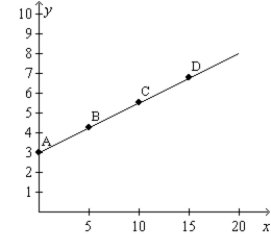 -Refer to Figure 27-6. Point A represents a situation in which
 (Multiple Choice)
4.9/5 (74)
(74) Veronica deposited $1,000 into an account two years ago. The first year she earned 7 percent interest; the second year she earned 5 percent. How much money does Veronica have in her account today?
(Multiple Choice)
4.9/5 (83)
(83) Figure 27-2. The figure shows a utility function for Britney.  -Refer to Figure 27-2. From the appearance of the utility function, we know that
 (Multiple Choice)
5.0/5 (87)
(87) Cleo promises to pay Jacques $1,000 two years from today. If the interest rate is 4 percent, then how much is this future payment worth today?
(Multiple Choice)
4.8/5 (87)
(87) 
Filters
- Essay(0)
- Multiple Choice(0)
- Short Answer(0)
- True False(0)
- Matching(0)