



 Chat with AI
Exam 17: Production and Growth

Exam 1: Ten Principles of Economics438 Questions
Exam 2: Thinking Like an Economist620 Questions
Exam 3: Interdependence and the Gains From Trade527 Questions
Exam 4: The Market Forces of Supply and Demand700 Questions
Exam 5: Elasticity and Its Application598 Questions
Exam 6: Supply, Demand, and Government Policies648 Questions
Exam 7: Consumers, Producers, and the Efficiency of Markets550 Questions
Exam 8: Application: The Costs of Taxation514 Questions
Exam 9: Application: International Trade496 Questions
Exam 10: Externalities522 Questions
Exam 11: Public Goods and Common Resources434 Questions
Exam 12: The Costs of Production420 Questions
Exam 13: Firms in Competitive Markets543 Questions
Exam 14: Monopoly637 Questions
Exam 15: Measuring a Nations Income522 Questions
Exam 16: Measuring the Cost of Living545 Questions
Exam 17: Production and Growth507 Questions
Exam 18: Saving, Investment, and the Financial System567 Questions
Exam 19: The Basic Tools of Finance513 Questions
Exam 20: Unemployment699 Questions
Exam 21: The Monetary System518 Questions
Exam 22: Money Growth and Inflation487 Questions
Exam 23: Aggregate Demand and Aggregate Supply563 Questions
Exam 24: The Influence of Monetary and Fiscal Policy on Aggregate Demand512 Questions
Select questions type


A barber shop produces 192 haircuts a day. Each barber in the shop works 8 hours per day and produces the same number of haircuts per hour. If the shop's productivity is 2 haircuts per hour of labor, then how many barbers does the shop employ?
(Multiple Choice)
4.9/5  (77)
(77) According to research by Robert Fogel, what proportion of the British population in 1780 was so malnourished that they could not perform manual labor?
(Multiple Choice)
4.8/5 (75)
(75) Popeye produces 20 cans of spinach in 8 hours. Wimpy produces 15 hamburgers in 10 hours. If each hamburger trades for 1.5 cans of spinach, then
(Multiple Choice)
4.8/5 (82)
(82) Suppose Japanese-based Toshiba Corporation builds and operates a new computer factory in the United States. Future production from such an investment will
(Multiple Choice)
4.9/5 (80)
(80) Other things the same, which of the following would increase productivity?
(Multiple Choice)
4.8/5 (79)
(79) Studies have found that there is a relationship between height and productivity. Briefly explain.
(Essay)
5.0/5 (81)
(81) Despite its status as one of the richest countries in the world, Japan
(Multiple Choice)
4.9/5 (77)
(77) All else equal, if there are diminishing returns and constant returns to scale, then what happens to productivity if capital and labor both increase but capital increases by more?
(Multiple Choice)
4.8/5 (73)
(73) Table 25-1.
Athens and Troy both produce only ribs and baked potatoes.
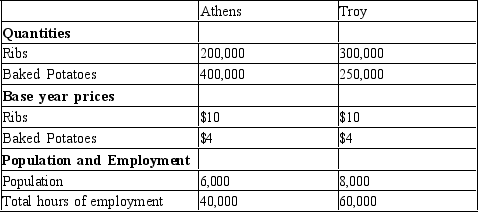 -Refer to Table 25-1. Which of the following is correct?
 (Multiple Choice)
4.8/5 (81)
(81) The opening of a new American-owned factory in Algeria would tend to increase Algeria's GDP more than it increases Algeria's GNP because
(Multiple Choice)
4.9/5 (85)
(85) "When workers have a relatively small quantity of capital to use in producing goods and services, giving them an additional unit of capital increases their productivity by a relatively large amount." This statement
(Multiple Choice)
5.0/5 (73)
(73) Over the last ten years productivity grew faster in Mapoli than in Romeria while the population and total hours worked remained the same in both countries. It follows that
(Multiple Choice)
4.8/5 (95)
(95) Suppose a person receives an education in her home country. Which of the following will tend to make the increase in GDP of the person's home country larger than the increase in this person's income?
(Multiple Choice)
4.9/5 (80)
(80) In which of the following countries has economic growth been sufficiently high that income would double every ten years?
(Multiple Choice)
4.9/5 (76)
(76) All else equal, if there are diminishing returns, then which of the following is true if a country increases its capital by one unit?
(Multiple Choice)
4.8/5 (82)
(82) 
Filters
- Essay(0)
- Multiple Choice(0)
- Short Answer(0)
- True False(0)
- Matching(0)