



 Chat with AI
Exam 16: Measuring the Cost of Living

Exam 1: Ten Principles of Economics438 Questions
Exam 2: Thinking Like an Economist620 Questions
Exam 3: Interdependence and the Gains From Trade527 Questions
Exam 4: The Market Forces of Supply and Demand700 Questions
Exam 5: Elasticity and Its Application598 Questions
Exam 6: Supply, Demand, and Government Policies648 Questions
Exam 7: Consumers, Producers, and the Efficiency of Markets550 Questions
Exam 8: Application: The Costs of Taxation514 Questions
Exam 9: Application: International Trade496 Questions
Exam 10: Externalities522 Questions
Exam 11: Public Goods and Common Resources434 Questions
Exam 12: The Costs of Production420 Questions
Exam 13: Firms in Competitive Markets543 Questions
Exam 14: Monopoly637 Questions
Exam 15: Measuring a Nations Income522 Questions
Exam 16: Measuring the Cost of Living545 Questions
Exam 17: Production and Growth507 Questions
Exam 18: Saving, Investment, and the Financial System567 Questions
Exam 19: The Basic Tools of Finance513 Questions
Exam 20: Unemployment699 Questions
Exam 21: The Monetary System518 Questions
Exam 22: Money Growth and Inflation487 Questions
Exam 23: Aggregate Demand and Aggregate Supply563 Questions
Exam 24: The Influence of Monetary and Fiscal Policy on Aggregate Demand512 Questions
Select questions type


Suppose that in 2010, the producer price index increases by 1.5 percent. As a result, economists most likely will predict that
(Multiple Choice)
4.8/5  (80)
(80) Bob deposits $100 in a bank account that pays an annual interest rate of 5 percent. A year later, Bob withdraws his $105. If deflation was 5 percent during the year the money was deposited, then Bob's purchasing power has not changed.
(True/False)
4.8/5 (80)
(80) The group of goods and services used to compute the GDP deflator changes automatically over time, but the group of goods and services used to compute the CPI does not.
(True/False)
4.8/5 (70)
(70) In the basket of goods that is used to compute the consumer price index, the three largest categories of consumer spending are
(Multiple Choice)
5.0/5 (75)
(75) If the nominal interest rate is 4.2 percent and the rate of inflation is -0.5 percent, then the real interest rate is
(Multiple Choice)
4.7/5 (85)
(85) Assume an economy experienced a positive rate of inflation between 2003 and 2004 and again between 2004 and 2005. However, the inflation rate was higher between 2004 and 2005 than it was between 2003 and 2004. Which of the following scenarios is consistent with this assumption?
(Multiple Choice)
4.9/5 (78)
(78) Table 24-16
The table below lists annual consumer price index and inflation rates for a country over the period 2010-2013. Assume the year 2010 is used as the base year.
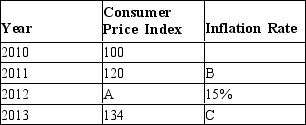 -Refer to Table 24-16. Calculate the missing value that belongs in space B.
 (Short Answer)
4.9/5 (79)
(79) The consumer price index was 200 in 2008 and 190 in 2009. The nominal interest rate during this period was 4.5 percent. What was the real interest rate during this period?
(Multiple Choice)
4.9/5 (71)
(71) For an imaginary economy, the value of the consumer price index was 140 in 2013, and the inflation rate was 5.0 percent between 2013 and 2014. The consumer price index in 2014 was
(Multiple Choice)
4.8/5 (73)
(73) Table 24-12. Will's expenditures on food for three consecutive years, along with other values, are presented in the table below.
 -Refer to Table 24-12. Suppose the consumer price index is 15.5 percent higher in 2011 than in 2009. Then Will's food expenditures for 2010 in 2011 dollars amount to
 (Multiple Choice)
4.9/5 (73)
(73) Which of the following statements best represents economists' beliefs about the bias in the CPI as a measure of the cost of living?
(Multiple Choice)
4.9/5 (71)
(71) Table 24-3
The table below pertains to Iowan, an economy in which the typical consumer's basket consists of 4 pounds of pork and 3 bushels of corn.
 -Refer to Table 24-3. The cost of the basket in 2012 was
 (Multiple Choice)
4.9/5 (81)
(81) If the cost of apparel increases by 50 percent, then, other things the same, the CPI is likely to increase by about
(Multiple Choice)
4.8/5 (82)
(82) If the price index was 90 in year 1, 100 in year 2, and 95 in year 3, then the economy experienced
(Multiple Choice)
4.9/5 (81)
(81) For an imaginary economy, the value of the consumer price index was 138.75 in 2016, and the inflation rate was 10 percent between 2015 and 2016. The consumer price index in 2015 was
(Multiple Choice)
4.9/5 (93)
(93) Most, but not all, athletic apparel sold in the United States is imported from other nations. If the price of athletic apparel increases, the GDP deflator will
(Multiple Choice)
4.9/5 (73)
(73) 
Filters
- Essay(0)
- Multiple Choice(0)
- Short Answer(0)
- True False(0)
- Matching(0)