



 Chat with AI
Exam 8: Application: The Costs of Taxation

Exam 1: Ten Principles of Economics438 Questions
Exam 2: Thinking Like an Economist620 Questions
Exam 3: Interdependence and the Gains From Trade527 Questions
Exam 4: The Market Forces of Supply and Demand700 Questions
Exam 5: Elasticity and Its Application598 Questions
Exam 6: Supply, Demand, and Government Policies648 Questions
Exam 7: Consumers, Producers, and the Efficiency of Markets550 Questions
Exam 8: Application: The Costs of Taxation514 Questions
Exam 9: Application: International Trade496 Questions
Exam 10: Externalities522 Questions
Exam 11: Public Goods and Common Resources434 Questions
Exam 12: The Costs of Production420 Questions
Exam 13: Firms in Competitive Markets543 Questions
Exam 14: Monopoly637 Questions
Exam 15: Measuring a Nations Income522 Questions
Exam 16: Measuring the Cost of Living545 Questions
Exam 17: Production and Growth507 Questions
Exam 18: Saving, Investment, and the Financial System567 Questions
Exam 19: The Basic Tools of Finance513 Questions
Exam 20: Unemployment699 Questions
Exam 21: The Monetary System518 Questions
Exam 22: Money Growth and Inflation487 Questions
Exam 23: Aggregate Demand and Aggregate Supply563 Questions
Exam 24: The Influence of Monetary and Fiscal Policy on Aggregate Demand512 Questions
Select questions type


Suppose that instead of a supply-demand diagram, you are given the following information:
Qs = 100 + 3P Qd = 400 - 2P
From this information compute equilibrium price and quantity. Now suppose that a tax is placed on buyers so that
Qd = 400 - 2P + T).
If T = 15, solve for the new equilibrium price and quantity. Note: P is the price received by sellers and P + T is the price paid by buyers.) Compare these answers for equilibrium price and quantity with your first answers. What does this show you?
(Essay)
4.8/5  (72)
(72) Figure 8-8
Suppose the government imposes a $10 per unit tax on a good.  -Refer to Figure 8-8. After the tax goes into effect, consumer surplus is the area
 (Multiple Choice)
4.8/5 (73)
(73) Figure 8-10  -Refer to Figure 8-10. Suppose the government imposes a tax that reduces the quantity sold in the market after the tax to Q2. With the tax, the total surplus is
 (Multiple Choice)
4.8/5 (80)
(80) In terms of gains from trade, why is it true that taxes cause deadweight losses?
(Essay)
5.0/5 (68)
(68) Figure 8-6
The vertical distance between points A and B represents a tax in the market.  -Refer to Figure 8-6. Without a tax, consumer surplus in this market is
 (Multiple Choice)
4.8/5 (78)
(78) Figure 8-5
Suppose that the government imposes a tax of P3 - P1.  -Refer to Figure 8-5. The loss in total welfare that results from the tax is represented by area
 (Multiple Choice)
4.9/5 (77)
(77) When a tax is imposed on a good, consumer surplus decreases and producer surplus remains unchanged.
(True/False)
4.9/5 (82)
(82) Figure 8-1 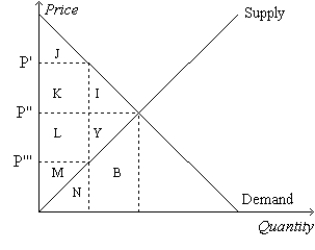 -Refer to Figure 8-1. Suppose the government imposes a tax of P' - P'''. The tax revenue is measured by the area
 (Multiple Choice)
4.9/5 (86)
(86) Figure 8-3
The vertical distance between points A and C represents a tax in the market.  -Refer to Figure 8-3. The per unit burden of the tax on buyers is
 (Multiple Choice)
4.8/5 (79)
(79) When a tax is imposed, the loss of consumer surplus and producer surplus as a result of the tax exceeds the tax revenue collected by the government.
(True/False)
4.9/5 (95)
(95) Figure 8-3
The vertical distance between points A and C represents a tax in the market.
-Refer to Figure 8-3. Which of the following equations is valid for the tax revenue that the tax provides to the government?
-Refer to Figure 8-3. Which of the following equations is valid for the tax revenue that the tax provides to the government? (Multiple Choice)
4.7/5 (74)
(74) Figure 8-10
-Refer to Figure 8-10. Suppose the government imposes a tax that reduces the quantity sold in the market after the tax to Q2. The size of the tax is
-Refer to Figure 8-10. Suppose the government imposes a tax that reduces the quantity sold in the market after the tax to Q2. The size of the tax is (Multiple Choice)
4.8/5 (75)
(75) Total surplus in a market does not change when the government imposes a tax on that market because the loss of consumer surplus and producer surplus is equal to the gain of government revenue.
(True/False)
5.0/5 (71)
(71) Figure 8-22  -Refer to Figure 8-22. Suppose the government changed the per-unit tax from $3.00 to $4.50. Compared to the original tax rate, this higher tax rate would
 (Multiple Choice)
4.9/5 (89)
(89) Figure 8-12  -Refer to Figure 8-12. Suppose a $3 per-unit tax is placed on this good. The amount of deadweight loss resulting from this tax is
 (Multiple Choice)
4.8/5 (80)
(80) Figure 8-1
-Refer to Figure 8-1. Suppose the government imposes a tax of P' - P'''. Total surplus after the tax is measured by the area
-Refer to Figure 8-1. Suppose the government imposes a tax of P' - P'''. Total surplus after the tax is measured by the area (Multiple Choice)
4.9/5 (82)
(82) Figure 8-5
Suppose that the government imposes a tax of P3 - P1.
-Refer to Figure 8-5. The equilibrium price before the tax is imposed is
-Refer to Figure 8-5. The equilibrium price before the tax is imposed is (Multiple Choice)
4.8/5 (77)
(77) 
Filters
- Essay(0)
- Multiple Choice(0)
- Short Answer(0)
- True False(0)
- Matching(0)