



 Chat with AI
Exam 6: Supply, Demand, and Government Policies

Exam 1: Ten Principles of Economics438 Questions
Exam 2: Thinking Like an Economist620 Questions
Exam 3: Interdependence and the Gains From Trade527 Questions
Exam 4: The Market Forces of Supply and Demand700 Questions
Exam 5: Elasticity and Its Application598 Questions
Exam 6: Supply, Demand, and Government Policies648 Questions
Exam 7: Consumers, Producers, and the Efficiency of Markets550 Questions
Exam 8: Application: The Costs of Taxation514 Questions
Exam 9: Application: International Trade496 Questions
Exam 10: Externalities522 Questions
Exam 11: Public Goods and Common Resources434 Questions
Exam 12: The Costs of Production420 Questions
Exam 13: Firms in Competitive Markets543 Questions
Exam 14: Monopoly637 Questions
Exam 15: Measuring a Nations Income522 Questions
Exam 16: Measuring the Cost of Living545 Questions
Exam 17: Production and Growth507 Questions
Exam 18: Saving, Investment, and the Financial System567 Questions
Exam 19: The Basic Tools of Finance513 Questions
Exam 20: Unemployment699 Questions
Exam 21: The Monetary System518 Questions
Exam 22: Money Growth and Inflation487 Questions
Exam 23: Aggregate Demand and Aggregate Supply563 Questions
Exam 24: The Influence of Monetary and Fiscal Policy on Aggregate Demand512 Questions
Select questions type


Figure 6-36  -Refer to Figure 6-36. If the government places a $2 tax in the market, the buyer bears $2 of the tax burden.
 (True/False)
4.9/5  (93)
(93) Figure 6-20  -Refer to Figure 6-20. Suppose a tax of $5 per unit is imposed on this market. How much will sellers receive per unit after the tax is imposed?
 (Multiple Choice)
4.8/5 (67)
(67) Binding price floors benefit sellers because they allow sellers to sell all the goods they want at a higher price.
(True/False)
4.9/5 (70)
(70) Figure 6-19  -Refer to Figure 6-19. Suppose a tax of $2 per unit is imposed on this market. How much will buyers pay per unit after the tax is imposed?
 (Multiple Choice)
4.9/5 (85)
(85) Figure 6-25  -Refer to Figure 6-25. The price that buyers pay after the tax is imposed is
 (Multiple Choice)
5.0/5 (86)
(86) The tax burden falls more heavily on the side of the market that is more inelastic.
(True/False)
4.9/5 (93)
(93) Figure 6-9  -Refer to Figure 6-9. At which price would a price floor be nonbinding?
 (Multiple Choice)
4.8/5 (82)
(82) Figure 6-17
This figure shows the market demand and market supply curves for good Y 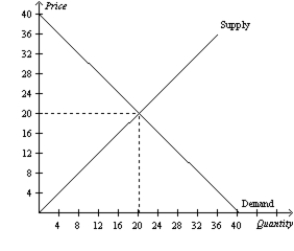 -Refer to Figure 6-17. A government-imposed price of $12 in this market is an example of a
 (Multiple Choice)
4.9/5 (96)
(96) Figure 6-25
-Refer to Figure 6-25. The burden of the tax on sellers is
-Refer to Figure 6-25. The burden of the tax on sellers is (Multiple Choice)
4.8/5 (89)
(89) Suppose that the demand for digital cameras is elastic, and the supply of digital cameras is inelastic. A tax of $20 per camera levied on digital cameras will decrease the effective price received by sellers of digital cameras by
(Multiple Choice)
4.8/5 (74)
(74) Does a binding price ceiling result in a shortage or a surplus in the market?
(Essay)
4.8/5 (78)
(78) Which of the following was not a result of the luxury tax imposed by Congress in 1990?
(Multiple Choice)
4.8/5 (94)
(94) Studies by economists have found that a 10 percent increase in the minimum wage decreases teenage employment 10 percent.
(True/False)
4.8/5 (65)
(65) Figure 6-22  -Refer to Figure 6-22. The effective price sellers receive after the tax is imposed is
 (Multiple Choice)
4.9/5 (102)
(102) When a binding price ceiling is imposed on a market for a good, some people who want to buy the good cannot do so.
(True/False)
4.8/5 (90)
(90) 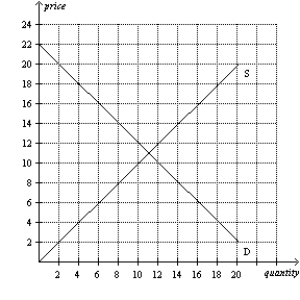 -Refer to Figure 6-10. A price ceiling set at
Figure 6-9
-Refer to Figure 6-9. At which price would a price ceiling be nonbinding?
-Refer to Figure 6-9. At which price would a price ceiling be nonbinding? (Multiple Choice)
4.9/5 (78)
(78) 
Filters
- Essay(0)
- Multiple Choice(0)
- Short Answer(0)
- True False(0)
- Matching(0)