



 Chat with AI
Exam 5: Elasticity and Its Application

Exam 1: Ten Principles of Economics438 Questions
Exam 2: Thinking Like an Economist620 Questions
Exam 3: Interdependence and the Gains From Trade527 Questions
Exam 4: The Market Forces of Supply and Demand700 Questions
Exam 5: Elasticity and Its Application598 Questions
Exam 6: Supply, Demand, and Government Policies648 Questions
Exam 7: Consumers, Producers, and the Efficiency of Markets550 Questions
Exam 8: Application: The Costs of Taxation514 Questions
Exam 9: Application: International Trade496 Questions
Exam 10: Externalities522 Questions
Exam 11: Public Goods and Common Resources434 Questions
Exam 12: The Costs of Production420 Questions
Exam 13: Firms in Competitive Markets543 Questions
Exam 14: Monopoly637 Questions
Exam 15: Measuring a Nations Income522 Questions
Exam 16: Measuring the Cost of Living545 Questions
Exam 17: Production and Growth507 Questions
Exam 18: Saving, Investment, and the Financial System567 Questions
Exam 19: The Basic Tools of Finance513 Questions
Exam 20: Unemployment699 Questions
Exam 21: The Monetary System518 Questions
Exam 22: Money Growth and Inflation487 Questions
Exam 23: Aggregate Demand and Aggregate Supply563 Questions
Exam 24: The Influence of Monetary and Fiscal Policy on Aggregate Demand512 Questions
Select questions type


Suppose that when the price rises by 20% for a particular good, the quantity demanded of that good falls by 10%.
The price elasticity of demand for this good is equal to 2.0.
(True/False)
4.8/5  (80)
(80) When the price of an eBook is $15.00, the quantity demanded is 400 eBooks per day. When the price falls to $10.00, the quantity demanded increases to 700. Given this information and using the midpoint method, we know that the demand for eBooks is
(Multiple Choice)
4.9/5 (82)
(82) If we observe that when the price of chocolate decreases by 10%, quantity demanded increases by 25%, then the demand for chocolate is price elastic.
(True/False)
4.9/5 (84)
(84) Even the demand for a necessity such as gasoline will respond to a change in price, especially over a longer time horizon.
(True/False)
4.9/5 (87)
(87) Figure 5-4 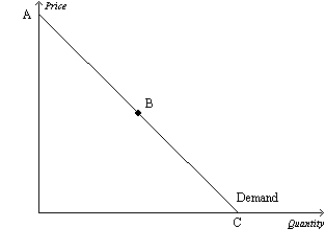 -Refer to Figure 5-4. Assume, for the good in question, two specific points on the demand curve are Q = 1,000, P= $40) and Q = 1,500, P = $30). Then which of the following scenarios is possible?
 (Multiple Choice)
4.7/5 (93)
(93) Table 5-8
 -Refer to Table 5-8. Using the midpoint method, what is the income elasticity of demand for good X?
 (Multiple Choice)
4.9/5 (82)
(82) If the price elasticity of supply is 1.5, and a price increase led to a 3% increase in quantity supplied, then the price increase is about
(Multiple Choice)
4.9/5 (91)
(91) When the price of a good is $5, the quantity demanded is 100 units per month; when the price is $7, the quantity demanded is 80 units per month. Using the midpoint method, the price elasticity of demand is about
(Multiple Choice)
4.7/5 (86)
(86) Table 5-13
Consider the following demand schedule.
 -Refer to Table 5-13. Using the midpoint method, what is the price elasticity of demand between $12 and $15?
 (Short Answer)
4.9/5 (75)
(75) Demand for a good is said to be inelastic if the quantity demanded increases slightly when the price falls by a large amount.
(True/False)
4.8/5 (80)
(80) Supply is said to be inelastic if the quantity supplied responds substantially to changes in the price and elastic if the quantity supplied responds only slightly to price.
(True/False)
4.8/5 (78)
(78) Recently, in Smalltown, the price of Twinkies fell from $0.80 to $0.70. As a result, the quantity demanded of Ho- Ho's decreased from 120 to 100. What would be the appropriate elasticity to compute? Using the midpoint method, compute this elasticity. What does your answer tell you?
(Essay)
4.8/5 (73)
(73) Figure 5-6 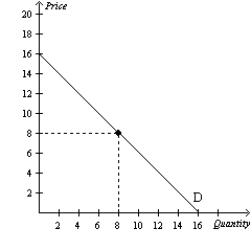 -Refer to Figure 5-6. For prices below $8, demand is price
 (Multiple Choice)
5.0/5 (75)
(75) If the price of walnuts rises, many people would switch from consuming walnuts to consuming pecans. But if the price of salt rises, people would have difficulty purchasing something to use in its place. These examples illustrate the importance of
(Multiple Choice)
4.7/5 (76)
(76) Which of the following could be the price elasticity of demand for a good for which an increase in price would decrease revenue?
(Multiple Choice)
4.8/5 (69)
(69) Knowing that the demand for wheat is inelastic, if all farmers voluntarily did not plant wheat on 10 percent of their land, then
(Multiple Choice)
4.9/5 (78)
(78) 
Filters
- Essay(0)
- Multiple Choice(0)
- Short Answer(0)
- True False(0)
- Matching(0)