



 Chat with AI
Exam 3: Interdependence and the Gains From Trade

Exam 1: Ten Principles of Economics438 Questions
Exam 2: Thinking Like an Economist620 Questions
Exam 3: Interdependence and the Gains From Trade527 Questions
Exam 4: The Market Forces of Supply and Demand700 Questions
Exam 5: Elasticity and Its Application598 Questions
Exam 6: Supply, Demand, and Government Policies648 Questions
Exam 7: Consumers, Producers, and the Efficiency of Markets550 Questions
Exam 8: Application: The Costs of Taxation514 Questions
Exam 9: Application: International Trade496 Questions
Exam 10: Externalities522 Questions
Exam 11: Public Goods and Common Resources434 Questions
Exam 12: The Costs of Production420 Questions
Exam 13: Firms in Competitive Markets543 Questions
Exam 14: Monopoly637 Questions
Exam 15: Measuring a Nations Income522 Questions
Exam 16: Measuring the Cost of Living545 Questions
Exam 17: Production and Growth507 Questions
Exam 18: Saving, Investment, and the Financial System567 Questions
Exam 19: The Basic Tools of Finance513 Questions
Exam 20: Unemployment699 Questions
Exam 21: The Monetary System518 Questions
Exam 22: Money Growth and Inflation487 Questions
Exam 23: Aggregate Demand and Aggregate Supply563 Questions
Exam 24: The Influence of Monetary and Fiscal Policy on Aggregate Demand512 Questions
Select questions type


A professor spends 10 hours per day giving lectures and writing papers. For the professor, a graph that shows his various possible mixes of output lectures given per day and papers written per day) is called his
(Multiple Choice)
4.8/5  (83)
(83) Figure 3-15
Perry's Production Possibilities Frontier Jordan's Production Possibilities Frontier
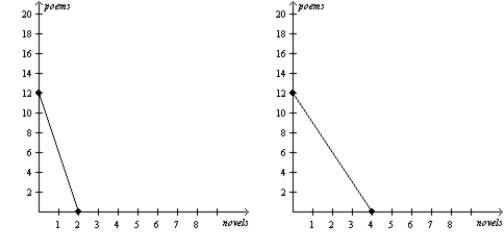 -Refer to Figure 3-15. Perry should specialize in the production of
 (Multiple Choice)
4.9/5 (62)
(62) Table 3-17
The following table contains some production possibilities for an economy for a given year.
 -Refer to Table 3-17. If the production possibilities frontier is bowed outward, then "?" could be
 (Multiple Choice)
4.9/5 (84)
(84) Suppose that in one hour Dewey can produce either 10 bushels of corn or 20 yards of cloth. Dewey's opportunity cost of producing one bushel of corn is 1/2 yard of cloth.
(True/False)
4.9/5 (84)
(84) Figure 3-20
Canada's Production Possibilities Frontier Mexico's Production Possibilities Frontier 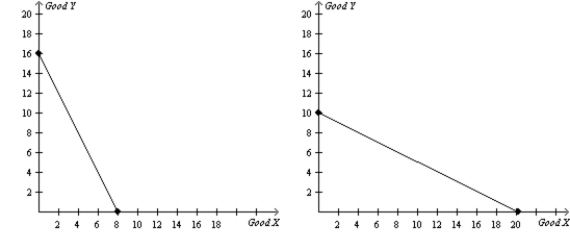 -Refer to Figure 3-20. At which of the following prices would both Canada and Mexico gain from trade with each other?
 (Multiple Choice)
4.9/5 (85)
(85) Table 3-26
Assume that Japan and Korea can switch between producing cars and producing airplanes at a constant rate.
 -Refer to Table 3-26. Assume that Japan and Korea each has 2400 hours available. Originally, each country divided its time equally between the production of cars and airplanes. Now, each country spends all its time producing the good in which it has a comparative advantage. As a result, the total output of cars increased by
 (Multiple Choice)
4.9/5 (72)
(72) Table 3-41
 -Refer to Table 3-41. If the two countries decide to trade with each other, which country should specialize in producing compasses?
 (Short Answer)
4.9/5 (77)
(77) Figure 3-20
Canada's Production Possibilities Frontier Mexico's Production Possibilities Frontier
-Refer to Figure 3-20. Canada would incur an opportunity cost of 6 units of Good X if it increased its production of Good Y by
-Refer to Figure 3-20. Canada would incur an opportunity cost of 6 units of Good X if it increased its production of Good Y by (Multiple Choice)
4.8/5 (78)
(78) Figure 3-5
Hosne's Production Possibilities Frontier Merve's Production Possibilities Frontier  -Refer to Figure 3-5. If Hosne and Merve both spend all of their time making wallets, then total production is
 (Multiple Choice)
4.9/5 (73)
(73) Figure 3-7
Bintu's Production Possibilities Frontier Juba's Production Possibilities Frontier  -Refer to Figure 3-7. If Bintu and Juba both spend all of their time making bowls, then total production is
 (Multiple Choice)
4.9/5 (87)
(87) Ken and Traci are two woodworkers who both make tables and chairs. In one month, Ken can make 3 tables or 18 chairs, whereas Traci can make 8 tables or 24 chairs. Given this, we know that the opportunity cost of 1 table is
(Multiple Choice)
4.7/5 (79)
(79) Table 3-11
Assume that Max and Min can switch between producing mittens and producing hats at a constant rate.
 -Refer to Table 3-11. Assume that Max and Min each has 36 labor hours available. If each person divides his/her time equally between the production of mittens and hats, then total production is
 (Multiple Choice)
4.9/5 (70)
(70) Table 3-27
Assume that Huang and Min can switch between producing parasols and producing porcelain plates at a constant rate.
 -Refer to Table 3-27. The opportunity cost of 1 parasol for Min is
 (Multiple Choice)
4.9/5 (78)
(78) Under what conditions is an economy's production possibilities frontier also its consumption possibilities frontier?
(Short Answer)
4.8/5 (74)
(74) Table 3-21
Assume that Jamaica and Norway can switch between producing coolers and producing radios at a constant rate. The following table shows the number of coolers or number of radios each country can produce in one day.
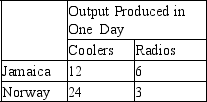 -Refer to Table 3-21. Jamaica has an absolute advantage in the production of
 (Multiple Choice)
4.7/5 (81)
(81) Table 3-37
Assume that Aruba and Iceland can switch between producing coolers and producing radios at a constant rate.
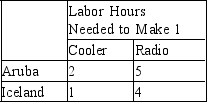 -Refer to Table 3-37. Iceland should export
 (Multiple Choice)
4.9/5 (78)
(78) Table 3-8
Assume that England and Spain can switch between producing cheese and producing bread at a constant rate.
 -Refer to Table 3-8. We could use the information in the table to draw a production possibilities frontier for England and a second production possibilities frontier for Spain. If we were to do this, measuring bread along the horizontal axis, then
 (Multiple Choice)
4.7/5 (82)
(82) Table 3-20
Assume that Brad and Theresa can switch between producing wheat and producing beef at a constant rate.
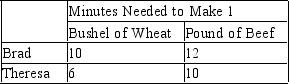 -Refer to Table 3-20. Brad has a comparative advantage in the production of
 (Multiple Choice)
4.8/5 (84)
(84) 
Filters
- Essay(0)
- Multiple Choice(0)
- Short Answer(0)
- True False(0)
- Matching(0)