



 Chat with AI
Exam 14: Long-Term Liabilities

Exam 1: Accounting in Business240 Questions
Exam 2: Analyzing and Recording Transactions197 Questions
Exam 3: Adjusting Accounts and Preparing Financial Statements224 Questions
Exam 4: Completing the Accounting Cycle176 Questions
Exam 5: Accounting for Merchandising Operations198 Questions
Exam 6: Inventories and Cost of Sales198 Questions
Exam 7: Accounting Information Systems176 Questions
Exam 8: Cash and Internal Controls196 Questions
Exam 9: Accounting for Receivables191 Questions
Exam 10: Plant Assets, Natural Resources, and Intangibles223 Questions
Exam 11: Current Liabilities and Payroll Accounting193 Questions
Exam 12: Accounting for Partnerships139 Questions
Exam 13: Accounting for Corporations246 Questions
Exam 14: Long-Term Liabilities198 Questions
Exam 15: Investments and International Operations192 Questions
Exam 16: Reporting the Statement of Cash Flows187 Questions
Exam 17: Analysis of Financial Statements187 Questions
Exam 18: Managerial Accounting Concepts and Principles197 Questions
Exam 19: Job Order Cost Accounting164 Questions
Exam 20: Process Cost Accounting174 Questions
Exam 21: Cost Allocation and Performance Measurement170 Questions
Exam 22: Cost-Volume-Profit Analysis186 Questions
Exam 23: Master Budgets and Planning162 Questions
Exam 24: Flexible Budgets and Standard Costs174 Questions
Exam 25: Capital Budgeting and Managerial Decisions150 Questions
Exam 26: Time Value of Money60 Questions
Select questions type


If a bond's interest period does not coincide with the issuing company's accounting period, an adjusting entry is necessary to recognize bond interest expense accruing since the most recent interest payment.
(True/False)
4.8/5  (83)
(83) Mortgage contracts grant the lender the right to be paid from the cash proceeds of the sale of a borrower's assets identified in the mortgage.
(True/False)
4.9/5 (79)
(79) On January 1, a company issues bonds dated January 1 with a par value of $300,000. The bonds mature in 5 years. The contract rate is 9%, and interest is paid semiannually on June 30 and December 31. The market rate is 8% and the bonds are sold for $312,177. The journal entry to record the first interest payment using straight-line amortization is:
(Multiple Choice)
4.9/5 (81)
(81) Hornet Corporation has a loan agreement that provides it with cash today, and the company must pay $25,000 one year from today, $15,000 two years from today, and $5,000 three years from today. Hornet agrees to pay 10% interest. The following are factors from a present value table: 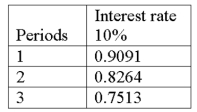 What is the amount of cash that Hornet receives today?
 (Not Answered)
This question doesn't have any answer yet
The legal document identifying the rights and obligations of both the bondholders and the issuer is called the ___________________________________.
(Short Answer)
4.8/5 (79)
(79) Mortgage bonds are backed only by the good faith and credit of the issuing company.
(True/False)
4.9/5 (74)
(74) Harrison Company's balance sheet reflects total assets of $250,000 and total liabilities of $150,000. Calculate the company's debt-to-equity ratio.
(Not Answered)
This question doesn't have any answer yet
______________ bonds are bonds that are scheduled for maturity on one specified date.
(Short Answer)
4.9/5 (69)
(69) Compound interest means that interest in a second period is based on the total amount borrowed plus the interest accrued in the first period.
(True/False)
4.7/5 (73)
(73) On October 1, a $30,000, 6%, 3-year installment note payable is issued by a company. The note requires equal payments of principal plus accrued interest be paid at the end of each year on September 30. The present value of an annuity factor for 3 years at 6% is 2.6730. The payment will be:
(Multiple Choice)
4.8/5 (89)
(89) The contract between the bond issuer and the bondholders, which identifies the rights and obligations of the parties, is called a(n):
(Multiple Choice)
4.9/5 (79)
(79) Collateral from unsecured loans may be sold to offset the loan obligation if the loan is in default.
(True/False)
4.9/5 (79)
(79) A company invests $10,000 at 7% compounded annually. At the end of the second year, the company should have $11,400 in the fund.
$10,000 + ($10,000 x 7%) + [($10,000 + ($10,000 x 7%)) x 7%] = $11,449 or
$10,000 x 1.07 x 1.07 = $11,449
(True/False)
4.9/5 (82)
(82) When the contract rate is above the market rate, a bond sells at a discount.
(True/False)
4.8/5 (69)
(69) On January 1, a company issued 10%, 10-year bonds payable with a par value of $720,000. The bonds pay interest each July 1 and January 1. The bonds were sold for $817,860 cash, which provides the holders an annual yield of 8%. Prepare the issuer's journal entry to record the first semiannual interest payment assuming the effective interest method is used.
(Not Answered)
This question doesn't have any answer yet
The ____________ concept is the idea that cash paid (or received) in the future has less value now than the same amount of cash paid (or received) today.
(Short Answer)
4.9/5 (82)
(82) A company purchased two new delivery vans for a total of $250,000 on January 1, Year 1. The company paid $40,000 cash and signed a $210,000, 3-year, 8% note for the remaining balance. The note is to be paid in three annual end-of-year payments of $81,487 each, with the first payment on December 31, Year 1. Each payment includes interest on the unpaid balance plus principal.
(1) Prepare a note amortization table using the format below: 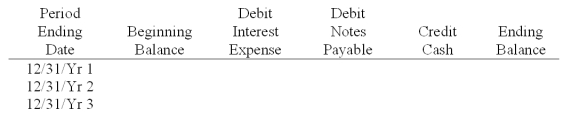 (2) Prepare the journal entries to record the purchase of the vans on January 1, Year 1 and the second annual installment payment on December 31, Year 2.
 (Not Answered)
This question doesn't have any answer yet
A company's debt-to-equity ratio was 1.0 at the end of Year 1. By the end of Year 2, it had increased to 1.7. Since the ratio increased from Year 1 to Year 2, the degree of risk in the firm's financing structure decreased during Year 2.
(True/False)
4.9/5 (98)
(98) 
Filters
- Essay(0)
- Multiple Choice(0)
- Short Answer(0)
- True False(0)
- Matching(0)