



 Chat with AI
Exam 14: Long-Term Liabilities

Exam 1: Accounting in Business240 Questions
Exam 2: Analyzing and Recording Transactions197 Questions
Exam 3: Adjusting Accounts and Preparing Financial Statements224 Questions
Exam 4: Completing the Accounting Cycle176 Questions
Exam 5: Accounting for Merchandising Operations198 Questions
Exam 6: Inventories and Cost of Sales198 Questions
Exam 7: Accounting Information Systems176 Questions
Exam 8: Cash and Internal Controls196 Questions
Exam 9: Accounting for Receivables191 Questions
Exam 10: Plant Assets, Natural Resources, and Intangibles223 Questions
Exam 11: Current Liabilities and Payroll Accounting193 Questions
Exam 12: Accounting for Partnerships139 Questions
Exam 13: Accounting for Corporations246 Questions
Exam 14: Long-Term Liabilities198 Questions
Exam 15: Investments and International Operations192 Questions
Exam 16: Reporting the Statement of Cash Flows187 Questions
Exam 17: Analysis of Financial Statements187 Questions
Exam 18: Managerial Accounting Concepts and Principles197 Questions
Exam 19: Job Order Cost Accounting164 Questions
Exam 20: Process Cost Accounting174 Questions
Exam 21: Cost Allocation and Performance Measurement170 Questions
Exam 22: Cost-Volume-Profit Analysis186 Questions
Exam 23: Master Budgets and Planning162 Questions
Exam 24: Flexible Budgets and Standard Costs174 Questions
Exam 25: Capital Budgeting and Managerial Decisions150 Questions
Exam 26: Time Value of Money60 Questions
Select questions type


On January 1, a company issues bonds with a par value of $300,000. The bonds mature in 5 years and pay 8% annual interest each June 30 and December 31. On the issue date, the market rate of interest is 6%. Compute the price of the bonds on their issue date. The following information is taken from present value tables: 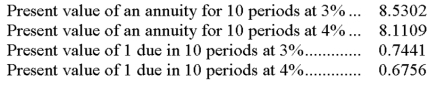
(Not Answered)
This question doesn't have any answer yet
Two common ways of retiring bonds before maturity are to (1) exercise a call option or (2) purchase them on the open market.
(True/False)
4.7/5  (78)
(78) The debt-to-equity ratio enables financial statement users to assess the risk of a company's financing structure.
(True/False)
4.9/5 (77)
(77) A corporation plans to invest $1 million in oil exploration. The corporation is considering two plans to raise the money. Under Plan #1, bonds with a contract rate of interest of 6% would be issued. Under Plan #2, additional shares of common stock would be issued at $20 per share. The corporation currently has 300,000 shares of stock outstanding, and it expects to earn $700,000 per year before bond interest and income taxes. The net income and return on investment for both plans is shown below: 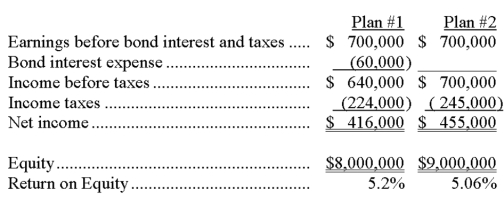 Comment on the relative effects of each alternative, including when one form of financing is preferred to another.
 (Essay)
4.8/5 (74)
(74) Explain the amortization of a bond premium. Identify and describe the amortization methods available.
(Essay)
4.9/5 (76)
(76) Return on equity _______________ when the expected rate of return from the acquired assets is greater than the rate of interest on the bonds used to finance the asset acquisition.
(Short Answer)
4.8/5 (81)
(81) Bonds owned by investors whose names and addresses are recorded by the issuing company, and for which interest payments are made with checks or cash transfers to the bondholders, are called:
(Multiple Choice)
4.9/5 (95)
(95) A corporation borrowed $125,000 cash by signing a 5-year, 9% installment note requiring equal annual payments each December 31 of $32,136. What journal entry would the issuer record for the first payment?
(Multiple Choice)
4.7/5 (54)
(54) A company purchased equipment and signed a 7-year installment loan at 9% annual interest. The annual payments equal $9,000. The present value of an annuity for 7 years at 9% is 5.0330. The present value of the loan is:
(Multiple Choice)
4.8/5 (90)
(90) A company issued 10-year, 9% bonds with a par value of $500,000 when the market rate was 9.5%. The company received $484,087 in cash proceeds. Using the straight-line method, prepare the issuer's journal entry to record the first semiannual interest payment and the amortization of any bond discount or premium.
(Not Answered)
This question doesn't have any answer yet
Bond interest paid by a corporation is an expense, whereas dividends paid are not an expense of the corporation.
(True/False)
4.8/5 (83)
(83) The market value or issue price of a bond is equal to the present value of all future cash payments provided by the bond.
(True/False)
4.8/5 (79)
(79) Explain the present value concept as it applies to long term liabilities.
(Essay)
4.7/5 (68)
(68) Bonds and long-term notes are similar in that they are typically transacted with multiple lenders.
(True/False)
4.9/5 (70)
(70) To provide security to creditors and to reduce interest costs, bonds and notes payable can be secured by:
(Multiple Choice)
4.8/5 (74)
(74) Explain the amortization of a bond discount. Identify and describe the amortization methods available.
(Essay)
4.8/5 (71)
(71) _________________________ leases are short-term or cancelable leases in which the lessor retains the risks and rewards of ownership.
(Short Answer)
4.9/5 (69)
(69) Bonds that have an option exercisable by the issuer to retire them at a stated dollar amount prior to maturity are known as:
(Multiple Choice)
4.8/5 (82)
(82) 
Filters
- Essay(0)
- Multiple Choice(0)
- Short Answer(0)
- True False(0)
- Matching(0)