



 Chat with AI
Exam 14: Long-Term Liabilities

Exam 1: Accounting in Business240 Questions
Exam 2: Analyzing and Recording Transactions197 Questions
Exam 3: Adjusting Accounts and Preparing Financial Statements224 Questions
Exam 4: Completing the Accounting Cycle176 Questions
Exam 5: Accounting for Merchandising Operations198 Questions
Exam 6: Inventories and Cost of Sales198 Questions
Exam 7: Accounting Information Systems176 Questions
Exam 8: Cash and Internal Controls196 Questions
Exam 9: Accounting for Receivables191 Questions
Exam 10: Plant Assets, Natural Resources, and Intangibles223 Questions
Exam 11: Current Liabilities and Payroll Accounting193 Questions
Exam 12: Accounting for Partnerships139 Questions
Exam 13: Accounting for Corporations246 Questions
Exam 14: Long-Term Liabilities198 Questions
Exam 15: Investments and International Operations192 Questions
Exam 16: Reporting the Statement of Cash Flows187 Questions
Exam 17: Analysis of Financial Statements187 Questions
Exam 18: Managerial Accounting Concepts and Principles197 Questions
Exam 19: Job Order Cost Accounting164 Questions
Exam 20: Process Cost Accounting174 Questions
Exam 21: Cost Allocation and Performance Measurement170 Questions
Exam 22: Cost-Volume-Profit Analysis186 Questions
Exam 23: Master Budgets and Planning162 Questions
Exam 24: Flexible Budgets and Standard Costs174 Questions
Exam 25: Capital Budgeting and Managerial Decisions150 Questions
Exam 26: Time Value of Money60 Questions
Select questions type


On January 1, a company issues bonds with a par value of $300,000. The bonds mature in 5 years, and pay 8% annual interest, payable each June 30 and December 31. On the issue date, the market rate of interest for the bonds is 10%. Compute the price of the bonds on their issue date. The following information is taken from present value tables: 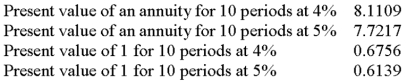
(Not Answered)
This question doesn't have any answer yet
On January 1 of Year 1, Drum Line Airways issued $3,500,000 of par value bonds for $3,200,000. The bonds pay interest semiannually on January 1 and July 1. The contract rate of interest is 7% while the market rate of interest for similar bonds is 8%. The bond premium or discount is being amortized at a rate of $10,000 every six months. The company's December 31, Year 1 balance sheet should reflect total liabilities associated with the bond issue in the amount of:
(Multiple Choice)
4.8/5  (84)
(84) Walker Corporation issued 14%, 5-year bonds with a par value of $5,000,000 on January 1, Year 1. Interest is to be paid semiannually on each June 30 and December 31. The bonds are issued at $5,368,035 cash when the market rate for this bond is 12%.
(a) Prepare the general journal entry to record the issuance of the bonds on January 1, year 1.
(b) Show how the bonds would be reported on Walker's balance sheet at January 1, Year 1.
(c) Assume that Walker uses the effective interest method of amortization of any discount or premium on bonds. Prepare the general journal entry to record the first semiannual interest payment on June 30, Year 1.
(d) Assume instead that Walker uses the straight-line method of amortization of any discount or premium on bonds. Prepare the general journal entry to record the first semiannual interest payment on June 30, Year 1.
(Not Answered)
This question doesn't have any answer yet
All of the following statements regarding accounting treatments for liabilities under U.S. GAAP and IFRS are True except:
(Multiple Choice)
4.8/5 (75)
(75) The carrying value of bonds at maturity is always equal to:
(Multiple Choice)
4.9/5 (66)
(66) On August 1, a company issues bonds with a par value of $600,000. The bonds mature in 10 years, and pay 6% annual interest, payable each February 1 and August 1. The bonds sold at $632,000. The company uses the straight-line method of amortizing bond premiums. The company's year-end is December 31. Prepare the general journal entry to record the interest accrued at December 31.
(Not Answered)
This question doesn't have any answer yet
When applying equal total payments to a note, with each payment the amount applied to the note principal _______________ while the interest expense for the note ______________.
(Short Answer)
4.9/5 (77)
(77) A company has assets of $350,000 and total liabilities of $200,000. Its debt-to-equity ratio is 0.6.
If total assets and total liabilities are $350,000 and $200,000, respectively, stockholders' equity must be $150,000. Thus, the debt-to-equity ratio is $200,000/$150,000 or 1.3.
(True/False)
4.9/5 (95)
(95) A company has bonds outstanding with a par value of $100,000. The unamortized premium on these bonds is $2,700. If the company retired these bonds at a call price of 99, the gain or loss on this retirement is:
(Multiple Choice)
5.0/5 (76)
(76) A company previously issued $2,000,000, 10% bonds, receiving a $120,000 premium. On the current year's interest date, after the bond interest was paid and after 40% of the total premium had been amortized, the company purchased the entire bond issue on the open market at 98 and retired it. Prepare the journal entry to record the retirement of these bonds.
(Not Answered)
This question doesn't have any answer yet
What is a lease? Explain the difference between an operating lease and a capital lease.
(Essay)
4.7/5 (71)
(71) A company's ability to issue unsecured debt depends on its credit standing.
(True/False)
4.9/5 (81)
(81) A company must repay the bank a single payment of $10,000 cash in 3 years for a loan it entered into. The loan is at 8% interest compounded annually. The present value factor for 3 years at 8% is 0.7938. The present value of the loan is:
(Multiple Choice)
4.9/5 (81)
(81) When the contract rate on a bond issue is less than the market rate, the bonds will generally sell at a discount.
(True/False)
4.9/5 (78)
(78) Pitt Corporation's most recent balance sheet reports total assets of $35,000,000 and total liabilities of $17,500,000. Management is considering issuing $5,000,000 of par value bonds (at par) with a maturity date of ten years and a contract rate of 7%. What effect, if any, would issuing the bonds have on the company's debt-to-equity ratio?
(Multiple Choice)
4.8/5 (88)
(88) 
Filters
- Essay(0)
- Multiple Choice(0)
- Short Answer(0)
- True False(0)
- Matching(0)