



 Chat with AI
Exam 12: Electing the President

Exam 1: Urban Services107 Questions
Exam 2: Business Efficiency104 Questions
Exam 3: Planning and Scheduling108 Questions
Exam 4: Linear Programming111 Questions
Exam 5: Exploring Data: Distributions115 Questions
Exam 6: Exploring Data: Relationships104 Questions
Exam 7: Data for Decisions99 Questions
Exam 8: Probability: the Mathematics of Chance108 Questions
Exam 9: Social Choice: the Impossible Dream103 Questions
Exam 10: The Manipulability of Voting Systems106 Questions
Exam 11: Weighted Voting Systems111 Questions
Exam 12: Electing the President93 Questions
Exam 13: Fair Division121 Questions
Exam 14: Apportionment112 Questions
Exam 15: Game Theory: the Mathematics of Competition113 Questions
Exam 16: Identification Numbers110 Questions
Exam 17: Information Science94 Questions
Exam 18: Growth and Form111 Questions
Exam 19: Symmetry and Patterns115 Questions
Exam 20: Tilings112 Questions
Exam 21: Savings Models113 Questions
Exam 22: Borrowing Models113 Questions
Exam 23: The Economics of Resources119 Questions
Select questions type


Use the following information to answer the Questions
Suppose that the continuous distribution of voters' ideal points is the bent solid line below.  -Explain why the bent solid line describes a continuous distribution.
 (Essay)
4.9/5  (81)
(81) Give an example of a voter distribution over the interval [0,1] that is skewed to the left.
(Essay)
4.7/5 (80)
(80) Use the following information to answer the Questions
Five board members of a company must decide between two other board members (A and B) for a certain position. The voters are concerned with two issues and their ideal points are represented as ordered pairs: (1, 5), (3, 4), (5, 2), (6, 4), and (6, 2). Assume that A and B announce policy positions of (1, 2) and (5, 4), respectively.
-What is the midpoint of the two policy positions?
(Multiple Choice)
4.9/5 (71)
(71) Use the following to answer the Questions
A distribution of voters is uniform over [0, 1]. Candidates A and B have already entered the election and have chosen positions at 1/4 and 3/4, respectively.
-If C enters at 1, what fraction of the vote does the winner receive?
(Multiple Choice)
4.8/5 (87)
(87) Use the following information to answer the Questions
Seven board members of a company must decide between two other board members (A and B) for a certain position. The voters are concerned with two issues and their ideal points are represented as ordered pairs: (1, 5), (3, 3), (5, 2), (6, 4), (6, 2), (4, 4), and (3, 2). Assume that A and B announce policy positions of (2, 2) and (5, 4), respectively.
-Which candidate would be elected for the position based on the ideal points?
(Short Answer)
4.8/5 (73)
(73) What is the largest value of the extended median if the voters' ideal points are 2, 2, 4, 4, 6, 8, 8, 8, 10, 10?
(Multiple Choice)
4.8/5 (73)
(73) A candidate selects a point on the horizontal axis of a voter distribution where no position can guarantee a better outcome, no matter what position another candidate adopts. This position is the:
(Multiple Choice)
4.8/5 (81)
(81) Which statement is correct for the bent solid line given below? 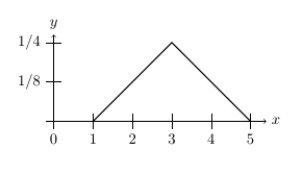
(Multiple Choice)
4.7/5 (87)
(87) Use the following information to answer the Questions
Suppose that 17 voters have ideal points as given in the following table. Ideal points 0 1 2 3 4 5 6 Number of voters 1 2 3 5 3 2 1 Candidate A announces a policy position of 1 and Candidate B announces a policy position of 5.
-Suppose that a voter is added with ideal points of 3. Is there a 2/3-separation opportunity for a third Candidate C to enter the race?
(Essay)
4.9/5 (84)
(84) Use the following information to answer the Questions
Consider the following distribution of 32 voters at eight different positions over the interval [0, 1]. Location 0.2 0.3 0.4 0.5 0.6 0.7 0.8 0.9 Number of voters 1 6 2 7 7 2 6 1
-Assume that Candidate A and Candidate B's policy positions are 0.3 and 0.8. If Candidate C enters at 0.55, what fraction of the vote does the winner receive?
(Multiple Choice)
4.9/5 (82)
(82) Use the following information to answer the Questions
Suppose 36 voters are distributed at nine different positions over the interval [0, 1], as suggested by this incomplete table. Location 0.1 0.2 0.3 0.4 0.5 0.6 0.7 0.8 0.9 Number of voters ? ? ? ? ? ? ? ? ?
-Which situation below would result in a skewed distribution?
(Multiple Choice)
4.8/5 (80)
(80) Use the following distribution of 32 voters at eight different positions over the interval [0, 1] to answer the Questions Position 0.1 0.2 0.3 0.5 0.6 0.7 0.8 0.9 Number of voters 6 5 5 3 4 6 2 1
-What is the equilibrium position in a two-candidate election?
(Multiple Choice)
4.8/5 (78)
(78) Suppose voters are distributed so that they are only located at certain positions along the left-right continuum. What is this type of distribution called?
(Short Answer)
4.7/5 (75)
(75) Consider the following distribution of 35 voters at eight different positions over the interval [0, 1]. Location 0.2 0.3 0.4 0.5 0.6 0.7 0.8 0.9 Number of 4 7 4 2 3 7 4 4 voters This distribution of voters is best described as:
(Multiple Choice)
4.9/5 (87)
(87) Use the following information to answer the Questions
Suppose that the continuous distribution of voters' ideal points is the bent solid line below.
-Assuming Candidate A and Candidate B's policy positions are 2.7 and 3.3, determine whether Candidate C can enter and win the election.
-Assuming Candidate A and Candidate B's policy positions are 2.7 and 3.3, determine whether Candidate C can enter and win the election. (Essay)
4.8/5 (78)
(78) Use the following information to answer the Questions
Consider the following distribution of 34 voters at eight different positions over the interval [0, 1]. Location 0.2 0.3 0.4 0.5 0.6 0.7 0.8 0.9 Number of voters 3 6 7 4 3 4 4 3
-This distribution of voters is best described as:
(Multiple Choice)
4.8/5 (74)
(74) Find the range of values that make up the extended median if the voters' ideal points are 2, 3, 4, 4, 6, 8, 8, 8, 9, 10.
(Essay)
4.8/5 (90)
(90) 
Filters
- Essay(0)
- Multiple Choice(0)
- Short Answer(0)
- True False(0)
- Matching(0)