



 Chat with AI
Exam 12: Electing the President

Exam 1: Urban Services107 Questions
Exam 2: Business Efficiency104 Questions
Exam 3: Planning and Scheduling108 Questions
Exam 4: Linear Programming111 Questions
Exam 5: Exploring Data: Distributions115 Questions
Exam 6: Exploring Data: Relationships104 Questions
Exam 7: Data for Decisions99 Questions
Exam 8: Probability: the Mathematics of Chance108 Questions
Exam 9: Social Choice: the Impossible Dream103 Questions
Exam 10: The Manipulability of Voting Systems106 Questions
Exam 11: Weighted Voting Systems111 Questions
Exam 12: Electing the President93 Questions
Exam 13: Fair Division121 Questions
Exam 14: Apportionment112 Questions
Exam 15: Game Theory: the Mathematics of Competition113 Questions
Exam 16: Identification Numbers110 Questions
Exam 17: Information Science94 Questions
Exam 18: Growth and Form111 Questions
Exam 19: Symmetry and Patterns115 Questions
Exam 20: Tilings112 Questions
Exam 21: Savings Models113 Questions
Exam 22: Borrowing Models113 Questions
Exam 23: The Economics of Resources119 Questions
Select questions type


Use the following information to answer the Questions
Suppose that 17 voters have ideal points as given in the following table. Ideal points 0 1 2 3 4 5 6 Number of voters 1 2 3 5 3 2 1 Candidate A announces a policy position of 1 and Candidate B announces a policy position of 5.
-Is there a 2/3-separation opportunity for a third Candidate C to enter the race?
(Essay)
4.9/5  (77)
(77) What is the smallest value of the extended median if the voters' ideal points are 2, 2, 4, 4, 6, 8, 8, 8, 10, 10?
(Multiple Choice)
4.7/5 (88)
(88) Use the following information to answer the Questions
Suppose that the continuous distribution of voters' ideal points is the bent solid line below. 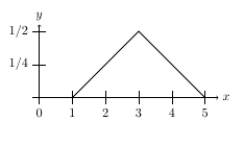 -Assuming Candidate A and Candidate B's policy positions are 2 and 4, determine whether Candidate C can enter and win the election.
 (Essay)
4.7/5 (71)
(71) Use the following information to answer the Questions
Seven board members of a company must decide between two other board members (A and B) for a certain position. The voters are concerned with two issues and their ideal points are represented as ordered pairs: (1, 5), (3, 3), (5, 2), (6, 4), (6, 2), (4, 4), and (3, 2). Assume that A and B announce policy positions of (2, 2) and (5, 4), respectively.
-Find the number of board members who would vote for B based on ideal points.
(Short Answer)
4.8/5 (77)
(77) Use the following information to answer the Questions
Seven board members of a company must decide between two other board members (A and B) for a certain position. The voters are concerned with two issues and their ideal points are represented as ordered pairs: (1, 4), (2, 3), (5, 2), (6, 3), (6, 1), (4, 4), and (3, 3). Assume that A and B announce policy positions of (1, 1) and (6, 4), respectively.
-Which candidate would win the election based on ideal points?
(Multiple Choice)
4.8/5 (77)
(77) Use the following information to answer the Questions.
Consider the following distribution of 33 voters at eight different positions over the interval [0,1]. Position 0.1 0.2 0.3 0.4 0.5 0.6 0.7 0.8 0.9 Number of voters 6 2 2 1 1 2 2 4 1
-For two candidates A and B with distinct policy positions 0.3 and 0.75, respectively, find the number of votes for the candidate B based on voter's ideal positions.
(Short Answer)
4.8/5 (82)
(82) Use the following information to answer Questions
Consider the following distribution of 34 voters at eight different positions over the interval [0, 1]. Location 0.2 0.3 0.4 0.5 0.6 0.7 0.8 0.9 Number of voters 2 3 5 7 7 5 3 2
-Candidate A announces a policy position of 0.3 and Candidate B announces a policy position of 0.8. Is there a 2/3-separation opportunity for a third Candidate C to enter the race?
(True/False)
4.8/5 (77)
(77) Use the following information to answer the Questions.
Consider the following distribution of 33 voters at eight different positions over the interval [0,1]. Position 0.1 0.2 0.3 0.4 0.5 0.6 0.7 0.8 0.9 Number of voters 6 2 2 1 1 2 2 4 1
-What is the equilibrium position in a two-candidate election?
(Short Answer)
4.8/5 (68)
(68) Use the following to answer the Questions
A distribution of voters is uniform over [0, 1]. Candidates A and B have already entered the election and have chosen positions at 1/4 and 3/4, respectively.
-If C enters at 1/2, who wins the election?
(Multiple Choice)
5.0/5 (85)
(85) Use the following information to answer the Questions
Suppose that the continuous distribution of voters' ideal points is the bent solid line below.
-Assuming that Candidate A's policy position is 4 and Candidate B announces a policy position of 2.5, describe which voters vote for Candidate B.
-Assuming that Candidate A's policy position is 4 and Candidate B announces a policy position of 2.5, describe which voters vote for Candidate B. (Essay)
4.9/5 (70)
(70) Use the following to answer the Questions
Suppose that the continuous distribution of voters' ideal points is the bent solid line below. 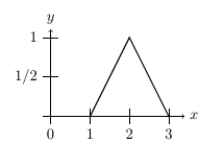 -Assume that Candidate A and Candidate B's policy positions are 1.5 and 2.5. If Candidate C enters at 2, what fraction of the vote does the winner receive?
 (Multiple Choice)
4.9/5 (83)
(83) Use the following information to answer the Questions
Seven board members of a company must decide between two other board members (A and B) for a certain position. The voters are concerned with two issues and their ideal points are represented as ordered pairs: (1, 4), (2, 3), (5, 2), (6, 3), (6, 1), (4, 4), and (3, 3). Assume that A and B announce policy positions of (1, 1) and (6, 4), respectively.
-What is the midpoint of the two policy positions?
(Multiple Choice)
4.7/5 (79)
(79) Use the following information to answer the Questions
Consider the following distribution of 35 voters at eight different positions over the interval [0, 1]. Location 0.2 0.3 0.4 0.5 0.6 0.7 0.8 0.9 Number of voters 4 7 4 2 3 7 4 4
-What is the median position of the voters?
(Multiple Choice)
4.8/5 (68)
(68) Use the following information to answer the Questions
Consider the following distribution of 35 voters at eight different positions over the interval [0, 1]. Location 0.2 0.3 0.4 0.5 0.6 0.7 0.8 0.9 Number of voters 4 7 4 2 3 7 4 4
-This distribution of voters is best described as:
(Multiple Choice)
4.7/5 (87)
(87) Use the following information to answer the Questions
Seven board members of a company must decide between two other board members (A and B) for a certain position. The voters are concerned with two issues and their ideal points are represented as ordered pairs: (1, 4), (2, 3), (5, 2), (6, 3), (6, 1), (4, 4), and (3, 3). Assume that A and B announce policy positions of (1, 1) and (6, 4), respectively.
-How many board members would vote for B based on ideal points?
(Multiple Choice)
4.8/5 (82)
(82) Use the following information to answer the Questions.
Consider the following distribution of 33 voters at eight different positions over the interval [0,1]. Position 0.1 0.2 0.3 0.4 0.5 0.6 0.7 0.8 0.9 Number of voters 6 2 2 1 1 2 2 4 1
-What is the median of the distribution?
(Short Answer)
4.9/5 (77)
(77) Suppose 16 voters are distributed at different positions over the interval [0, 1], as shown below. Location 0.1 0.2 0.3 0.4 0.5 0.6 0.7 0.8 0.9 Number of voters 2 0 4 5 4 1 0 0 0 What is the median position of the voters?
(Multiple Choice)
4.8/5 (74)
(74) 
Filters
- Essay(0)
- Multiple Choice(0)
- Short Answer(0)
- True False(0)
- Matching(0)