



 Chat with AI
Exam 12: Electing the President

Exam 1: Urban Services107 Questions
Exam 2: Business Efficiency104 Questions
Exam 3: Planning and Scheduling108 Questions
Exam 4: Linear Programming111 Questions
Exam 5: Exploring Data: Distributions115 Questions
Exam 6: Exploring Data: Relationships104 Questions
Exam 7: Data for Decisions99 Questions
Exam 8: Probability: the Mathematics of Chance108 Questions
Exam 9: Social Choice: the Impossible Dream103 Questions
Exam 10: The Manipulability of Voting Systems106 Questions
Exam 11: Weighted Voting Systems111 Questions
Exam 12: Electing the President93 Questions
Exam 13: Fair Division121 Questions
Exam 14: Apportionment112 Questions
Exam 15: Game Theory: the Mathematics of Competition113 Questions
Exam 16: Identification Numbers110 Questions
Exam 17: Information Science94 Questions
Exam 18: Growth and Form111 Questions
Exam 19: Symmetry and Patterns115 Questions
Exam 20: Tilings112 Questions
Exam 21: Savings Models113 Questions
Exam 22: Borrowing Models113 Questions
Exam 23: The Economics of Resources119 Questions
Select questions type


Use the following information to answer the Questions
Five board members of a company must decide between two other board members (A and B) for a certain position. The voters are concerned with two issues and their ideal points are represented as ordered pairs: (1, 5), (3, 4), (5, 2), (6, 4), and (6, 2). Assume that A and B announce policy positions of (1, 2) and (5, 4), respectively.
-What is the equation of the line which divides the two-dimensional space separating voters preferring A over B from those preferring B over A?
(Multiple Choice)
4.8/5  (101)
(101) Use the following distribution of 33 voters at eight different positions over the interval [0, 1] to answer Questions Position 0.1 0.3 0.4 0.5 0.6 0.7 0.8 0.9 Number of voters 1 4 6 6 6 2 5 3
-What is the median of the distribution?
(Multiple Choice)
4.9/5 (82)
(82) Use the following information to answer the Questions
Five board members of a company must decide between two other board members (A and B) for a certain position. The voters are concerned with two issues and their ideal points are represented as ordered pairs: (1, 5), (3, 4), (5, 2), (6, 4), and (6, 2). Assume that A and B announce policy positions of (1, 2) and (5, 4), respectively.
-Which candidate would win the election?
(Multiple Choice)
4.7/5 (79)
(79) Use the following information to answer the Questions
Five board members of a company must decide between two other board members (A and B) for a certain position. The voters are concerned with two issues and their ideal points are represented as ordered pairs: (1, 5), (3, 4), (5, 2), (6, 4), and (6, 2). Assume that A and B announce policy positions of (1, 2) and (5, 4), respectively.
-How many board members would vote for B based on ideal points?
(Multiple Choice)
4.8/5 (76)
(76) Use the following to answer the Questions
A distribution of voters is uniform over [0, 1]. Candidates A and B have already entered the election and have chosen positions at 1/4 and 3/4, respectively.
-If C enters at 1, who receives a plurality?
(Multiple Choice)
4.9/5 (88)
(88) The point on the horizontal axis of a voter distribution where half of the voters have attitudes that lie to the left and half of the voters have attitudes that lie to the right is the:
(Multiple Choice)
4.9/5 (71)
(71) Use the following distribution of 33 voters at eight different positions over the interval [0, 1] to answer Questions Position 0.1 0.3 0.4 0.5 0.6 0.7 0.8 0.9 Number of voters 1 4 6 6 6 2 5 3
-For two candidates A and B with distinct policy positions 0.3 and 0.8, respectively, find the number of votes for the candidate A based on voter's ideal positions.
(Multiple Choice)
4.9/5 (69)
(69) Use the following to answer the Questions
Suppose that the continuous distribution of voters' ideal points is the bent solid line below. 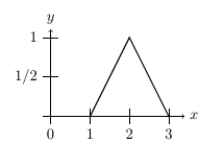 -Assuming that Candidate A's policy position is 2.5, if Candidate B announces a policy position between 1 and 1.5, then who will be the winner of the election?
 (Multiple Choice)
4.9/5 (75)
(75) Use the following to answer the Questions
A distribution of voters is uniform over [0, 1]. Candidates A and B have already entered the election and have chosen positions at 1/4 and 3/4, respectively.
-If C enters at 1/3, who receives a plurality?
(Multiple Choice)
5.0/5 (69)
(69) Use the following to answer the Questions
Suppose that the continuous distribution of voters' ideal points is the bent solid line below.
-Assume that Candidate A and Candidate B's policy positions are 1.5 and 2.5. If Candidate C enters at 2, who would win the election?
-Assume that Candidate A and Candidate B's policy positions are 1.5 and 2.5. If Candidate C enters at 2, who would win the election? (Multiple Choice)
4.8/5 (83)
(83) Use the following distribution of 32 voters at eight different positions over the interval [0, 1] to answer the Questions Position 0.1 0.2 0.3 0.5 0.6 0.7 0.8 0.9 Number of voters 6 5 5 3 4 6 2 1
-For two candidates A and B with distinct policy positions 0.2 and 0.7, respectively, find the number of votes for the candidate A based on voter's ideal positions.
(Multiple Choice)
4.8/5 (80)
(80) Suppose 16 voters are distributed at different positions over the interval [0, 1], as shown below. Location 0.1 0.2 0.3 0.4 0.5 0.6 0.7 0.8 0.9 Number of voters 2 0 4 5 4 1 0 0 0 What is the median position of the voters?
(Multiple Choice)
4.8/5 (74)
(74) Use the following information to answer Questions
Consider the following distribution of 34 voters at eight different positions over the interval [0, 1]. Location 0.2 0.3 0.4 0.5 0.6 0.7 0.8 0.9 Number of voters 2 3 5 7 7 5 3 2
-This distribution of voters is best described as:
(Multiple Choice)
4.9/5 (73)
(73) Use the following distribution of 31 voters at seven different positions over the interval [0, 1] to answer the Questions Position 0.1 0.2 0.3 0.4 0.5 0.7 0.8 Number of voters 1 4 5 6 5 6 4
-What is the equilibrium position in a two-candidate election?
(Multiple Choice)
4.8/5 (84)
(84) Use the following information to answer the Questions
Seven board members of a company must decide between two other board members (A and B) for a certain position. The voters are concerned with two issues and their ideal points are represented as ordered pairs: (1, 5), (3, 3), (5, 2), (6, 4), (6, 2), (4, 4), and (3, 2). Assume that A and B announce policy positions of (2, 2) and (5, 4), respectively.
-Find the midpoint of the two policy positions.
(Short Answer)
4.9/5 (76)
(76) Use the following information to answer the Questions
Consider the following distribution of 32 voters at eight different positions over the interval [0, 1]. Location 0.2 0.3 0.4 0.5 0.6 0.7 0.8 0.9 Number of voters 1 6 2 7 7 2 6 1
-Assume that Candidate A and Candidate B's policy positions are 0.3 and 0.8. If Candidate C enters at 0.49, what fraction of the vote does the winner receive?
(Multiple Choice)
4.8/5 (69)
(69) 
Filters
- Essay(0)
- Multiple Choice(0)
- Short Answer(0)
- True False(0)
- Matching(0)