



 Chat with AI
Exam 3: Carbon and the Molecular Diversity of Life

Exam 1: Introduction: Evolution and the Foundations of Biology36 Questions
Exam 2: The Chemical Context of Life135 Questions
Exam 3: Carbon and the Molecular Diversity of Life121 Questions
Exam 4: A Tour of the Cell72 Questions
Exam 5: Membrane Transport and Cell Signaling89 Questions
Exam 6: An Introduction to Metabolism74 Questions
Exam 7: Cellular Respiration and Fermentation90 Questions
Exam 8: Photosynthesis71 Questions
Exam 9: The Cell Cycle63 Questions
Exam 10: Meiosis and Sexual Life Cycles65 Questions
Exam 11: Mendel and the Gene Idea65 Questions
Exam 12: The Chromosomal Basis of Inheritance46 Questions
Exam 13: The Molecular Basis of Inheritance68 Questions
Exam 14: Gene Expression: From Gene to Protein83 Questions
Exam 15: Regulation of Gene Expression53 Questions
Exam 16: Development, Stem Cells, and Cancer34 Questions
Exam 17: Viruses35 Questions
Exam 18: Genomes and Their Evolution31 Questions
Exam 19: Descent With Modification54 Questions
Exam 20: Phylogeny53 Questions
Exam 21: The Evolution of Populations69 Questions
Exam 22: The Origin of Species60 Questions
Exam 23: Broad Patterns of Evolution38 Questions
Exam 24: Early Life and the Diversification of Prokaryotes89 Questions
Exam 25: The Origin and Diversification of Eukaryotes71 Questions
Exam 26: The Colonization of Land by Plants and Fungi153 Questions
Exam 27: The Rise of Animal Diversity107 Questions
Exam 28: Plant Structure and Growth50 Questions
Exam 29: Resource Acquisition, Nutrition, and Transport in Vascular Plants130 Questions
Exam 30: Reproduction and Domestication of Flowering Plants68 Questions
Exam 31: Plant Responses to Internal and External Signals71 Questions
Exam 32: Homeostasis and Endocrine Signaling122 Questions
Exam 33: Animal Nutrition61 Questions
Exam 34: Circulation and Gas Exchange77 Questions
Exam 35: The Immune System84 Questions
Exam 36: Reproduction and Development109 Questions
Exam 37: Neurons, Synapses, and Signaling68 Questions
Exam 38: Nervous and Sensory Systems89 Questions
Exam 39: Motor Mechanisms and Behavior74 Questions
Exam 40: Population Ecology and the Distribution of Organisms92 Questions
Exam 41: Species Interactions55 Questions
Exam 42: Ecosystems and Energy79 Questions
Exam 43: Global Ecology and Conservation Biology70 Questions
Select questions type


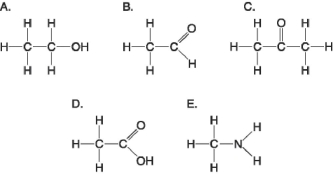 Figure 3.5
-Which molecule(s) shown in Figure 3.5 is (are) ionized in a cell?
Figure 3.5
-Which molecule(s) shown in Figure 3.5 is (are) ionized in a cell? (Multiple Choice)
4.7/5  (85)
(85)  Figure 3.6
-Which molecule shown in Figure 3.6 can function as a base?
Figure 3.6
-Which molecule shown in Figure 3.6 can function as a base? (Multiple Choice)
4.8/5 (85)
(85) Refer to Figure 3.12 to answer the following questions.
 Figure 3.12
-Which bond is a peptide bond?
Figure 3.12
-Which bond is a peptide bond? (Multiple Choice)
4.9/5 (66)
(66) 
Changing a single amino acid in a protein consisting of 325 amino acids would
(Multiple Choice)
4.8/5 (84)
(84) Which of the following descriptions best fits the class of molecules known as nucleotides?
(Multiple Choice)
4.9/5 (80)
(80) 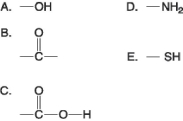 Figure 3.4
-Which of the groups in Figure 3.4 is a carboxyl functional group?
Figure 3.4
-Which of the groups in Figure 3.4 is a carboxyl functional group? (Multiple Choice)
4.7/5 (81)
(81) In a normal cellular protein, where would you expect to find a hydrophobic amino acid such as valine?
(Multiple Choice)
4.9/5 (71)
(71) If cells are grown in a medium containing radioactive 15N, which of these molecules will be labeled?
(Multiple Choice)
4.9/5 (74)
(74) Which of the following are nitrogenous bases of the pyrimidine type?
(Multiple Choice)
4.9/5 (83)
(83) 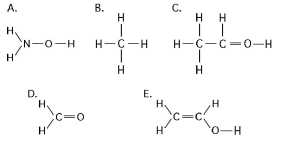 Figure 3.3
-Which of the structures illustrated in Figure 3.3 contain(s) a carbonyl functional group?
Figure 3.3
-Which of the structures illustrated in Figure 3.3 contain(s) a carbonyl functional group? (Multiple Choice)
4.9/5 (88)
(88)  Figure 3.8
-Which of the following statements is true regarding the molecule illustrated in Figure 3.8?
Figure 3.8
-Which of the following statements is true regarding the molecule illustrated in Figure 3.8? (Multiple Choice)
4.8/5 (85)
(85) Which of the following are nitrogenous bases of the purine type?
(Multiple Choice)
4.9/5 (83)
(83) Figure 3.4
-Which functional group shown in Figure 3.4 is characteristic of alcohols?
Figure 3.4
-Which functional group shown in Figure 3.4 is characteristic of alcohols? (Multiple Choice)
4.8/5 (87)
(87) The difference between the sugar in DNA and the sugar in RNA is that the sugar in DNA
(Multiple Choice)
4.8/5 (80)
(80)  Figure 3.11
-Which of the following statements is true regarding the chemical reaction illustrated in Figure 3.11?
Figure 3.11
-Which of the following statements is true regarding the chemical reaction illustrated in Figure 3.11? (Multiple Choice)
4.8/5 (80)
(80) Figure 3.4
-Which of the groups shown in Figure 3.4 is a carbonyl functional group?
Figure 3.4
-Which of the groups shown in Figure 3.4 is a carbonyl functional group? (Multiple Choice)
4.8/5 (78)
(78) 
Filters
- Essay(0)
- Multiple Choice(0)
- Short Answer(0)
- True False(0)
- Matching(0)