



 Chat with AI
Exam 33: Animal Nutrition

Exam 1: Introduction: Evolution and the Foundations of Biology36 Questions
Exam 2: The Chemical Context of Life135 Questions
Exam 3: Carbon and the Molecular Diversity of Life121 Questions
Exam 4: A Tour of the Cell72 Questions
Exam 5: Membrane Transport and Cell Signaling89 Questions
Exam 6: An Introduction to Metabolism74 Questions
Exam 7: Cellular Respiration and Fermentation90 Questions
Exam 8: Photosynthesis71 Questions
Exam 9: The Cell Cycle63 Questions
Exam 10: Meiosis and Sexual Life Cycles65 Questions
Exam 11: Mendel and the Gene Idea65 Questions
Exam 12: The Chromosomal Basis of Inheritance46 Questions
Exam 13: The Molecular Basis of Inheritance68 Questions
Exam 14: Gene Expression: From Gene to Protein83 Questions
Exam 15: Regulation of Gene Expression53 Questions
Exam 16: Development, Stem Cells, and Cancer34 Questions
Exam 17: Viruses35 Questions
Exam 18: Genomes and Their Evolution31 Questions
Exam 19: Descent With Modification54 Questions
Exam 20: Phylogeny53 Questions
Exam 21: The Evolution of Populations69 Questions
Exam 22: The Origin of Species60 Questions
Exam 23: Broad Patterns of Evolution38 Questions
Exam 24: Early Life and the Diversification of Prokaryotes89 Questions
Exam 25: The Origin and Diversification of Eukaryotes71 Questions
Exam 26: The Colonization of Land by Plants and Fungi153 Questions
Exam 27: The Rise of Animal Diversity107 Questions
Exam 28: Plant Structure and Growth50 Questions
Exam 29: Resource Acquisition, Nutrition, and Transport in Vascular Plants130 Questions
Exam 30: Reproduction and Domestication of Flowering Plants68 Questions
Exam 31: Plant Responses to Internal and External Signals71 Questions
Exam 32: Homeostasis and Endocrine Signaling122 Questions
Exam 33: Animal Nutrition61 Questions
Exam 34: Circulation and Gas Exchange77 Questions
Exam 35: The Immune System84 Questions
Exam 36: Reproduction and Development109 Questions
Exam 37: Neurons, Synapses, and Signaling68 Questions
Exam 38: Nervous and Sensory Systems89 Questions
Exam 39: Motor Mechanisms and Behavior74 Questions
Exam 40: Population Ecology and the Distribution of Organisms92 Questions
Exam 41: Species Interactions55 Questions
Exam 42: Ecosystems and Energy79 Questions
Exam 43: Global Ecology and Conservation Biology70 Questions
Select questions type


A group of animals among which a relatively long cecum is likely to be found is the
(Multiple Choice)
4.9/5  (83)
(83) 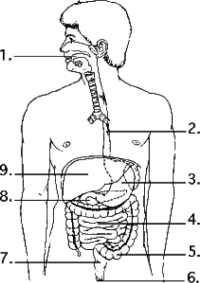 Figure 33.2
-Examine the digestive system structures in the figure above. The agents that help emulsify fats are produced in location
Figure 33.2
-Examine the digestive system structures in the figure above. The agents that help emulsify fats are produced in location (Multiple Choice)
4.9/5 (76)
(76) Use the following information to answer the question below.
Mouse mutations can affect an animal's appetite and eating habits. The ob gene codes for a satiety factor, the hormone leptin. The db gene product, the leptin receptor, is required to respond to the satiety factor.
-Imagine that you are a biologist who is attempting to get an accurate measure of an animal's basal metabolic rate. The best time to measure the metabolic rate is when the animal
(Multiple Choice)
4.8/5 (78)
(78) Animals that migrate great distances would obtain the greatest energetic benefit of storing chemical energy as
(Multiple Choice)
4.9/5 (85)
(85) The absorption of fats differs from that of carbohydrates in that the
(Multiple Choice)
4.8/5 (81)
(81) An advantage of a complete digestive system over a gastrovascular cavity is that the complete system
(Multiple Choice)
4.7/5 (81)
(81) Upon activation by stomach acidity, the secretions of the parietal cells
(Multiple Choice)
4.8/5 (73)
(73) Which pair correctly associates a physiological process with the appropriate vitamin?
(Multiple Choice)
4.8/5 (95)
(95) A general rule relating the capacity of a specific animal's digestive system to provide adequate access to substrates for biosynthesis of cellular components, as well as fuel molecules needed for ATP production, is that the animal should have access to
(Multiple Choice)
4.9/5 (83)
(83) Certain nutrients are considered "essential" in the diets of some animals because
(Multiple Choice)
4.9/5 (64)
(64) Digestive secretions with a pH of 2 are characteristic of the
(Multiple Choice)
4.7/5 (88)
(88) Which of the following organs is incorrectly paired with its function?
(Multiple Choice)
4.8/5 (79)
(79) Coprophagy, the nutrition-boosting ingestion of fecal material, is important for the nutritional balance of
(Multiple Choice)
4.9/5 (83)
(83) When the beta cells of the pancreas release insulin into the blood,
(Multiple Choice)
4.9/5 (87)
(87) Cattle are able to survive on a diet consisting almost entirely of plant material because
(Multiple Choice)
4.8/5 (81)
(81) 
Filters
- Essay(0)
- Multiple Choice(0)
- Short Answer(0)
- True False(0)
- Matching(0)