



 Chat with AI
Exam 33: Animal Nutrition

Exam 1: Introduction: Evolution and the Foundations of Biology36 Questions
Exam 2: The Chemical Context of Life135 Questions
Exam 3: Carbon and the Molecular Diversity of Life121 Questions
Exam 4: A Tour of the Cell72 Questions
Exam 5: Membrane Transport and Cell Signaling89 Questions
Exam 6: An Introduction to Metabolism74 Questions
Exam 7: Cellular Respiration and Fermentation90 Questions
Exam 8: Photosynthesis71 Questions
Exam 9: The Cell Cycle63 Questions
Exam 10: Meiosis and Sexual Life Cycles65 Questions
Exam 11: Mendel and the Gene Idea65 Questions
Exam 12: The Chromosomal Basis of Inheritance46 Questions
Exam 13: The Molecular Basis of Inheritance68 Questions
Exam 14: Gene Expression: From Gene to Protein83 Questions
Exam 15: Regulation of Gene Expression53 Questions
Exam 16: Development, Stem Cells, and Cancer34 Questions
Exam 17: Viruses35 Questions
Exam 18: Genomes and Their Evolution31 Questions
Exam 19: Descent With Modification54 Questions
Exam 20: Phylogeny53 Questions
Exam 21: The Evolution of Populations69 Questions
Exam 22: The Origin of Species60 Questions
Exam 23: Broad Patterns of Evolution38 Questions
Exam 24: Early Life and the Diversification of Prokaryotes89 Questions
Exam 25: The Origin and Diversification of Eukaryotes71 Questions
Exam 26: The Colonization of Land by Plants and Fungi153 Questions
Exam 27: The Rise of Animal Diversity107 Questions
Exam 28: Plant Structure and Growth50 Questions
Exam 29: Resource Acquisition, Nutrition, and Transport in Vascular Plants130 Questions
Exam 30: Reproduction and Domestication of Flowering Plants68 Questions
Exam 31: Plant Responses to Internal and External Signals71 Questions
Exam 32: Homeostasis and Endocrine Signaling122 Questions
Exam 33: Animal Nutrition61 Questions
Exam 34: Circulation and Gas Exchange77 Questions
Exam 35: The Immune System84 Questions
Exam 36: Reproduction and Development109 Questions
Exam 37: Neurons, Synapses, and Signaling68 Questions
Exam 38: Nervous and Sensory Systems89 Questions
Exam 39: Motor Mechanisms and Behavior74 Questions
Exam 40: Population Ecology and the Distribution of Organisms92 Questions
Exam 41: Species Interactions55 Questions
Exam 42: Ecosystems and Energy79 Questions
Exam 43: Global Ecology and Conservation Biology70 Questions
Select questions type


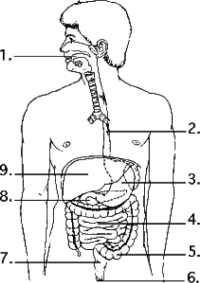 Figure 33.2
-Examine the digestive system structures in the figure above. The highest rate of nutrient absorption occurs at location(s)
Figure 33.2
-Examine the digestive system structures in the figure above. The highest rate of nutrient absorption occurs at location(s) (Multiple Choice)
4.9/5  (82)
(82) Use the following table showing the contents of a multivitamin supplement and its percentage of recommended daily values (% DV) to answer the following questions.
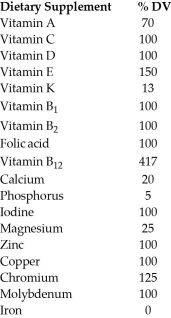 Figure 33.1
-Folic acid supplements are especially important for pregnant women because
Figure 33.1
-Folic acid supplements are especially important for pregnant women because (Multiple Choice)
4.8/5 (77)
(77) For a nondiabetic person, the glucose concentration in this part of the vasculature varies more than in any other part.
(Multiple Choice)
4.7/5 (82)
(82) Because adult lampreys attach onto the surface of large fish for long periods of time to feed on body fluids, they can accomplish nutritional balance without need for a
(Multiple Choice)
4.9/5 (73)
(73) Complex nutrients are digested and then absorbed into the lymph or bloodstream as
(Multiple Choice)
4.8/5 (88)
(88) Figure 33.2
-Examine the digestive system structures in the figure above. Most of the digestion of fats occurs in section(s)
Figure 33.2
-Examine the digestive system structures in the figure above. Most of the digestion of fats occurs in section(s) (Multiple Choice)
4.9/5 (95)
(95) Hypoglycemia, or low levels of glucose in the blood of a healthy human, is "corrected"
(Multiple Choice)
4.9/5 (76)
(76) Use the following table showing the contents of a multivitamin supplement and its percentage of recommended daily values (% DV) to answer the following questions.
Figure 33.1
-The most likely reason that some of the vitamins and minerals in this supplement are found at less than 100% is
Figure 33.1
-The most likely reason that some of the vitamins and minerals in this supplement are found at less than 100% is (Multiple Choice)
4.8/5 (81)
(81) After ingestion by humans, the first category of macromolecules to be chemically digested by enzymes in the mouth is
(Multiple Choice)
4.8/5 (92)
(92) Which of the following is not a major activity of the stomach?
(Multiple Choice)
4.7/5 (73)
(73) Fat digestion yields fatty acids and glycerol, whereas protein digestion yields amino acids; both digestive processes
(Multiple Choice)
4.8/5 (85)
(85) Fat digestion yields fatty acids and glycerol, whereas protein digestion yields amino acids; both digestive processes
(Multiple Choice)
4.9/5 (91)
(91) To maintain adequate nutrition, animals require dietary access to certain amino acids. An amino acid that is referred to as "nonessential" would be best described as one that
(Multiple Choice)
4.9/5 (92)
(92) Glandular secretions that are released initially as inactive precursors of digestive enzymes are the
(Multiple Choice)
4.9/5 (84)
(84) After eating a carbohydrate-rich meal, the mammalian pancreas increases its secretion of
(Multiple Choice)
4.9/5 (86)
(86) The cells that secrete the acidic components of stomach juices are
(Multiple Choice)
4.9/5 (82)
(82) 
Filters
- Essay(0)
- Multiple Choice(0)
- Short Answer(0)
- True False(0)
- Matching(0)