



 Chat with AI
Exam 40: Population Ecology and the Distribution of Organisms

Exam 1: Introduction: Evolution and the Foundations of Biology36 Questions
Exam 2: The Chemical Context of Life135 Questions
Exam 3: Carbon and the Molecular Diversity of Life121 Questions
Exam 4: A Tour of the Cell72 Questions
Exam 5: Membrane Transport and Cell Signaling89 Questions
Exam 6: An Introduction to Metabolism74 Questions
Exam 7: Cellular Respiration and Fermentation90 Questions
Exam 8: Photosynthesis71 Questions
Exam 9: The Cell Cycle63 Questions
Exam 10: Meiosis and Sexual Life Cycles65 Questions
Exam 11: Mendel and the Gene Idea65 Questions
Exam 12: The Chromosomal Basis of Inheritance46 Questions
Exam 13: The Molecular Basis of Inheritance68 Questions
Exam 14: Gene Expression: From Gene to Protein83 Questions
Exam 15: Regulation of Gene Expression53 Questions
Exam 16: Development, Stem Cells, and Cancer34 Questions
Exam 17: Viruses35 Questions
Exam 18: Genomes and Their Evolution31 Questions
Exam 19: Descent With Modification54 Questions
Exam 20: Phylogeny53 Questions
Exam 21: The Evolution of Populations69 Questions
Exam 22: The Origin of Species60 Questions
Exam 23: Broad Patterns of Evolution38 Questions
Exam 24: Early Life and the Diversification of Prokaryotes89 Questions
Exam 25: The Origin and Diversification of Eukaryotes71 Questions
Exam 26: The Colonization of Land by Plants and Fungi153 Questions
Exam 27: The Rise of Animal Diversity107 Questions
Exam 28: Plant Structure and Growth50 Questions
Exam 29: Resource Acquisition, Nutrition, and Transport in Vascular Plants130 Questions
Exam 30: Reproduction and Domestication of Flowering Plants68 Questions
Exam 31: Plant Responses to Internal and External Signals71 Questions
Exam 32: Homeostasis and Endocrine Signaling122 Questions
Exam 33: Animal Nutrition61 Questions
Exam 34: Circulation and Gas Exchange77 Questions
Exam 35: The Immune System84 Questions
Exam 36: Reproduction and Development109 Questions
Exam 37: Neurons, Synapses, and Signaling68 Questions
Exam 38: Nervous and Sensory Systems89 Questions
Exam 39: Motor Mechanisms and Behavior74 Questions
Exam 40: Population Ecology and the Distribution of Organisms92 Questions
Exam 41: Species Interactions55 Questions
Exam 42: Ecosystems and Energy79 Questions
Exam 43: Global Ecology and Conservation Biology70 Questions
Select questions type


Imagine that a deep temperate zone lake did not "turn over" during the spring and fall seasons. Based on the physical and biological properties of limnetic ecosystems, what would be the difference from normal seasonal turnover?
(Multiple Choice)
4.7/5  (81)
(81) If the direction of Earth's rotation reversed, the most predictable effect would be
(Multiple Choice)
4.9/5 (93)
(93) Which of the following examples would most accurately measure the density of the population being studied?
(Multiple Choice)
4.8/5 (74)
(74) Which of the following environmental features might influence microclimates?
(Multiple Choice)
4.9/5 (76)
(76) The eight climographs in Figure 40.1 show yearly temperature (line graph and left vertical axis) and precipitation (bar graph and right vertical axis) averages for each month for some locations on Earth. Choose the climograph that best answers the question.
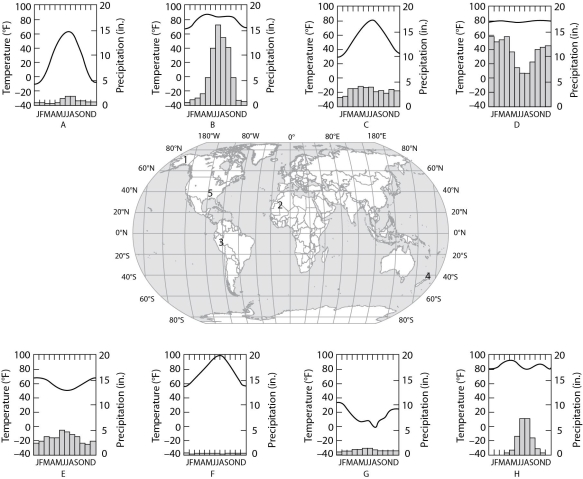 Figure 40.1
-Which climograph shows the climate for location 2?
Figure 40.1
-Which climograph shows the climate for location 2? (Multiple Choice)
4.8/5 (86)
(86) In the ecological development of terrestrial biomes, which factor is most dependent on all the others?
(Multiple Choice)
4.8/5 (85)
(85) An ecologist recorded 12 white-tailed deer, Odocoileus virginianus, per square mile in one woodlot and 20 per square mile in another woodlot. What was the ecologist comparing?
(Multiple Choice)
4.8/5 (81)
(81) Use the survivorship curves in Figure 40.3 to answer the following questions.
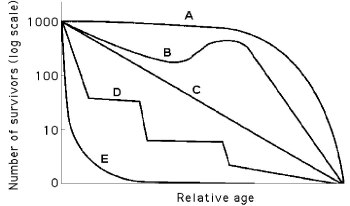 Figure 40.3
-Which curve best describes survivorship in humans who live in developed nations?
Figure 40.3
-Which curve best describes survivorship in humans who live in developed nations? (Multiple Choice)
5.0/5 (88)
(88) Which of the following choices would most likely promote random distribution?
(Multiple Choice)
4.9/5 (77)
(77) Which of the following pairs of reproductive strategies is consistent with energetic trade-off and reproductive success?
(Multiple Choice)
5.0/5 (79)
(79) Starting from a single individual, what is the size of a population of bacteria that reproduce by binary fission every 20 minutes at the end of a 2-hour time period? (Assume unlimited resources and no mortality.)
(Multiple Choice)
4.9/5 (70)
(70) Often the growth cycle of one population has an effect on the cycle of another. As moose populations increase, for example, wolf populations also increase. Thus, if we are considering the logistic equation for the wolf population, dN/dt = rN  ,
Which of the factors accounts for the effect of the moose population?
,
Which of the factors accounts for the effect of the moose population? (Multiple Choice)
4.8/5 (88)
(88) Why is the climate drier on the leeward side of mountain ranges that are subjected to prevailing winds?
(Multiple Choice)
4.8/5 (77)
(77) Coral reefs can be found on the southeast coast of the United States but not at similar latitudes on the southwest coast. Differences in which of the following most likely account for this?
(Multiple Choice)
4.8/5 (68)
(68) Which of the following biomes is correctly paired with the description of its climate?
(Multiple Choice)
4.8/5 (75)
(75) Consider two forests: one is an undisturbed old-growth forest, whereas the other has recently been logged. In which forest are species likely to experience exponential growth, and why?
(Multiple Choice)
4.7/5 (77)
(77) In mountainous areas of western North America, north-facing slopes would be expected to
(Multiple Choice)
4.8/5 (83)
(83) Imagine some cosmic catastrophe jolts Earth so that its axis is perpendicular to the orbital plane between Earth and the sun. The most obvious effect of this change would be
(Multiple Choice)
4.9/5 (95)
(95) Which of the following groups would be most likely to exhibit uniform dispersion?
(Multiple Choice)
4.9/5 (77)
(77) Which of the following choices includes all of the others in creating global terrestrial climates?
(Multiple Choice)
4.7/5 (76)
(76) 
Filters
- Essay(0)
- Multiple Choice(0)
- Short Answer(0)
- True False(0)
- Matching(0)