



 Chat with AI
Exam 40: Population Ecology and the Distribution of Organisms

Exam 1: Introduction: Evolution and the Foundations of Biology36 Questions
Exam 2: The Chemical Context of Life135 Questions
Exam 3: Carbon and the Molecular Diversity of Life121 Questions
Exam 4: A Tour of the Cell72 Questions
Exam 5: Membrane Transport and Cell Signaling89 Questions
Exam 6: An Introduction to Metabolism74 Questions
Exam 7: Cellular Respiration and Fermentation90 Questions
Exam 8: Photosynthesis71 Questions
Exam 9: The Cell Cycle63 Questions
Exam 10: Meiosis and Sexual Life Cycles65 Questions
Exam 11: Mendel and the Gene Idea65 Questions
Exam 12: The Chromosomal Basis of Inheritance46 Questions
Exam 13: The Molecular Basis of Inheritance68 Questions
Exam 14: Gene Expression: From Gene to Protein83 Questions
Exam 15: Regulation of Gene Expression53 Questions
Exam 16: Development, Stem Cells, and Cancer34 Questions
Exam 17: Viruses35 Questions
Exam 18: Genomes and Their Evolution31 Questions
Exam 19: Descent With Modification54 Questions
Exam 20: Phylogeny53 Questions
Exam 21: The Evolution of Populations69 Questions
Exam 22: The Origin of Species60 Questions
Exam 23: Broad Patterns of Evolution38 Questions
Exam 24: Early Life and the Diversification of Prokaryotes89 Questions
Exam 25: The Origin and Diversification of Eukaryotes71 Questions
Exam 26: The Colonization of Land by Plants and Fungi153 Questions
Exam 27: The Rise of Animal Diversity107 Questions
Exam 28: Plant Structure and Growth50 Questions
Exam 29: Resource Acquisition, Nutrition, and Transport in Vascular Plants130 Questions
Exam 30: Reproduction and Domestication of Flowering Plants68 Questions
Exam 31: Plant Responses to Internal and External Signals71 Questions
Exam 32: Homeostasis and Endocrine Signaling122 Questions
Exam 33: Animal Nutrition61 Questions
Exam 34: Circulation and Gas Exchange77 Questions
Exam 35: The Immune System84 Questions
Exam 36: Reproduction and Development109 Questions
Exam 37: Neurons, Synapses, and Signaling68 Questions
Exam 38: Nervous and Sensory Systems89 Questions
Exam 39: Motor Mechanisms and Behavior74 Questions
Exam 40: Population Ecology and the Distribution of Organisms92 Questions
Exam 41: Species Interactions55 Questions
Exam 42: Ecosystems and Energy79 Questions
Exam 43: Global Ecology and Conservation Biology70 Questions
Select questions type


The three basic variables that make up the life history of an organism are
(Multiple Choice)
4.8/5  (65)
(65) Which of the following graphs illustrates the population growth curve of single bacterium growing in a flask of ideal medium at optimum temperature over a 24-hour period?
(Multiple Choice)
4.8/5 (72)
(72) When climbing a mountain, we can observe transitions in biological communities that are analogous to the changes
(Multiple Choice)
4.8/5 (83)
(83) What would be the effect on climate in the temperate latitudes if Earth were to slow its rate of rotation from a 24-hour period of rotation to a 48-hour period of rotation?
(Multiple Choice)
4.8/5 (84)
(84) Which of the following sets of measurements would best describe a population's physical structure and vital statistics?
(Multiple Choice)
4.9/5 (72)
(72) As N approaches K for a certain population, which of the following is predicted by the logistic equation?
(Multiple Choice)
4.9/5 (77)
(77) Which of the following graphs illustrates the growth over several seasons of a population of snowshoe hares that were introduced to an appropriate habitat also inhabited by predators in northern Canada?
(Multiple Choice)
4.9/5 (83)
(83) Which of the following examples of an ecological effect leading to an evolutionary effect is most correct?
(Multiple Choice)
4.9/5 (87)
(87) Which of the following events might you predict to occur if the tilt of Earth's axis relative to its plane of orbit was increased to 33 1/2 degrees?
(Multiple Choice)
4.9/5 (72)
(72) Long-term studies of Belding's ground squirrels show that immigrants move nearly 2 km from where they are born and become 1-8% of the males and 0.7-6% of the females in other populations. On an evolutionary scale, why is this significant?
(Multiple Choice)
4.8/5 (67)
(67) Which of the following statements best describes the effect of climate on biome distribution?
(Multiple Choice)
4.9/5 (91)
(91) The eight climographs in Figure 40.1 show yearly temperature (line graph and left vertical axis) and precipitation (bar graph and right vertical axis) averages for each month for some locations on Earth. Choose the climograph that best answers the question.
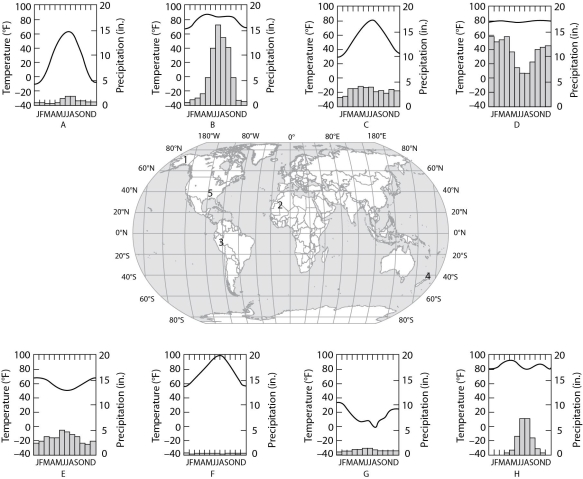 Figure 40.1
-Which climograph shows the climate for location 1?
Figure 40.1
-Which climograph shows the climate for location 1? (Multiple Choice)
4.8/5 (87)
(87) Air masses formed over the Pacific Ocean are moved by prevailing westerlies where they encounter extensive north-south mountain ranges, such as the Sierra Nevadas and the Cascades. Which statement best describes the outcome of this encounter between a landform and an air mass?
(Multiple Choice)
4.9/5 (66)
(66) What is the limiting factor for the growth of trees in the tundra?
(Multiple Choice)
4.7/5 (76)
(76) Which of the following scenarios would provide the most legitimate data on population density?
(Multiple Choice)
4.9/5 (71)
(71) Figure 40.2 shows a generalized cross section of the marine environment with various zones labeled with letters. Choose the letter that best answers the question.
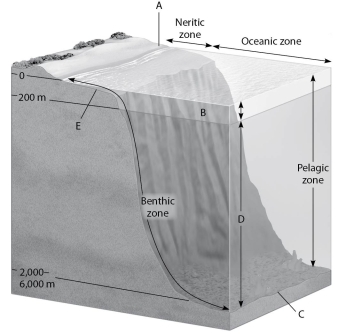 Figure 40.2
-Which zone has the lowest biomass per unit of area?
Figure 40.2
-Which zone has the lowest biomass per unit of area? (Multiple Choice)
4.8/5 (88)
(88) Exponential growth of a population is represented by dN/dt =
(Multiple Choice)
4.9/5 (91)
(91) Generalized global air circulation and precipitation patterns are caused by
(Multiple Choice)
4.9/5 (75)
(75) 
Filters
- Essay(0)
- Multiple Choice(0)
- Short Answer(0)
- True False(0)
- Matching(0)