



 Chat with AI
Exam 8: Photosynthesis

Exam 1: Introduction: Evolution and the Foundations of Biology36 Questions
Exam 2: The Chemical Context of Life135 Questions
Exam 3: Carbon and the Molecular Diversity of Life121 Questions
Exam 4: A Tour of the Cell72 Questions
Exam 5: Membrane Transport and Cell Signaling89 Questions
Exam 6: An Introduction to Metabolism74 Questions
Exam 7: Cellular Respiration and Fermentation90 Questions
Exam 8: Photosynthesis71 Questions
Exam 9: The Cell Cycle63 Questions
Exam 10: Meiosis and Sexual Life Cycles65 Questions
Exam 11: Mendel and the Gene Idea65 Questions
Exam 12: The Chromosomal Basis of Inheritance46 Questions
Exam 13: The Molecular Basis of Inheritance68 Questions
Exam 14: Gene Expression: From Gene to Protein83 Questions
Exam 15: Regulation of Gene Expression53 Questions
Exam 16: Development, Stem Cells, and Cancer34 Questions
Exam 17: Viruses35 Questions
Exam 18: Genomes and Their Evolution31 Questions
Exam 19: Descent With Modification54 Questions
Exam 20: Phylogeny53 Questions
Exam 21: The Evolution of Populations69 Questions
Exam 22: The Origin of Species60 Questions
Exam 23: Broad Patterns of Evolution38 Questions
Exam 24: Early Life and the Diversification of Prokaryotes89 Questions
Exam 25: The Origin and Diversification of Eukaryotes71 Questions
Exam 26: The Colonization of Land by Plants and Fungi153 Questions
Exam 27: The Rise of Animal Diversity107 Questions
Exam 28: Plant Structure and Growth50 Questions
Exam 29: Resource Acquisition, Nutrition, and Transport in Vascular Plants130 Questions
Exam 30: Reproduction and Domestication of Flowering Plants68 Questions
Exam 31: Plant Responses to Internal and External Signals71 Questions
Exam 32: Homeostasis and Endocrine Signaling122 Questions
Exam 33: Animal Nutrition61 Questions
Exam 34: Circulation and Gas Exchange77 Questions
Exam 35: The Immune System84 Questions
Exam 36: Reproduction and Development109 Questions
Exam 37: Neurons, Synapses, and Signaling68 Questions
Exam 38: Nervous and Sensory Systems89 Questions
Exam 39: Motor Mechanisms and Behavior74 Questions
Exam 40: Population Ecology and the Distribution of Organisms92 Questions
Exam 41: Species Interactions55 Questions
Exam 42: Ecosystems and Energy79 Questions
Exam 43: Global Ecology and Conservation Biology70 Questions
Select questions type


Use Figure 8.2 and the compounds labeled A, B, C, D, and E to answer the following questions.
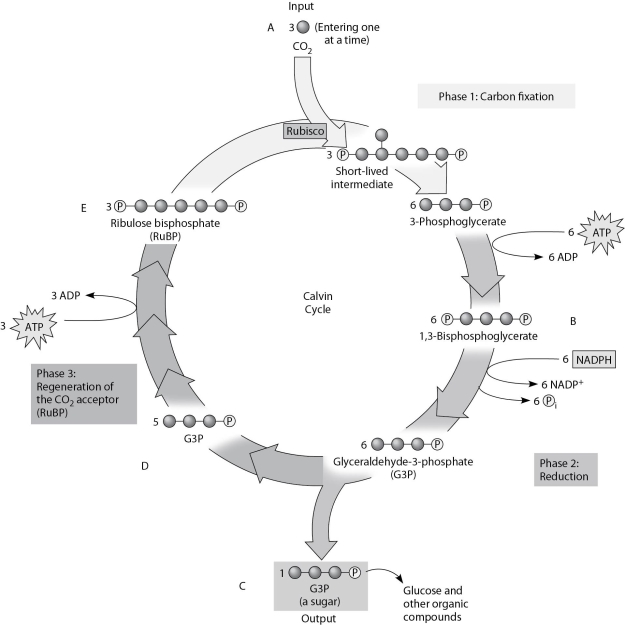 Figure 8.2
-Which molecule(s) of the Calvin cycle is (are) also found in glycolysis?
Figure 8.2
-Which molecule(s) of the Calvin cycle is (are) also found in glycolysis? (Multiple Choice)
4.7/5  (80)
(80) The light reactions of photosynthesis supply the Calvin cycle with
(Multiple Choice)
4.9/5 (83)
(83) Which statement describes the functioning of photosystem II?
(Multiple Choice)
4.8/5 (86)
(86) When oxygen is released as a result of photosynthesis, it is a direct by-product of
(Multiple Choice)
4.9/5 (64)
(64) Some photosynthetic bacteria (e.g., purple sulfur bacteria) have only photosystem I, whereas others (e.g., cyanobacteria) have both photosystem I and photosystem II. Which of the following might this observation imply?
(Multiple Choice)
4.8/5 (76)
(76) The phylogenetic distribution of the enzyme rubisco is limited to
(Multiple Choice)
4.9/5 (99)
(99) Suppose the interior of the thylakoids of isolated chloroplasts were made acidic and then transferred in the dark to a pH 8 solution. What would be likely to happen?
(Multiple Choice)
5.0/5 (78)
(78) Carotenoids are often found in foods that are considered to have antioxidant properties in human nutrition. What related function do they have in plants?
(Multiple Choice)
4.7/5 (76)
(76) Photorespiration lowers the efficiency of photosynthesis by
(Multiple Choice)
5.0/5 (73)
(73) In C3 photosynthesis, the reactions that require ATP take place in
(Multiple Choice)
4.9/5 (74)
(74) In photosynthetic cells, synthesis of ATP by the chemiosmotic mechanism occurs during
(Multiple Choice)
5.0/5 (75)
(75) What would be the expected effect on plants if the atmospheric CO2 concentration was doubled?
(Multiple Choice)
4.9/5 (82)
(82) In mitochondria, chemiosmosis translocates protons from the matrix into the intermembrane space, whereas in chloroplasts, chemiosmosis translocates protons from
(Multiple Choice)
4.8/5 (72)
(72) Which of the following does not occur during the Calvin cycle?
(Multiple Choice)
5.0/5 (73)
(73) Use Figure 8.2 and the compounds labeled A, B, C, D, and E to answer the following questions.
Figure 8.2
-To identify the molecule that accepts CO2, Calvin and Benson manipulated the carbon-fixation cycle by either cutting off CO2 or cutting off light from cultures of photosynthetic algae. They then measured the concentrations of various metabolites immediately following the manipulation. How would these experiments help identify the CO2 acceptor? Study Figure 8.2 to help you in determining the correct answer.
Figure 8.2
-To identify the molecule that accepts CO2, Calvin and Benson manipulated the carbon-fixation cycle by either cutting off CO2 or cutting off light from cultures of photosynthetic algae. They then measured the concentrations of various metabolites immediately following the manipulation. How would these experiments help identify the CO2 acceptor? Study Figure 8.2 to help you in determining the correct answer. (Multiple Choice)
4.9/5 (84)
(84) In a plant cell, where are the ATP synthase complexes located?
(Multiple Choice)
4.9/5 (81)
(81) Where do the enzymatic reactions of the Calvin cycle take place?
(Multiple Choice)
4.9/5 (81)
(81) Which of the following statements best describes the relationship between photosynthesis and respiration?
(Multiple Choice)
4.9/5 (85)
(85) 
Filters
- Essay(0)
- Multiple Choice(0)
- Short Answer(0)
- True False(0)
- Matching(0)