



 Chat with AI
Exam 8: Photosynthesis

Exam 1: Introduction: Evolution and the Foundations of Biology36 Questions
Exam 2: The Chemical Context of Life135 Questions
Exam 3: Carbon and the Molecular Diversity of Life121 Questions
Exam 4: A Tour of the Cell72 Questions
Exam 5: Membrane Transport and Cell Signaling89 Questions
Exam 6: An Introduction to Metabolism74 Questions
Exam 7: Cellular Respiration and Fermentation90 Questions
Exam 8: Photosynthesis71 Questions
Exam 9: The Cell Cycle63 Questions
Exam 10: Meiosis and Sexual Life Cycles65 Questions
Exam 11: Mendel and the Gene Idea65 Questions
Exam 12: The Chromosomal Basis of Inheritance46 Questions
Exam 13: The Molecular Basis of Inheritance68 Questions
Exam 14: Gene Expression: From Gene to Protein83 Questions
Exam 15: Regulation of Gene Expression53 Questions
Exam 16: Development, Stem Cells, and Cancer34 Questions
Exam 17: Viruses35 Questions
Exam 18: Genomes and Their Evolution31 Questions
Exam 19: Descent With Modification54 Questions
Exam 20: Phylogeny53 Questions
Exam 21: The Evolution of Populations69 Questions
Exam 22: The Origin of Species60 Questions
Exam 23: Broad Patterns of Evolution38 Questions
Exam 24: Early Life and the Diversification of Prokaryotes89 Questions
Exam 25: The Origin and Diversification of Eukaryotes71 Questions
Exam 26: The Colonization of Land by Plants and Fungi153 Questions
Exam 27: The Rise of Animal Diversity107 Questions
Exam 28: Plant Structure and Growth50 Questions
Exam 29: Resource Acquisition, Nutrition, and Transport in Vascular Plants130 Questions
Exam 30: Reproduction and Domestication of Flowering Plants68 Questions
Exam 31: Plant Responses to Internal and External Signals71 Questions
Exam 32: Homeostasis and Endocrine Signaling122 Questions
Exam 33: Animal Nutrition61 Questions
Exam 34: Circulation and Gas Exchange77 Questions
Exam 35: The Immune System84 Questions
Exam 36: Reproduction and Development109 Questions
Exam 37: Neurons, Synapses, and Signaling68 Questions
Exam 38: Nervous and Sensory Systems89 Questions
Exam 39: Motor Mechanisms and Behavior74 Questions
Exam 40: Population Ecology and the Distribution of Organisms92 Questions
Exam 41: Species Interactions55 Questions
Exam 42: Ecosystems and Energy79 Questions
Exam 43: Global Ecology and Conservation Biology70 Questions
Select questions type


P680+ is said to be the strongest biological oxidizing agent. Given its function, why is this necessary?
(Multiple Choice)
4.8/5  (78)
(78) In metabolic processes of cell respiration and photosynthesis, prosthetic groups such as heme and iron-sulfur complexes are encountered in components of the electron transport chain. What do they do?
(Multiple Choice)
4.8/5 (79)
(79) A plant has a unique photosynthetic pigment. The leaves of this plant appear to be reddish yellow. What wavelengths of visible light are being absorbed by this pigment?
(Multiple Choice)
4.8/5 (66)
(66) A spaceship is designed to support animal life for a multiyear voyage to the outer planets of the solar system. Plants will be grown to provide oxygen and to recycle carbon dioxide. Because the spaceship will be too far from the sun for photosynthesis, an artificial light source will be needed.
-What wavelengths of light should be used to maximize plant growth with a minimum of energy expenditure?
(Multiple Choice)
4.8/5 (80)
(80) In thylakoids, protons travel through ATP synthase from the thylakoid space to the stroma. Therefore, the catalytic "knobs" of ATP synthase would be located
(Multiple Choice)
4.9/5 (78)
(78) A spaceship is designed to support animal life for a multiyear voyage to the outer planets of the solar system. Plants will be grown to provide oxygen and to recycle carbon dioxide. Because the spaceship will be too far from the sun for photosynthesis, an artificial light source will be needed.
-A gardener is concerned that her greenhouse is getting too hot from too much light, and seeks to shade her plants with colored translucent plastic sheets, the color of which allows passage of only that wavelength. What color should she use to reduce overall light energy, but still maximize plant growth?
(Multiple Choice)
4.8/5 (87)
(87) What does the chemiosmotic process in chloroplasts involve?
(Multiple Choice)
4.8/5 (79)
(79) In the process of carbon fixation, RuBP attaches a CO2 to produce a six-carbon molecule, which is then split to produce two molecules of 3-phosphoglycerate. After phosphorylation and reduction produces glyceraldehyde 3-phosphate (G3P), what more needs to happen to complete the Calvin cycle?
(Multiple Choice)
4.9/5 (77)
(77) 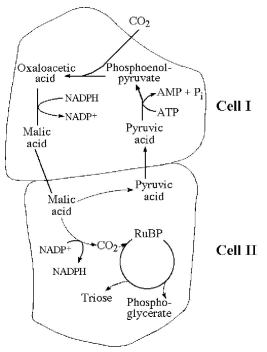 Figure 8.3
-Which of the following statements is true concerning Figure 8.3?
Figure 8.3
-Which of the following statements is true concerning Figure 8.3? (Multiple Choice)
4.9/5 (82)
(82) Theodor W. Engelmann illuminated a filament of algae with light that passed through a prism, thus exposing different segments of algae to different wavelengths of light. He added aerobic bacteria and then noted in which areas the bacteria congregated. He noted that the largest groups were found in the areas illuminated by the red and blue light.
-If you ran the same experiment without passing light through a prism, what would you predict?
(Multiple Choice)
4.7/5 (93)
(93) Which of the following events occurs in the light reactions of photosynthesis?
(Multiple Choice)
4.9/5 (77)
(77) If photosynthesizing green algae are provided with CO2 containing heavy oxygen (18O), later analysis will show that all of the following molecules produced by the algae contain 18O except
(Multiple Choice)
4.8/5 (64)
(64) Which of the following are directly associated with photosystem I?
(Multiple Choice)
4.9/5 (76)
(76) Use Figure 8.2 and the compounds labeled A, B, C, D, and E to answer the following questions.
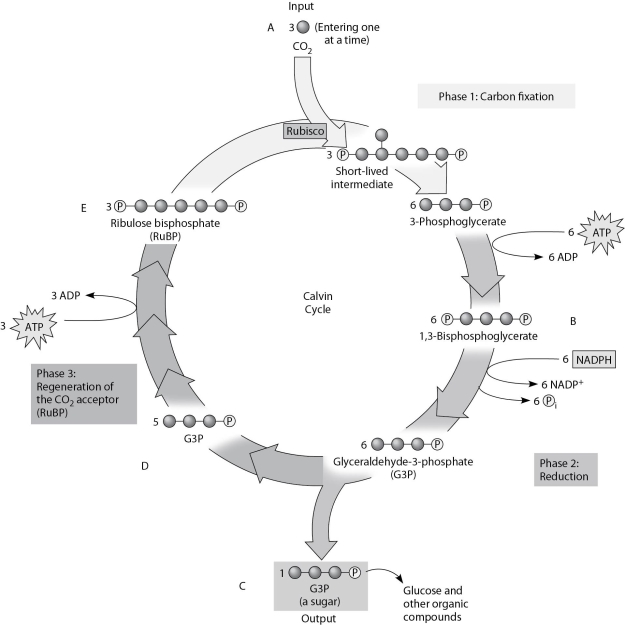 Figure 8.2
-If the carbon atom of each of the incoming CO2 molecules is labeled with a radioactive isotope of carbon, which organic molecules will be radioactively labeled after one cycle?
Figure 8.2
-If the carbon atom of each of the incoming CO2 molecules is labeled with a radioactive isotope of carbon, which organic molecules will be radioactively labeled after one cycle? (Multiple Choice)
4.9/5 (84)
(84) A spaceship is designed to support animal life for a multiyear voyage to the outer planets of the solar system. Plants will be grown to provide oxygen and to recycle carbon dioxide. Because the spaceship will be too far from the sun for photosynthesis, an artificial light source will be needed.
-Halobacterium has a photosynthetic membrane that appears purple. Its photosynthetic action spectrum is the inverse of the action spectrum for green plants. (That is, the Halobacterium action spectrum has a peak where the green plant action spectrum has a trough.) What wavelengths of light do the Halobacterium photosynthetic pigments absorb?
(Multiple Choice)
4.7/5 (77)
(77) Theodor W. Engelmann illuminated a filament of algae with light that passed through a prism, thus exposing different segments of algae to different wavelengths of light. He added aerobic bacteria and then noted in which areas the bacteria congregated. He noted that the largest groups were found in the areas illuminated by the red and blue light.
-An outcome of this experiment was to help determine the relationship between
(Multiple Choice)
4.8/5 (69)
(69) 
Filters
- Essay(0)
- Multiple Choice(0)
- Short Answer(0)
- True False(0)
- Matching(0)