



 Chat with AI
Exam 10: Molecular Biology of the Gene

Exam 1: Biology: Exploring Life47 Questions
Exam 2: The Chemical Basis of Life73 Questions
Exam 3: The Molecules of Cells89 Questions
Exam 4: A Tour of the Cell93 Questions
Exam 5: The Working Cell81 Questions
Exam 6: How Cells Harvest Chemical Energy82 Questions
Exam 7: Photosynthesis: Using Light to Make Food83 Questions
Exam 8: The Cellular Basis of Reproduction and Inheritance81 Questions
Exam 9: Patterns of Inheritance76 Questions
Exam 10: Molecular Biology of the Gene85 Questions
Exam 11: How Genes Are Controlled84 Questions
Exam 12: DNA Technology and Genomics80 Questions
Exam 13: How Populations Evolve67 Questions
Exam 14: The Origin of Species59 Questions
Exam 15: Tracing Evolutionary History88 Questions
Exam 16: Microbial Life: Prokaryotes and Protists80 Questions
Exam 17: The Evolution of Plant and Fungal Diversity85 Questions
Exam 18: The Evolution of Invertebrate Diversity81 Questions
Exam 19: The Evolution of Vertebrate Diversity77 Questions
Exam 20: Unifying Concepts of Animal Structure and Function68 Questions
Exam 21: Nutrition and Digestion96 Questions
Exam 22: Gas Exchange68 Questions
Exam 23: Circulation81 Questions
Exam 24: The Immune System76 Questions
Exam 25: Control of Body Temperature and Water Balance67 Questions
Exam 26: Hormones and the Endocrine System66 Questions
Exam 27: Reproduction and Embryonic Development88 Questions
Exam 28: Nervous Systems75 Questions
Exam 29: The Senses62 Questions
Exam 30: How Animals Move72 Questions
Exam 31: Plant Structure, Growth, and Reproduction81 Questions
Exam 32: Plant Nutrition and Transport69 Questions
Exam 33: Control Systems in Plants61 Questions
Exam 34: The Biosphere: an Introduction to Earths Diverse Environments61 Questions
Exam 35: Behavioral Adaptations to the Environment54 Questions
Exam 36: Population Ecology57 Questions
Exam 37: Communities and Ecosystems62 Questions
Exam 38: Conservation Biology61 Questions
Select questions type


In the 1920s, Frederick Griffith conducted an experiment in which he mixed the dead cells of a bacterial strain that can cause pneumonia with live cells of a bacterial strain that cannot. When he cultured the live cells, some of the daughter colonies proved able to cause pneumonia. Which of the following processes of bacterial DNA transfer does this experiment demonstrate?
(Multiple Choice)
4.7/5  (83)
(83) A physical or chemical agent that changes the nucleotide sequence of DNA is called a(n)
(Multiple Choice)
4.7/5 (75)
(75) We would expect that a 15-nucleotide sequence that includes a stop codon at the end (as part of the 15-nucleotide sequence) will direct the production of a polypeptide that consists of
(Multiple Choice)
4.9/5 (81)
(81) Which of the following enzymes does HIV use to synthesize DNA on an RNA template?
(Multiple Choice)
4.8/5 (77)
(77) Which of the following enzymes catalyzes the elongation of a new DNA strand?
(Multiple Choice)
4.9/5 (89)
(89) The transfer of genetic information from DNA to RNA is called
(Multiple Choice)
4.7/5 (73)
(73) Conjugation, transformation, and transduction are all ways that bacteria
(Multiple Choice)
4.8/5 (68)
(68) It is possible to synthesize proteins in vitro (in a test tube) without the use of living cells. If starting from a mature mRNA transcript, which of the following components would not be needed to do this?
(Multiple Choice)
4.7/5 (79)
(79) Bloom syndrome is a rare disease characterized by growth deficiencies, genomic instability, and the early development of cancers. The BLM gene encodes the BLM protein, which when mutated may result in Bloom syndrome.
-To detect whether or not a cell has a specific region of a gene, researchers add radioactively labeled DNA molecules that can bind to their complementary DNA sequences. To detect a mutant version of the BLM gene, researchers added the radioactive DNA molecule 5' - GCTAGCTAAGCCCA - 3' to cells. What DNA sequence were the researchers trying to detect?
(Multiple Choice)
4.9/5 (83)
(83) What nucleotide sequence would be found on the complementary DNA strand of the strand shown here? 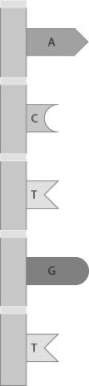
(Multiple Choice)
4.9/5 (67)
(67) Which of the following statements about plant viruses is false?
(Multiple Choice)
4.8/5 (83)
(83) Where do transcription and translation occur in prokaryotic cells?
(Multiple Choice)
4.8/5 (96)
(96) Dilated cardiomyopathy (DCM) is a common cause of sudden death and heart failure. Many mutations can cause DCM, but several of them are linked to the protein troponin, which is an essential protein that helps regulate muscle contraction in the heart.
-The A159E mutation causes an A amino acid to be replaced with an E amino acid (their structures are shown here). What type of mutation is the A159E mutation? 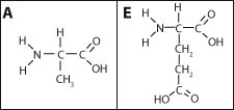
(Multiple Choice)
4.8/5 (91)
(91) Which of the following human activities has contributed to an increase in the number of bacteria having R plasmids?
(Multiple Choice)
4.7/5 (80)
(80) Which of the following options most accurately lists the sequence of events in translation?
(Multiple Choice)
5.0/5 (72)
(72) Consider the following sentence: "The dog did not eat." Which of the following variations of this sentence is most like a frameshift mutation?
(Multiple Choice)
4.8/5 (65)
(65) Which of the following statements about herpesviruses is false?
(Multiple Choice)
4.8/5 (67)
(67) 
Filters
- Essay(0)
- Multiple Choice(0)
- Short Answer(0)
- True False(0)
- Matching(0)