



 Chat with AI
Exam 10: Molecular Biology of the Gene

Exam 1: Biology: Exploring Life47 Questions
Exam 2: The Chemical Basis of Life73 Questions
Exam 3: The Molecules of Cells89 Questions
Exam 4: A Tour of the Cell93 Questions
Exam 5: The Working Cell81 Questions
Exam 6: How Cells Harvest Chemical Energy82 Questions
Exam 7: Photosynthesis: Using Light to Make Food83 Questions
Exam 8: The Cellular Basis of Reproduction and Inheritance81 Questions
Exam 9: Patterns of Inheritance76 Questions
Exam 10: Molecular Biology of the Gene85 Questions
Exam 11: How Genes Are Controlled84 Questions
Exam 12: DNA Technology and Genomics80 Questions
Exam 13: How Populations Evolve67 Questions
Exam 14: The Origin of Species59 Questions
Exam 15: Tracing Evolutionary History88 Questions
Exam 16: Microbial Life: Prokaryotes and Protists80 Questions
Exam 17: The Evolution of Plant and Fungal Diversity85 Questions
Exam 18: The Evolution of Invertebrate Diversity81 Questions
Exam 19: The Evolution of Vertebrate Diversity77 Questions
Exam 20: Unifying Concepts of Animal Structure and Function68 Questions
Exam 21: Nutrition and Digestion96 Questions
Exam 22: Gas Exchange68 Questions
Exam 23: Circulation81 Questions
Exam 24: The Immune System76 Questions
Exam 25: Control of Body Temperature and Water Balance67 Questions
Exam 26: Hormones and the Endocrine System66 Questions
Exam 27: Reproduction and Embryonic Development88 Questions
Exam 28: Nervous Systems75 Questions
Exam 29: The Senses62 Questions
Exam 30: How Animals Move72 Questions
Exam 31: Plant Structure, Growth, and Reproduction81 Questions
Exam 32: Plant Nutrition and Transport69 Questions
Exam 33: Control Systems in Plants61 Questions
Exam 34: The Biosphere: an Introduction to Earths Diverse Environments61 Questions
Exam 35: Behavioral Adaptations to the Environment54 Questions
Exam 36: Population Ecology57 Questions
Exam 37: Communities and Ecosystems62 Questions
Exam 38: Conservation Biology61 Questions
Select questions type


When one DNA molecule is copied to make two new DNA molecules, the resulting DNA molecules contain
(Multiple Choice)
4.9/5  (88)
(88) A single base mutation occurs in a gene that codes for a protein due to an error in DNA replication. Which of the following outcomes is not possible?
(Multiple Choice)
4.9/5 (62)
(62) If Hershey and Chase had used radioactive oxygen in their experiments instead of phosphorus and sulfur, what results would they have likely obtained?
(Multiple Choice)
4.8/5 (78)
(78) ________ marks the end of a gene and causes transcription to stop.
(Multiple Choice)
4.8/5 (83)
(83) A protein coat that enclosed a viral genome is known as a(n)
(Multiple Choice)
4.9/5 (73)
(73) Below are three statements. Which of the following choices properly matches the statements with the correct biological processes? I. This occurs in the nucleus of eukaryotic cells with DNA polymerase.
II) Transfer RNAs bind amino acids in the cytoplasm.
III) An RNA polymerase enzyme is required.
(Multiple Choice)
4.9/5 (72)
(72) You are interested in designing an experiment to test the hypothesis that frogs use the same genetic code as humans. Which of the following experiments would not give you useful data to test this hypothesis?
(Multiple Choice)
4.9/5 (77)
(77) Which of the following statements about treatment or prevention of a prion infection is true?
(Multiple Choice)
4.8/5 (83)
(83) Diabetes mellitus is a metabolic disease that is characterized by the buildup of glucose in the blood, or hyperglycemia. Diabetes results either from the pancreas not being able to produce the hormone insulin (type 1 diabetes) or if the body's cells become resistant to insulin (type 2 diabetes). Insulin is a protein that binds to receptors on cell surfaces to allow glucose to enter the cell.
In order to manage the disease, type 1 diabetics require frequent insulin injections. Until the 1970s, insulin was obtained from processing the pancreases of large mammals such as cows and pigs; it was then purified for medicinal use. This all changed in the 1970s with the advent of recombinant DNA technology, which allows scientists to insert genes from other species into bacterial plasmids and have bacteria produce proteins from these other species' genes. In 1978, the gene that codes for human insulin was added to a bacterial plasmid and bacteria were used to produce human insulin. These bacteria acted as mini-factories that produced human insulin for type 1 diabetes patients. Today, the production of human insulin from bacteria is commonplace and is a multibillion dollar market for pharmaceutical companies.
-In order to add the gene for human insulin to a bacterial plasmid, the DNA molecules have to be "cut" with enzymes called restriction endonucleases and then pasted back together with enzymes called DNA ligases. Imagine that during this process, the first five nucleotides of the human insulin gene were accidentally cut out before it was pasted into the bacterial plasmid. What is the most likely outcome if this plasmid was added to bacterial cells?
(Multiple Choice)
4.8/5 (77)
(77) Diabetes mellitus is a metabolic disease that is characterized by the buildup of glucose in the blood, or hyperglycemia. Diabetes results either from the pancreas not being able to produce the hormone insulin (type 1 diabetes) or if the body's cells become resistant to insulin (type 2 diabetes). Insulin is a protein that binds to receptors on cell surfaces to allow glucose to enter the cell.
In order to manage the disease, type 1 diabetics require frequent insulin injections. Until the 1970s, insulin was obtained from processing the pancreases of large mammals such as cows and pigs; it was then purified for medicinal use. This all changed in the 1970s with the advent of recombinant DNA technology, which allows scientists to insert genes from other species into bacterial plasmids and have bacteria produce proteins from these other species' genes. In 1978, the gene that codes for human insulin was added to a bacterial plasmid and bacteria were used to produce human insulin. These bacteria acted as mini-factories that produced human insulin for type 1 diabetes patients. Today, the production of human insulin from bacteria is commonplace and is a multibillion dollar market for pharmaceutical companies.
-Suppose that the human insulin protein that was produced by the bacteria was much shorter than it should be. Upon further investigation, it was found that the DNA of the human insulin gene had a mutation while in the bacterial cells. What type of mutation could not result in these observations?
(Multiple Choice)
4.7/5 (71)
(71) Exposure to the HIV virus doesn't necessarily mean that a person will develop AIDS. Some people have genetic resistance to infection by HIV. Dr. Stephen O'Brien from the U.S. National Cancer Institute has recently identified a mutant form of a gene, called CCR5, that can protect against HIV infection. The mutation probably originated in Europe and became more prevalent among survivors of the bubonic plague. The mutated gene prevents the plague bacteria from attaching to cell membranes and, therefore, from entering and infecting body cells.
Although the HIV virus is very different from the bacteria that causes the plague, both diseases affect the exact same cells and use the same method of infection. The presence of the mutated gene in descendants of plague survivors helps prevent them from contracting AIDS. Pharmaceutical companies are using this information as the basis for a new approach to AIDS prevention. This could be very important in areas of the world where the mutation is scarce or absent, such as Africa.
-The most likely method by which the mutated CCR5 gene prevents AIDS is by
(Multiple Choice)
5.0/5 (95)
(95) Which of the following statements regarding viral diseases is false?
(Multiple Choice)
4.9/5 (86)
(86) Which of the following people conducted the experiments that demonstrated that DNA is the genetic material of bacteriophages?
(Multiple Choice)
4.8/5 (81)
(81)  -Using the genetic code shown, what protein sequence does the RNA sequence CUAGCUCGAUAUCUC code for?
 (Multiple Choice)
4.8/5 (80)
(80) If the left end of the daughter strand indicated by the arrow in the figure is being synthesized in one continuous piece, then 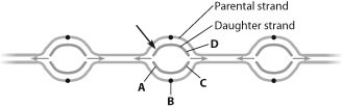
(Multiple Choice)
4.9/5 (81)
(81) In many bacteria, genes that confer resistance to antibiotics are carried on
(Multiple Choice)
4.8/5 (73)
(73) 
Filters
- Essay(0)
- Multiple Choice(0)
- Short Answer(0)
- True False(0)
- Matching(0)