



 Chat with AI
Exam 19: The Evolution of Vertebrate Diversity

Exam 1: Biology: Exploring Life47 Questions
Exam 2: The Chemical Basis of Life73 Questions
Exam 3: The Molecules of Cells89 Questions
Exam 4: A Tour of the Cell93 Questions
Exam 5: The Working Cell81 Questions
Exam 6: How Cells Harvest Chemical Energy82 Questions
Exam 7: Photosynthesis: Using Light to Make Food83 Questions
Exam 8: The Cellular Basis of Reproduction and Inheritance81 Questions
Exam 9: Patterns of Inheritance76 Questions
Exam 10: Molecular Biology of the Gene85 Questions
Exam 11: How Genes Are Controlled84 Questions
Exam 12: DNA Technology and Genomics80 Questions
Exam 13: How Populations Evolve67 Questions
Exam 14: The Origin of Species59 Questions
Exam 15: Tracing Evolutionary History88 Questions
Exam 16: Microbial Life: Prokaryotes and Protists80 Questions
Exam 17: The Evolution of Plant and Fungal Diversity85 Questions
Exam 18: The Evolution of Invertebrate Diversity81 Questions
Exam 19: The Evolution of Vertebrate Diversity77 Questions
Exam 20: Unifying Concepts of Animal Structure and Function68 Questions
Exam 21: Nutrition and Digestion96 Questions
Exam 22: Gas Exchange68 Questions
Exam 23: Circulation81 Questions
Exam 24: The Immune System76 Questions
Exam 25: Control of Body Temperature and Water Balance67 Questions
Exam 26: Hormones and the Endocrine System66 Questions
Exam 27: Reproduction and Embryonic Development88 Questions
Exam 28: Nervous Systems75 Questions
Exam 29: The Senses62 Questions
Exam 30: How Animals Move72 Questions
Exam 31: Plant Structure, Growth, and Reproduction81 Questions
Exam 32: Plant Nutrition and Transport69 Questions
Exam 33: Control Systems in Plants61 Questions
Exam 34: The Biosphere: an Introduction to Earths Diverse Environments61 Questions
Exam 35: Behavioral Adaptations to the Environment54 Questions
Exam 36: Population Ecology57 Questions
Exam 37: Communities and Ecosystems62 Questions
Exam 38: Conservation Biology61 Questions
Select questions type


A number of different genes have been identified as affecting skin color and there are probably more as yet unidentified. Each of these genes likely has several regulatory protein factors affecting their expression, and those proteins are coded for by yet more genes. Thus there are many genes involved in determining skin color. A reasonable hypothesis about the geographic distribution of these genes is
(Multiple Choice)
4.8/5  (72)
(72) According to the fossil record, the genus Homo first arose in
(Multiple Choice)
4.9/5 (71)
(71) Complete the analogy: ________ are to plant evolution as ________ is/are to vertebrate evolution.
(Multiple Choice)
4.8/5 (80)
(80) By far the largest number of extant fish species on Earth have
(Multiple Choice)
4.9/5 (82)
(82)  Source: Parra, E. J., Kittles, R. A., & Shriver, M. D. (2004). Implications of correlations between skin color and genetic ancestry for biomedical research. Nature Genetics, 36, S54-S60.
-The graphs shown indicate the range of melanin amounts in populations from four different geographic regions. Not all populations across the globe have the same number of genes or alleles controlling skin color. Which population is likely to be the most genetically diverse in terms of genes affecting skin color?
Source: Parra, E. J., Kittles, R. A., & Shriver, M. D. (2004). Implications of correlations between skin color and genetic ancestry for biomedical research. Nature Genetics, 36, S54-S60.
-The graphs shown indicate the range of melanin amounts in populations from four different geographic regions. Not all populations across the globe have the same number of genes or alleles controlling skin color. Which population is likely to be the most genetically diverse in terms of genes affecting skin color? (Multiple Choice)
4.9/5 (87)
(87) Of the over 19,000 new species described for the first time in 2009, more than half were
(Multiple Choice)
4.8/5 (89)
(89) A number of different genes have been identified as affecting skin color and there are probably more as yet unidentified. Each of these genes likely has several regulatory protein factors affecting their expression, and those proteins are coded for by yet more genes. Thus there are many genes, some of which have multiple alleles, involved in determining skin color. What property of skin color does this multigene foundation not explain?
(Multiple Choice)
4.9/5 (71)
(71) The greatest incidence of skin cancer (melanoma) would be expected to occur in
(Multiple Choice)
4.8/5 (91)
(91)  -Suppose a fossil was found and identified to be a species approximately 3.5 million years old. This fossil could be a representative of which species?
 (Multiple Choice)
4.9/5 (75)
(75) Reptiles are not able to eat as frequently as mammals and birds can eat. This is due to a trait that mammals and birds share but that reptiles do not have. What is this trait?
(Multiple Choice)
5.0/5 (86)
(86) Complete the analogy: ________ is/are to birds as ________ is/are to mammals.
(Multiple Choice)
4.9/5 (81)
(81) The earliest hominin to be found outside of Africa belongs to which species?
(Multiple Choice)
4.9/5 (70)
(70)
-Which option lists the major groups or genera from the fossil record in the correct order from earliest to most recent? 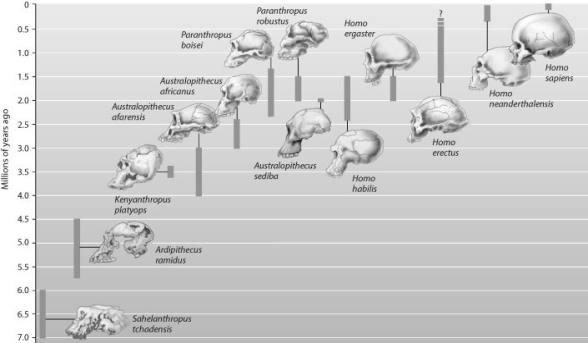
-Which option lists the major groups or genera from the fossil record in the correct order from earliest to most recent? (Multiple Choice)
4.9/5 (97)
(97) 
Filters
- Essay(0)
- Multiple Choice(0)
- Short Answer(0)
- True False(0)
- Matching(0)