



 Chat with AI
Exam 19: The Evolution of Vertebrate Diversity

Exam 1: Biology: Exploring Life47 Questions
Exam 2: The Chemical Basis of Life73 Questions
Exam 3: The Molecules of Cells89 Questions
Exam 4: A Tour of the Cell93 Questions
Exam 5: The Working Cell81 Questions
Exam 6: How Cells Harvest Chemical Energy82 Questions
Exam 7: Photosynthesis: Using Light to Make Food83 Questions
Exam 8: The Cellular Basis of Reproduction and Inheritance81 Questions
Exam 9: Patterns of Inheritance76 Questions
Exam 10: Molecular Biology of the Gene85 Questions
Exam 11: How Genes Are Controlled84 Questions
Exam 12: DNA Technology and Genomics80 Questions
Exam 13: How Populations Evolve67 Questions
Exam 14: The Origin of Species59 Questions
Exam 15: Tracing Evolutionary History88 Questions
Exam 16: Microbial Life: Prokaryotes and Protists80 Questions
Exam 17: The Evolution of Plant and Fungal Diversity85 Questions
Exam 18: The Evolution of Invertebrate Diversity81 Questions
Exam 19: The Evolution of Vertebrate Diversity77 Questions
Exam 20: Unifying Concepts of Animal Structure and Function68 Questions
Exam 21: Nutrition and Digestion96 Questions
Exam 22: Gas Exchange68 Questions
Exam 23: Circulation81 Questions
Exam 24: The Immune System76 Questions
Exam 25: Control of Body Temperature and Water Balance67 Questions
Exam 26: Hormones and the Endocrine System66 Questions
Exam 27: Reproduction and Embryonic Development88 Questions
Exam 28: Nervous Systems75 Questions
Exam 29: The Senses62 Questions
Exam 30: How Animals Move72 Questions
Exam 31: Plant Structure, Growth, and Reproduction81 Questions
Exam 32: Plant Nutrition and Transport69 Questions
Exam 33: Control Systems in Plants61 Questions
Exam 34: The Biosphere: an Introduction to Earths Diverse Environments61 Questions
Exam 35: Behavioral Adaptations to the Environment54 Questions
Exam 36: Population Ecology57 Questions
Exam 37: Communities and Ecosystems62 Questions
Exam 38: Conservation Biology61 Questions
Select questions type


Which statement best summarizes the difference between ectothermic and endothermic organisms?
(Multiple Choice)
4.8/5  (82)
(82) Which animal group is characterized by the absence of tails?
(Multiple Choice)
4.9/5 (76)
(76) Bipedalism is one of the most important characteristics of hominin evolution. The appearance of bipedalism led to anatomical changes that are considered to be distinguishing characteristics of hominin fossils. The evidence for bipedalism is supported by fossil evidence from more than 4 million years ago and 3.6-million-year-old footprints in volcanic ash.
Recently, however, scientists have focused on the link between tooth structure and diet in the evolution of the early hominins, specifically in Australopithecus species. Detailed studies of hominin dental features have provided evidence of an important dietary shift that led to adaptive radiation within this genus. Most of the evidence comes from analyses of tooth size and shape, microscopic wear patterns on teeth, and jaw structure. The evidence suggests that fibrous plant materials became more important through the Pliocene, perhaps as critical components in the diet of some species.
-Evidence from fossil dentition suggests that Australopithecus species
(Multiple Choice)
4.8/5 (86)
(86) According to this figure, which group includes the closest living relatives to tetrapods such as amphibians, reptiles, and mammals? 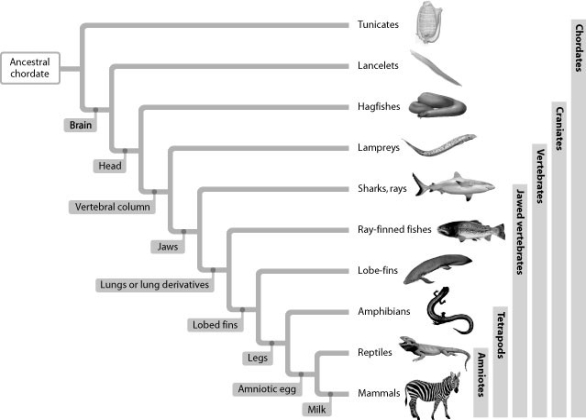
(Multiple Choice)
4.7/5 (65)
(65) Recall that the cuticle seals plant surfaces and helps plants conserve water, and the seed helps derived plant groups to reproduce effectively on dry land. The analogous adaptations in reptiles are ________ (analogous to the cuticle) and ________ (analogous to the seed).
(Multiple Choice)
4.9/5 (82)
(82) Which characteristic of vertebrates is associated with colonization of land?
(Multiple Choice)
4.9/5 (75)
(75) Compared to other hominins, modern Homo sapiens display a particular ability for
(Multiple Choice)
4.8/5 (87)
(87)  -Which line on the graph corresponds to an amniote?
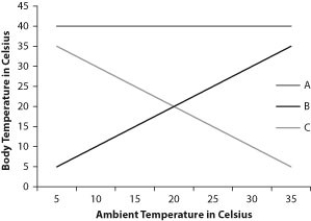
As an example of the relationship between structure and function the forward-facing eyes shared by all primates help them in
(Multiple Choice)
4.8/5 (83)
(83) ________ appears to have been the first hominin to use stone tools.
(Multiple Choice)
4.9/5 (87)
(87) The duck-billed platypus and other monotremes differ from other mammals in that they
(Multiple Choice)
4.9/5 (77)
(77) Amphibians were diverse and abundant in the lush swamp forests of the ________, which is sometimes referred to as the age of the amphibians.
(Multiple Choice)
4.8/5 (80)
(80)  Source: Parra, E. J., Kittles, R. A., & Shriver, M. D. (2004). Implications of correlations between skin color and genetic ancestry for biomedical research. Nature Genetics, 36, S54-S60.
-The graphs shown indicate the range of melanin amounts in the skin of populations from four different geographic regions. Which graph is likely to be from a geographic area where there is less UV radiation?
Source: Parra, E. J., Kittles, R. A., & Shriver, M. D. (2004). Implications of correlations between skin color and genetic ancestry for biomedical research. Nature Genetics, 36, S54-S60.
-The graphs shown indicate the range of melanin amounts in the skin of populations from four different geographic regions. Which graph is likely to be from a geographic area where there is less UV radiation? (Multiple Choice)
4.8/5 (69)
(69) The fossil "hobbits" discovered in Indonesia may be a ________ that lived ________.
(Multiple Choice)
4.9/5 (69)
(69) According to this figure, which two groups are most closely related? 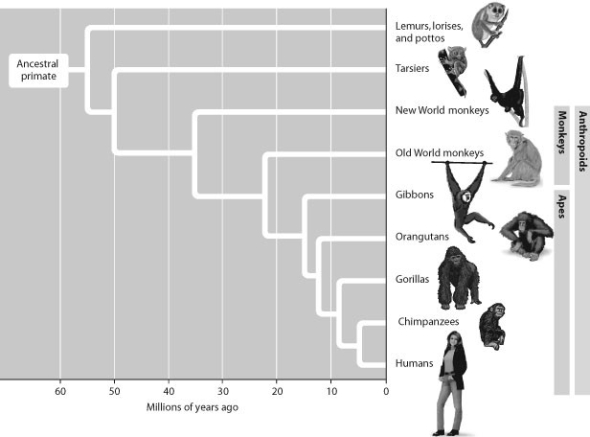
(Multiple Choice)
4.7/5 (76)
(76)  -Which clade is most directly related to lancelets?

Filters
- Essay(0)
- Multiple Choice(0)
- Short Answer(0)
- True False(0)
- Matching(0)