



 Chat with AI
Exam 27: Reproduction and Embryonic Development

Exam 1: Biology: Exploring Life47 Questions
Exam 2: The Chemical Basis of Life73 Questions
Exam 3: The Molecules of Cells89 Questions
Exam 4: A Tour of the Cell93 Questions
Exam 5: The Working Cell81 Questions
Exam 6: How Cells Harvest Chemical Energy82 Questions
Exam 7: Photosynthesis: Using Light to Make Food83 Questions
Exam 8: The Cellular Basis of Reproduction and Inheritance81 Questions
Exam 9: Patterns of Inheritance76 Questions
Exam 10: Molecular Biology of the Gene85 Questions
Exam 11: How Genes Are Controlled84 Questions
Exam 12: DNA Technology and Genomics80 Questions
Exam 13: How Populations Evolve67 Questions
Exam 14: The Origin of Species59 Questions
Exam 15: Tracing Evolutionary History88 Questions
Exam 16: Microbial Life: Prokaryotes and Protists80 Questions
Exam 17: The Evolution of Plant and Fungal Diversity85 Questions
Exam 18: The Evolution of Invertebrate Diversity81 Questions
Exam 19: The Evolution of Vertebrate Diversity77 Questions
Exam 20: Unifying Concepts of Animal Structure and Function68 Questions
Exam 21: Nutrition and Digestion96 Questions
Exam 22: Gas Exchange68 Questions
Exam 23: Circulation81 Questions
Exam 24: The Immune System76 Questions
Exam 25: Control of Body Temperature and Water Balance67 Questions
Exam 26: Hormones and the Endocrine System66 Questions
Exam 27: Reproduction and Embryonic Development88 Questions
Exam 28: Nervous Systems75 Questions
Exam 29: The Senses62 Questions
Exam 30: How Animals Move72 Questions
Exam 31: Plant Structure, Growth, and Reproduction81 Questions
Exam 32: Plant Nutrition and Transport69 Questions
Exam 33: Control Systems in Plants61 Questions
Exam 34: The Biosphere: an Introduction to Earths Diverse Environments61 Questions
Exam 35: Behavioral Adaptations to the Environment54 Questions
Exam 36: Population Ecology57 Questions
Exam 37: Communities and Ecosystems62 Questions
Exam 38: Conservation Biology61 Questions
Select questions type


Home pregnancy test kits can detect whether a woman is pregnant within 1 to 3 weeks of her egg being fertilized. The test kits include a short strip of paper that extends from a plastic case. After a woman urinates on the strip of paper and waits 3 to 5 minutes, a symbol is displayed on a small window in the plastic case. Some tests show a single line to indicate the woman is not pregnant (negative result) and two lines to indicate she is pregnant (positive result). Others show a minus or plus sign (or some other variation) to indicate negative and positive results.
The test reports a positive symbol if it detects the presence of HCG in the woman's urine. In order for HCG to be detected, it must be present in the urine at a concentration of at least 10 to 100 units per milliliter. Even though home pregnancy tests are well designed and have been tested extensively, false negative and false positive results do occur. A false positive occurs when a test tells a woman that she is pregnant when she really is not, and a false negative occurs when a test tells a woman that she is not pregnant when she really is. Most home pregnancy test kit manufacturers claim that their tests are over 99% accurate.
-What would be the best experiment for a manufacturer to conduct in order to determine the false positive rate of its test kits?
(Multiple Choice)
4.8/5  (68)
(68) Which statement about the reproductive system of human females is true?
(Multiple Choice)
4.8/5 (75)
(75) 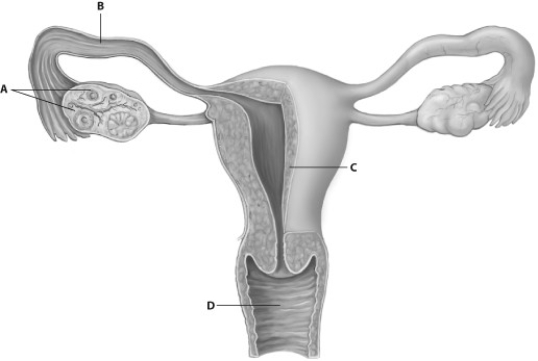 -In which part of the human female reproductive system does implantation normally take place?
 (Multiple Choice)
4.7/5 (79)
(79) Research indicates that ________ respond(s) to ________ signals that inform a cell about its position relative to other cells in the embryo.
(Multiple Choice)
4.9/5 (78)
(78) An advantage of human testes being positioned in an external sac rather than in the abdominal cavity is that the
(Multiple Choice)
4.9/5 (85)
(85) Which of the following STIs is caused by a virus that can also cause cancer?
(Multiple Choice)
4.9/5 (98)
(98) In a study of patients seeking assisted reproductive technology, researchers examined the level of FSH in each patient as well as the average number of oocytes they were able to retrieve. Here is an approximation of the data.
Older than 33 but Older than 38 but Younger than 33 younger than 37 younger than 41 Older than 41 FSH levels paseline =100\% 112\% 117\% 122\% Oocytes retrieved 8.8 7.5 4.7 3.2 Source: Adapted from Barad, D. H., Weghofer, A., and Gleicher, N. (2007). Age-specific levels for basal follicle-stimulating hormone assessment of ovarian function. Obstetrics & Gynecology, 109(6): 1404-1410.
-Based on these data what levels of FSH and oocytes retrieved would you predict for a woman who is postmenopausal?
(Multiple Choice)
4.9/5 (84)
(84) 
Filters
- Essay(0)
- Multiple Choice(0)
- Short Answer(0)
- True False(0)
- Matching(0)