



 Chat with AI
Exam 32: Plant Nutrition and Transport

Exam 1: Biology: Exploring Life47 Questions
Exam 2: The Chemical Basis of Life73 Questions
Exam 3: The Molecules of Cells89 Questions
Exam 4: A Tour of the Cell93 Questions
Exam 5: The Working Cell81 Questions
Exam 6: How Cells Harvest Chemical Energy82 Questions
Exam 7: Photosynthesis: Using Light to Make Food83 Questions
Exam 8: The Cellular Basis of Reproduction and Inheritance81 Questions
Exam 9: Patterns of Inheritance76 Questions
Exam 10: Molecular Biology of the Gene85 Questions
Exam 11: How Genes Are Controlled84 Questions
Exam 12: DNA Technology and Genomics80 Questions
Exam 13: How Populations Evolve67 Questions
Exam 14: The Origin of Species59 Questions
Exam 15: Tracing Evolutionary History88 Questions
Exam 16: Microbial Life: Prokaryotes and Protists80 Questions
Exam 17: The Evolution of Plant and Fungal Diversity85 Questions
Exam 18: The Evolution of Invertebrate Diversity81 Questions
Exam 19: The Evolution of Vertebrate Diversity77 Questions
Exam 20: Unifying Concepts of Animal Structure and Function68 Questions
Exam 21: Nutrition and Digestion96 Questions
Exam 22: Gas Exchange68 Questions
Exam 23: Circulation81 Questions
Exam 24: The Immune System76 Questions
Exam 25: Control of Body Temperature and Water Balance67 Questions
Exam 26: Hormones and the Endocrine System66 Questions
Exam 27: Reproduction and Embryonic Development88 Questions
Exam 28: Nervous Systems75 Questions
Exam 29: The Senses62 Questions
Exam 30: How Animals Move72 Questions
Exam 31: Plant Structure, Growth, and Reproduction81 Questions
Exam 32: Plant Nutrition and Transport69 Questions
Exam 33: Control Systems in Plants61 Questions
Exam 34: The Biosphere: an Introduction to Earths Diverse Environments61 Questions
Exam 35: Behavioral Adaptations to the Environment54 Questions
Exam 36: Population Ecology57 Questions
Exam 37: Communities and Ecosystems62 Questions
Exam 38: Conservation Biology61 Questions
Select questions type


The corporation Bayer produces an herbicide called Liberty and the LibertyLink soybean, a genetically modified soybean that is resistant to this herbicide. The genetic modification allows soybeans to produce a protein that is able to destroy the Liberty herbicide. Thus, when a farmer sprays the Liberty herbicide on a weed-infested field of LibertyLink soybeans, only susceptible weeds, and not the farmer's soybean crop, die. One weed that farmers would like to get rid of is dodder (Cuscuta pentagona) a plant that uses chemical cues to find other plants such as soybeans. When a soybean plant is found, dodder wraps its leafless stems around the soybean and uses modified roots to tap into the soybean's vascular system. Because of the physical connection between a soybean plant and dodder, scientists hypothesized that dodder could obtain substances from the soybean plant other than nutrients, sugar, and water. They predicted that dodder would be able to gain the protein that destroys the Liberty herbicide. They tested this hypothesis by growing dodder on LibertyLinksoybeans and then applying the Liberty herbicide to see if the dodder would die. Their results are displayed in the table.
Concentration of Herbicide (/) Treatment 0 0.36 0.72 3.6 Dodder on LibertyLink soybean Survived Survived Survived Died Dodder on normal soybean Survived Died Died Died Source: Adapted from Jiang, L., Qu, F., Li, Z., & Doohan, D. (2013). Inter‐species protein trafficking endows dodder (Cuscuta pentagona) with a host‐specific herbicide‐tolerant trait. New Phytologist, 198(4), 1017-1022.
-An alternative hypothesis to the translocation of the protein from the soybean to dodder is that the herbicide is translocated from the dodder to the soybean, and then the herbicide is destroyed in the soybean. What experimental results would rule out this alternative hypothesis?
(Multiple Choice)
4.8/5  (96)
(96) For water transport in vascular plants, the cohesive property of water is most important in the
(Multiple Choice)
4.8/5 (89)
(89) The corporation Bayer produces an herbicide called Liberty and the LibertyLink soybean, a genetically modified soybean that is resistant to this herbicide. The genetic modification allows soybeans to produce a protein that is able to destroy the Liberty herbicide. Thus, when a farmer sprays the Liberty herbicide on a weed-infested field of LibertyLink soybeans, only susceptible weeds, and not the farmer's soybean crop, die. One weed that farmers would like to get rid of is dodder (Cuscuta pentagona) a plant that uses chemical cues to find other plants such as soybeans. When a soybean plant is found, dodder wraps its leafless stems around the soybean and uses modified roots to tap into the soybean's vascular system. Because of the physical connection between a soybean plant and dodder, scientists hypothesized that dodder could obtain substances from the soybean plant other than nutrients, sugar, and water. They predicted that dodder would be able to gain the protein that destroys the Liberty herbicide. They tested this hypothesis by growing dodder on LibertyLinksoybeans and then applying the Liberty herbicide to see if the dodder would die. Their results are displayed in the table.
Concentration of Herbicide (/) Treatment 0 0.36 0.72 3.6 Dodder on LibertyLink soybean Survived Survived Survived Died Dodder on normal soybean Survived Died Died Died Source: Adapted from Jiang, L., Qu, F., Li, Z., & Doohan, D. (2013). Inter‐species protein trafficking endows dodder (Cuscuta pentagona) with a host‐specific herbicide‐tolerant trait. New Phytologist, 198(4), 1017-1022.
-Can the scientists conclude that the protein that destroys the herbicide is transferred to dodder from the soybean plant?
(Multiple Choice)
4.8/5 (80)
(80) Plants are sometimes used for phytoremediation in areas where the soil has been contaminated with heavy metals. Suppose the Acme Remediation Company is proposing to remediate a contaminated area that you wish to restore. Acme presents you with the following data as evidence of their company's ability to remediate soil.
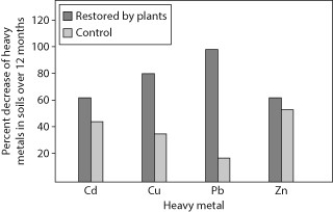 -According to the data, this remediation plan is most effective with which element?
 (Multiple Choice)
4.7/5 (77)
(77) Which option best describes the mechanism that causes a stoma to open?
(Multiple Choice)
4.9/5 (86)
(86) The term carnivorous as applied to carnivorous plants is not considered accurate by some biologists because
(Multiple Choice)
4.9/5 (81)
(81) Which list shows the set of plant macronutrients that make up about 98% of a plant's dry weight?
(Multiple Choice)
4.9/5 (84)
(84) 
Filters
- Essay(0)
- Multiple Choice(0)
- Short Answer(0)
- True False(0)
- Matching(0)