



 Chat with AI
Exam 32: Plant Nutrition and Transport

Exam 1: Biology: Exploring Life47 Questions
Exam 2: The Chemical Basis of Life73 Questions
Exam 3: The Molecules of Cells89 Questions
Exam 4: A Tour of the Cell93 Questions
Exam 5: The Working Cell81 Questions
Exam 6: How Cells Harvest Chemical Energy82 Questions
Exam 7: Photosynthesis: Using Light to Make Food83 Questions
Exam 8: The Cellular Basis of Reproduction and Inheritance81 Questions
Exam 9: Patterns of Inheritance76 Questions
Exam 10: Molecular Biology of the Gene85 Questions
Exam 11: How Genes Are Controlled84 Questions
Exam 12: DNA Technology and Genomics80 Questions
Exam 13: How Populations Evolve67 Questions
Exam 14: The Origin of Species59 Questions
Exam 15: Tracing Evolutionary History88 Questions
Exam 16: Microbial Life: Prokaryotes and Protists80 Questions
Exam 17: The Evolution of Plant and Fungal Diversity85 Questions
Exam 18: The Evolution of Invertebrate Diversity81 Questions
Exam 19: The Evolution of Vertebrate Diversity77 Questions
Exam 20: Unifying Concepts of Animal Structure and Function68 Questions
Exam 21: Nutrition and Digestion96 Questions
Exam 22: Gas Exchange68 Questions
Exam 23: Circulation81 Questions
Exam 24: The Immune System76 Questions
Exam 25: Control of Body Temperature and Water Balance67 Questions
Exam 26: Hormones and the Endocrine System66 Questions
Exam 27: Reproduction and Embryonic Development88 Questions
Exam 28: Nervous Systems75 Questions
Exam 29: The Senses62 Questions
Exam 30: How Animals Move72 Questions
Exam 31: Plant Structure, Growth, and Reproduction81 Questions
Exam 32: Plant Nutrition and Transport69 Questions
Exam 33: Control Systems in Plants61 Questions
Exam 34: The Biosphere: an Introduction to Earths Diverse Environments61 Questions
Exam 35: Behavioral Adaptations to the Environment54 Questions
Exam 36: Population Ecology57 Questions
Exam 37: Communities and Ecosystems62 Questions
Exam 38: Conservation Biology61 Questions
Select questions type


What form of nitrogen can most plants absorb and use directly?
(Multiple Choice)
4.7/5  (86)
(86) Carnivorous plants are more likely to be found in acid bogs because
(Multiple Choice)
4.8/5 (66)
(66) 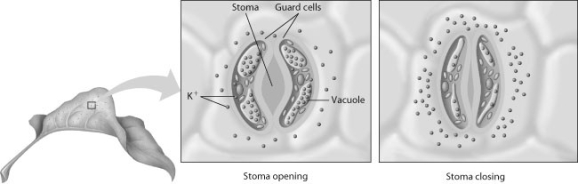 -Under what circumstances would guard cells look like those in the right panel?
 (Multiple Choice)
4.7/5 (70)
(70) Which condition would be most likely to cause stomata to open?
(Multiple Choice)
4.8/5 (74)
(74) The corporation Bayer produces an herbicide called Liberty and the LibertyLink soybean, a genetically modified soybean that is resistant to this herbicide. The genetic modification allows soybeans to produce a protein that is able to destroy the Liberty herbicide. Thus, when a farmer sprays the Liberty herbicide on a weed-infested field of LibertyLink soybeans, only susceptible weeds, and not the farmer's soybean crop, die. One weed that farmers would like to get rid of is dodder (Cuscuta pentagona) a plant that uses chemical cues to find other plants such as soybeans. When a soybean plant is found, dodder wraps its leafless stems around the soybean and uses modified roots to tap into the soybean's vascular system. Because of the physical connection between a soybean plant and dodder, scientists hypothesized that dodder could obtain substances from the soybean plant other than nutrients, sugar, and water. They predicted that dodder would be able to gain the protein that destroys the Liberty herbicide. They tested this hypothesis by growing dodder on LibertyLinksoybeans and then applying the Liberty herbicide to see if the dodder would die. Their results are displayed in the table.
Concentration of Herbicide (/) Treatment 0 0.36 0.72 3.6 Dodder on LibertyLink soybean Survived Survived Survived Died Dodder on normal soybean Survived Died Died Died Source: Adapted from Jiang, L., Qu, F., Li, Z., & Doohan, D. (2013). Inter‐species protein trafficking endows dodder (Cuscuta pentagona) with a host‐specific herbicide‐tolerant trait. New Phytologist, 198(4), 1017-1022.
-The modified roots of dodder grow into the stem of the host plant and into the host's xylem and phloem. Considering that water transport works the same in dodder as it does in other plants, trace the path of a single water molecule. Which list correctly orders the water molecule's path?
(Multiple Choice)
4.8/5 (85)
(85) A small seed may grow into a very large tree. As the tree grows, it adds a great deal of mass. Where does most of this mass come from?
(Multiple Choice)
4.9/5 (89)
(89) Legumes are frequently grown in rotation with primary field crops. What is the benefit of this practice?
(Multiple Choice)
4.9/5 (82)
(82) Under which weather condition would transpiration be most rapid?
(Multiple Choice)
4.9/5 (63)
(63) Which nitrogen-phosphorous-potassium ratio in a fertilizer would most likely solve the problem of yellowed leaves and stunted growth?
(Multiple Choice)
4.8/5 (77)
(77) The relationship between a plant and mycorrhizal fungi is best described as
(Multiple Choice)
4.9/5 (82)
(82) Plants are sometimes used for phytoremediation in areas where the soil has been contaminated with heavy metals. Suppose the Acme Remediation Company is proposing to remediate a contaminated area that you wish to restore. Acme presents you with the following data as evidence of their company's ability to remediate soil.
 -What likely caused the loss of metals in the control soil?
 (Multiple Choice)
4.8/5 (95)
(95) The corporation Bayer produces an herbicide called Liberty and the LibertyLink soybean, a genetically modified soybean that is resistant to this herbicide. The genetic modification allows soybeans to produce a protein that is able to destroy the Liberty herbicide. Thus, when a farmer sprays the Liberty herbicide on a weed-infested field of LibertyLink soybeans, only susceptible weeds, and not the farmer's soybean crop, die. One weed that farmers would like to get rid of is dodder (Cuscuta pentagona) a plant that uses chemical cues to find other plants such as soybeans. When a soybean plant is found, dodder wraps its leafless stems around the soybean and uses modified roots to tap into the soybean's vascular system. Because of the physical connection between a soybean plant and dodder, scientists hypothesized that dodder could obtain substances from the soybean plant other than nutrients, sugar, and water. They predicted that dodder would be able to gain the protein that destroys the Liberty herbicide. They tested this hypothesis by growing dodder on LibertyLinksoybeans and then applying the Liberty herbicide to see if the dodder would die. Their results are displayed in the table.
Concentration of Herbicide (/) Treatment 0 0.36 0.72 3.6 Dodder on LibertyLink soybean Survived Survived Survived Died Dodder on normal soybean Survived Died Died Died Source: Adapted from Jiang, L., Qu, F., Li, Z., & Doohan, D. (2013). Inter‐species protein trafficking endows dodder (Cuscuta pentagona) with a host‐specific herbicide‐tolerant trait. New Phytologist, 198(4), 1017-1022.
-With respect to translocation of sugars, a rapidly growing dodder plant is a ________ and the soybean plant is a ________.
(Multiple Choice)
5.0/5 (81)
(81) Which of the following are important in breaking down organic material in fertile topsoil?
(Multiple Choice)
4.8/5 (65)
(65) How do mineral ions get into the xylem cells of a plant root by way of the intracellular route?
(Multiple Choice)
4.9/5 (87)
(87) According to this figure, what can directly use atmospheric N2? 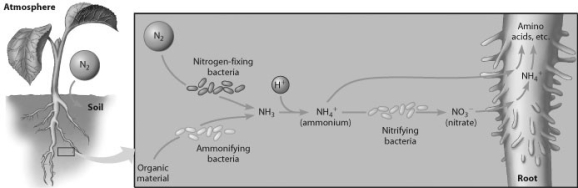
(Multiple Choice)
4.8/5 (75)
(75) 
Filters
- Essay(0)
- Multiple Choice(0)
- Short Answer(0)
- True False(0)
- Matching(0)