



 Chat with AI
Exam 4: A Tour of the Cell

Exam 1: Biology: Exploring Life47 Questions
Exam 2: The Chemical Basis of Life73 Questions
Exam 3: The Molecules of Cells89 Questions
Exam 4: A Tour of the Cell93 Questions
Exam 5: The Working Cell81 Questions
Exam 6: How Cells Harvest Chemical Energy82 Questions
Exam 7: Photosynthesis: Using Light to Make Food83 Questions
Exam 8: The Cellular Basis of Reproduction and Inheritance81 Questions
Exam 9: Patterns of Inheritance76 Questions
Exam 10: Molecular Biology of the Gene85 Questions
Exam 11: How Genes Are Controlled84 Questions
Exam 12: DNA Technology and Genomics80 Questions
Exam 13: How Populations Evolve67 Questions
Exam 14: The Origin of Species59 Questions
Exam 15: Tracing Evolutionary History88 Questions
Exam 16: Microbial Life: Prokaryotes and Protists80 Questions
Exam 17: The Evolution of Plant and Fungal Diversity85 Questions
Exam 18: The Evolution of Invertebrate Diversity81 Questions
Exam 19: The Evolution of Vertebrate Diversity77 Questions
Exam 20: Unifying Concepts of Animal Structure and Function68 Questions
Exam 21: Nutrition and Digestion96 Questions
Exam 22: Gas Exchange68 Questions
Exam 23: Circulation81 Questions
Exam 24: The Immune System76 Questions
Exam 25: Control of Body Temperature and Water Balance67 Questions
Exam 26: Hormones and the Endocrine System66 Questions
Exam 27: Reproduction and Embryonic Development88 Questions
Exam 28: Nervous Systems75 Questions
Exam 29: The Senses62 Questions
Exam 30: How Animals Move72 Questions
Exam 31: Plant Structure, Growth, and Reproduction81 Questions
Exam 32: Plant Nutrition and Transport69 Questions
Exam 33: Control Systems in Plants61 Questions
Exam 34: The Biosphere: an Introduction to Earths Diverse Environments61 Questions
Exam 35: Behavioral Adaptations to the Environment54 Questions
Exam 36: Population Ecology57 Questions
Exam 37: Communities and Ecosystems62 Questions
Exam 38: Conservation Biology61 Questions
Select questions type


What type of microscopy allowed scientists to visualize the cytoskeleton in living cells?
(Multiple Choice)
4.9/5  (80)
(80) Which of the following statements regarding the endomembrane system is false?
(Multiple Choice)
4.8/5 (68)
(68) It is essential for heart muscle cells to beat in a coordinated fashion. The cell junctions that would best facilitate this are
(Multiple Choice)
4.8/5 (85)
(85) A child dies following a series of chronic bacterial infections. At the autopsy, the physicians are startled to see that the child's white blood cells are loaded with vacuoles containing intact bacteria. Which of the following explanations could account for this finding?
(Multiple Choice)
4.8/5 (82)
(82) Which organelle is involved in the breakdown of fatty acids and the detoxification of alcohol?
(Multiple Choice)
4.8/5 (82)
(82) Which of the following statements about the functions of a plant cell central vacuole is false?
(Multiple Choice)
5.0/5 (80)
(80) Which of the following statements regarding cells is false?
(Multiple Choice)
4.8/5 (77)
(77) Which of the following statements regarding plasmodesmata is false?
(Multiple Choice)
4.8/5 (74)
(74) Studies of the endomembrane system often involve the use of a protein that can emit a green fluorescence (glow). A researcher wants to make a video of cell behavior, so she initially labels the outer nuclear envelope of a cell with the fluorescent tag and records a video for several hours. Later, she sees that the tag is part of a transport vesicle very close to the plasma membrane.
-The ability to stain protein molecules with a fluorescent dye would most clearly allow researchers to go beyond what they could previously detect with a microscope by allowing them to
(Multiple Choice)
4.9/5 (86)
(86) Which of the following would be most affected by a mutation that prevented cells from forming tight junctions?
(Multiple Choice)
4.8/5 (76)
(76) Studies of the endomembrane system often involve the use of a protein that can emit a green fluorescence (glow). A researcher wants to make a video of cell behavior, so she initially labels the outer nuclear envelope of a cell with the fluorescent tag and records a video for several hours. Later, she sees that the tag is part of a transport vesicle very close to the plasma membrane.
-The fluorescent tag likely did not become incorporated into which of the following organelles?
(Multiple Choice)
4.8/5 (69)
(69) Hexokinase is an enzyme that is involved with glycolysis (the breakdown of glucose for energy release) that occurs in the cytoplasm. What cellular structure makes hexokinase?
(Multiple Choice)
5.0/5 (74)
(74) 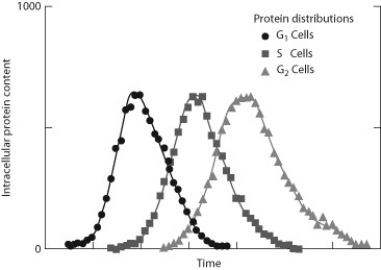 Much of the intracellular structure of a eukaryote cell is involved in protein synthesis. The accompanying figure shows the amounts of protein in cells at different parts of the cell cycle between two cell divisions. G1 is a stage just after the cell has divided, and G2 is the stage just before the cell divides again. S is a stage when the cell is synthesizing material such as DNA, mitochondria, and other organelles.
-The technique used to produce the data displayed might be useful for a cancer biologist who wishes to
Much of the intracellular structure of a eukaryote cell is involved in protein synthesis. The accompanying figure shows the amounts of protein in cells at different parts of the cell cycle between two cell divisions. G1 is a stage just after the cell has divided, and G2 is the stage just before the cell divides again. S is a stage when the cell is synthesizing material such as DNA, mitochondria, and other organelles.
-The technique used to produce the data displayed might be useful for a cancer biologist who wishes to (Multiple Choice)
4.9/5 (85)
(85) 
Filters
- Essay(0)
- Multiple Choice(0)
- Short Answer(0)
- True False(0)
- Matching(0)