



 Chat with AI
Exam 4: A Tour of the Cell

Exam 1: Biology: Exploring Life47 Questions
Exam 2: The Chemical Basis of Life73 Questions
Exam 3: The Molecules of Cells89 Questions
Exam 4: A Tour of the Cell93 Questions
Exam 5: The Working Cell81 Questions
Exam 6: How Cells Harvest Chemical Energy82 Questions
Exam 7: Photosynthesis: Using Light to Make Food83 Questions
Exam 8: The Cellular Basis of Reproduction and Inheritance81 Questions
Exam 9: Patterns of Inheritance76 Questions
Exam 10: Molecular Biology of the Gene85 Questions
Exam 11: How Genes Are Controlled84 Questions
Exam 12: DNA Technology and Genomics80 Questions
Exam 13: How Populations Evolve67 Questions
Exam 14: The Origin of Species59 Questions
Exam 15: Tracing Evolutionary History88 Questions
Exam 16: Microbial Life: Prokaryotes and Protists80 Questions
Exam 17: The Evolution of Plant and Fungal Diversity85 Questions
Exam 18: The Evolution of Invertebrate Diversity81 Questions
Exam 19: The Evolution of Vertebrate Diversity77 Questions
Exam 20: Unifying Concepts of Animal Structure and Function68 Questions
Exam 21: Nutrition and Digestion96 Questions
Exam 22: Gas Exchange68 Questions
Exam 23: Circulation81 Questions
Exam 24: The Immune System76 Questions
Exam 25: Control of Body Temperature and Water Balance67 Questions
Exam 26: Hormones and the Endocrine System66 Questions
Exam 27: Reproduction and Embryonic Development88 Questions
Exam 28: Nervous Systems75 Questions
Exam 29: The Senses62 Questions
Exam 30: How Animals Move72 Questions
Exam 31: Plant Structure, Growth, and Reproduction81 Questions
Exam 32: Plant Nutrition and Transport69 Questions
Exam 33: Control Systems in Plants61 Questions
Exam 34: The Biosphere: an Introduction to Earths Diverse Environments61 Questions
Exam 35: Behavioral Adaptations to the Environment54 Questions
Exam 36: Population Ecology57 Questions
Exam 37: Communities and Ecosystems62 Questions
Exam 38: Conservation Biology61 Questions
Select questions type


The ________ of a mitochondrion is/are an adaptation that increases the surface area and enhances a mitochondrion's ability to produce ATP.
(Multiple Choice)
4.9/5  (82)
(82)  Much of the intracellular structure of a eukaryote cell is involved in protein synthesis. The accompanying figure shows the amounts of protein in cells at different parts of the cell cycle between two cell divisions. G1 is a stage just after the cell has divided, and G2 is the stage just before the cell divides again. S is a stage when the cell is synthesizing material such as DNA, mitochondria, and other organelles.
-Which of these conclusions cannot reasonably be drawn from the graph?
Much of the intracellular structure of a eukaryote cell is involved in protein synthesis. The accompanying figure shows the amounts of protein in cells at different parts of the cell cycle between two cell divisions. G1 is a stage just after the cell has divided, and G2 is the stage just before the cell divides again. S is a stage when the cell is synthesizing material such as DNA, mitochondria, and other organelles.
-Which of these conclusions cannot reasonably be drawn from the graph? (Multiple Choice)
4.8/5 (81)
(81) Which of the following statements about the cytoskeleton is false?
(Multiple Choice)
4.9/5 (83)
(83) Which of the following statements about electron microscopes is true?
(Multiple Choice)
5.0/5 (66)
(66) Cyanide inhibits mitochondrial function; as a result, the rate of
(Multiple Choice)
4.9/5 (74)
(74) The endosymbiosis hypothesis is supported by all of the following pieces of evidence except the fact that
(Multiple Choice)
4.8/5 (80)
(80) Which of the following statements about cellular metabolism is false?
(Multiple Choice)
4.8/5 (100)
(100) A scanning electron microscope is used to study ________, whereas a transmission electron microscope is used to study ________.
(Multiple Choice)
4.8/5 (76)
(76) Microfilaments differ from microtubules in that microfilaments
(Multiple Choice)
4.7/5 (68)
(68) Which part of the mitochondrion shown enhances its ability to produce ATP by increasing the surface area of a mitochondrial membrane? 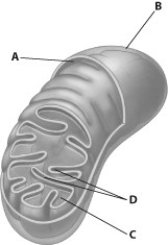
(Multiple Choice)
4.9/5 (80)
(80) The complex of proteins and DNA in a nondividing cell is called
(Multiple Choice)
4.8/5 (87)
(87) Which of the following structures is exclusively associated with prokaryotic cells?
(Multiple Choice)
4.8/5 (76)
(76) Studies of the endomembrane system often involve the use of a protein that can emit a green fluorescence (glow). A researcher wants to make a video of cell behavior, so she initially labels the outer nuclear envelope of a cell with the fluorescent tag and records a video for several hours. Later, she sees that the tag is part of a transport vesicle very close to the plasma membrane.
-What likely happened during the intervening time?
(Multiple Choice)
4.8/5 (84)
(84) 
Filters
- Essay(0)
- Multiple Choice(0)
- Short Answer(0)
- True False(0)
- Matching(0)