



 Chat with AI
Exam 6: How Cells Harvest Chemical Energy

Exam 1: Biology: Exploring Life47 Questions
Exam 2: The Chemical Basis of Life73 Questions
Exam 3: The Molecules of Cells89 Questions
Exam 4: A Tour of the Cell93 Questions
Exam 5: The Working Cell81 Questions
Exam 6: How Cells Harvest Chemical Energy82 Questions
Exam 7: Photosynthesis: Using Light to Make Food83 Questions
Exam 8: The Cellular Basis of Reproduction and Inheritance81 Questions
Exam 9: Patterns of Inheritance76 Questions
Exam 10: Molecular Biology of the Gene85 Questions
Exam 11: How Genes Are Controlled84 Questions
Exam 12: DNA Technology and Genomics80 Questions
Exam 13: How Populations Evolve67 Questions
Exam 14: The Origin of Species59 Questions
Exam 15: Tracing Evolutionary History88 Questions
Exam 16: Microbial Life: Prokaryotes and Protists80 Questions
Exam 17: The Evolution of Plant and Fungal Diversity85 Questions
Exam 18: The Evolution of Invertebrate Diversity81 Questions
Exam 19: The Evolution of Vertebrate Diversity77 Questions
Exam 20: Unifying Concepts of Animal Structure and Function68 Questions
Exam 21: Nutrition and Digestion96 Questions
Exam 22: Gas Exchange68 Questions
Exam 23: Circulation81 Questions
Exam 24: The Immune System76 Questions
Exam 25: Control of Body Temperature and Water Balance67 Questions
Exam 26: Hormones and the Endocrine System66 Questions
Exam 27: Reproduction and Embryonic Development88 Questions
Exam 28: Nervous Systems75 Questions
Exam 29: The Senses62 Questions
Exam 30: How Animals Move72 Questions
Exam 31: Plant Structure, Growth, and Reproduction81 Questions
Exam 32: Plant Nutrition and Transport69 Questions
Exam 33: Control Systems in Plants61 Questions
Exam 34: The Biosphere: an Introduction to Earths Diverse Environments61 Questions
Exam 35: Behavioral Adaptations to the Environment54 Questions
Exam 36: Population Ecology57 Questions
Exam 37: Communities and Ecosystems62 Questions
Exam 38: Conservation Biology61 Questions
Select questions type


Which of the following are products of cellular respiration?
(Multiple Choice)
4.8/5  (77)
(77) Most bats are inactive during the day (this is known as torpor) and feed during the night. The graph below shows hypothetical data for a bat species.
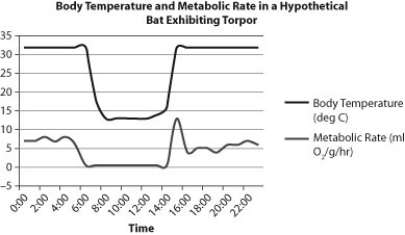 -Bats contain brown fat between their shoulder blades. How could this brown fat be an adaptation to torpor?
 (Multiple Choice)
4.8/5 (73)
(73) Which of the following metabolic pathways is common in aerobic and anaerobic metabolism?
(Multiple Choice)
4.8/5 (82)
(82) Humans use the calories they obtain from ________ as their source of energy.
(Multiple Choice)
4.9/5 (78)
(78) Most bats are inactive during the day (this is known as torpor) and feed during the night. The graph below shows hypothetical data for a bat species.
-Why does the relationship between metabolic rate and temperature exist?
-Why does the relationship between metabolic rate and temperature exist? (Multiple Choice)
4.8/5 (84)
(84) A friend tells you that he is going on a low-carb diet to lose weight because he thinks that carbs contain more energy than fats or protein. What would you tell your friend about his plan?
(Multiple Choice)
4.8/5 (81)
(81) Wood frogs freeze solid during the winter and then thaw in the spring. As the freezing progresses, blood circulation stops. How would you expect cells not being served by the circulatory system to produce ATP during this time, and what by-product would you expect to build up in the cells?
(Multiple Choice)
4.8/5 (87)
(87) A child is born with a rare disease in which mitochondria are missing from skeletal muscle cells. However, the muscles still function. Physicians find that the
(Multiple Choice)
4.8/5 (93)
(93) Rotenone is a poison commonly added to insecticides. Rotenone binds tightly with one of the electron carrier molecules in the electron transport chain, preventing electrons from passing to the next carrier molecule. Insects exposed to rotenone will die because
(Multiple Choice)
4.9/5 (71)
(71) Some friends are trying to make wine in their basement. They've added yeast to a sweet grape juice mixture and have allowed the yeast to grow. After several days they find that sugar levels in the grape juice have dropped, but there's no alcohol in the mixture. The most likely explanation is that the
(Multiple Choice)
4.9/5 (85)
(85) A student studying bird development recorded the mass of eggs from the time they were laid until the time they hatched in order to relate the mass of the egg to the final mass of the chick.
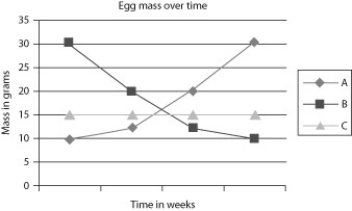 -Which of these is the correct explanation of mass change in developing eggs as illustrated in the graph?
 (Multiple Choice)
4.8/5 (64)
(64) Which H+ has just passed through the inner mitochondrial membrane by facilitated diffusion? 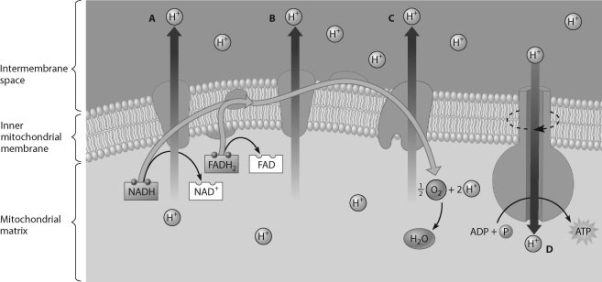
(Multiple Choice)
4.8/5 (80)
(80) When did the level of oxygen in Earth's atmosphere become high enough to sustain aerobic respiration?
(Multiple Choice)
4.9/5 (81)
(81) At the end of the citric acid cycle, most of the energy remaining from the original glucose is stored in
(Multiple Choice)
4.8/5 (92)
(92) How many molecules of NADH are produced during one round of glycolysis?
(Multiple Choice)
4.9/5 (77)
(77) NADH is also used by cells when making certain molecules. Based on your knowledge of the role of NADH in cellular respiration, what do you think NADH's role is in biosynthesis of molecules?
(Multiple Choice)
4.9/5 (85)
(85) 
Filters
- Essay(0)
- Multiple Choice(0)
- Short Answer(0)
- True False(0)
- Matching(0)