



 Chat with AI
Exam 4: Applications of Differentiation

Exam 1: Functions and Models118 Questions
Exam 2: Limits and Derivatives127 Questions
Exam 3: Differentiation Rules248 Questions
Exam 4: Applications of Differentiation273 Questions
Exam 5: Integrals239 Questions
Exam 6: Applications of Integration189 Questions
Exam 7: Differential Equations154 Questions
Exam 8: Infinite Sequences and Series341 Questions
Exam 9: Vectors and the Geometry of Space269 Questions
Exam 10: Vector Functions111 Questions
Exam 11: Partial Derivatives294 Questions
Exam 12: Multiple Integrals270 Questions
Exam 13: Vector Calculus240 Questions
Select questions type


Find each of the following limits or explain why it does not exist.(a) (b) (c)
(Short Answer)
4.9/5  (80)
(80) Find the value of the limit . Use L'Hospital's Rule, if applicable.
(Short Answer)
4.9/5 (82)
(82) Find the most general antiderivative of the function.(a) (b) (c) (d)
(Essay)
4.8/5 (79)
(79) Let . Use the graphs of f and to estimate, to two decimal places,
(a) the interval(s) where f is decreasing.(b) the interval(s) where f is concave upward.(c) the critical numbers of f .
(Essay)
4.9/5 (77)
(77) Find the value of the limit . Use L'Hospital's Rule, if applicable.
(Short Answer)
4.8/5 (63)
(63) Let .(a) Use your graphing calculator to graph f using the default viewing rectangle.(b) Find the critical points of f and use them to determine an appropriate viewing rectangle (or rectangles) for f. The graph f again using the viewing rectangle.(c) Compare the graphs in parts (a) and (b)
(Essay)
4.8/5 (76)
(76) Use the graph of f to estimate the value of c that satisfy the Mean Value Theorem for the interval . 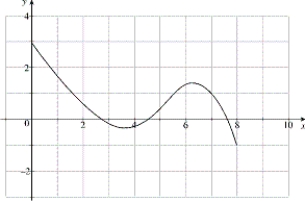
(Short Answer)
4.9/5 (74)
(74) Find the value of the limit . Use L'Hospital's Rule, if applicable.
(Short Answer)
4.8/5 (75)
(75) The graph of f is given below. 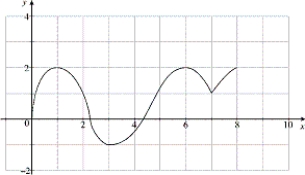 (a) Where is f increasing?
(b) Where is f decreasing?
(c) Where is f concave upward?
(d) Where is f concave downward?
(a) Where is f increasing?
(b) Where is f decreasing?
(c) Where is f concave upward?
(d) Where is f concave downward? (Essay)
4.8/5 (80)
(80) Amy is 2 miles offshore in a boat and wishes to reach a coastal village 6 miles down a straight shoreline from the point nearest to the boat. She can row 2 miles per hour and can walk 5 miles per hour. Where should she land her boat to reach the village in the least amount of time? How long will it take Amy to reach the village?
(Essay)
4.8/5 (87)
(87) Find the x-coordinate of the point of inflection of the function .
(Multiple Choice)
4.8/5 (83)
(83) Find the distance between the two critical numbers of the function .
(Multiple Choice)
4.9/5 (80)
(80) A particle moves along the curve . If x increases at a rate 8 units per minute, at what rate is y changing when ?
(Multiple Choice)
4.7/5 (84)
(84) A drinking cup is made in the shape of a right circular cylinder. For a fixed volume, we wish to make the total material used (the circular bottom and the cylindrical side) as small as possible. Under this condition, what is the ratio of the height to the diameter?
(Short Answer)
4.7/5 (85)
(85) The graph of the derivative of of a function f(x) is given below. 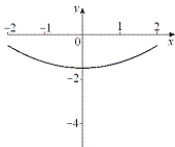 Sketch a possible graph of on the interval such that . On your graph, label the critical point(s) and inflection point(s).
 (Essay)
4.7/5 (83)
(83) Sketch the graph of on . For each initial approximation given below, determine graphically what happens if Newton's Method is used to approximate the roots of .(a) (b) (c) (d) (e)
(Essay)
4.9/5 (74)
(74) What is the length of the largest interval on which the function is increasing?
(Multiple Choice)
4.8/5 (81)
(81) 
Filters
- Essay(0)
- Multiple Choice(0)
- Short Answer(0)
- True False(0)
- Matching(0)