



 Chat with AI
Exam 4: Applications of Differentiation

Exam 1: Functions and Models118 Questions
Exam 2: Limits and Derivatives127 Questions
Exam 3: Differentiation Rules248 Questions
Exam 4: Applications of Differentiation273 Questions
Exam 5: Integrals239 Questions
Exam 6: Applications of Integration189 Questions
Exam 7: Differential Equations154 Questions
Exam 8: Infinite Sequences and Series341 Questions
Exam 9: Vectors and the Geometry of Space269 Questions
Exam 10: Vector Functions111 Questions
Exam 11: Partial Derivatives294 Questions
Exam 12: Multiple Integrals270 Questions
Exam 13: Vector Calculus240 Questions
Select questions type


Use Newton's method to approximate the root of that lies between and .
(Multiple Choice)
4.8/5  (90)
(90) A cyclist traveling at 40 ft/s decelerates at a constant 4 ft/s . How many feet does she travel before coming to a complete stop?
(Short Answer)
4.9/5 (63)
(63) Find the absolute minimum and maximum values of the function on the closed interval .
(Multiple Choice)
4.8/5 (84)
(84) The graph of the derivative of of a function f(x) is given below. 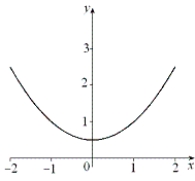 Sketch a possible graph of on the interval such that . On your graph, label the critical point(s) and inflection point(s).
 (Essay)
4.9/5 (76)
(76) At what rate is the volume of a cube increasing if its edges are 2 inches and are increasing at a rate 3 inches per minute?
(Multiple Choice)
4.9/5 (80)
(80) Choose the correct statement: If f(x) is continuous on (1, 3) then
(i) f(x) has no critical point over the interval.(ii) f(x) has no extreme value over the interval.(iii) f(x) might have extreme value over the interval.
(Short Answer)
5.0/5 (74)
(74) The graph of f is given below. 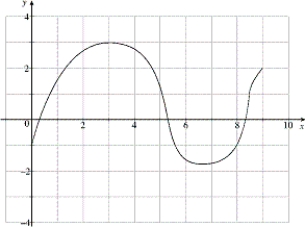 (a) Where is f increasing?
(b) Where is f decreasing?
(c) Where is f concave upward?
(d) Where is f concave downward?
(a) Where is f increasing?
(b) Where is f decreasing?
(c) Where is f concave upward?
(d) Where is f concave downward? (Essay)
4.7/5 (75)
(75) Find the difference between the local maximum and the local minimum values of the function .
(Multiple Choice)
4.9/5 (79)
(79) 
Filters
- Essay(0)
- Multiple Choice(0)
- Short Answer(0)
- True False(0)
- Matching(0)