



 Chat with AI
Exam 4: Applications of Differentiation

Exam 1: Functions and Models118 Questions
Exam 2: Limits and Derivatives127 Questions
Exam 3: Differentiation Rules248 Questions
Exam 4: Applications of Differentiation273 Questions
Exam 5: Integrals239 Questions
Exam 6: Applications of Integration189 Questions
Exam 7: Differential Equations154 Questions
Exam 8: Infinite Sequences and Series341 Questions
Exam 9: Vectors and the Geometry of Space269 Questions
Exam 10: Vector Functions111 Questions
Exam 11: Partial Derivatives294 Questions
Exam 12: Multiple Integrals270 Questions
Exam 13: Vector Calculus240 Questions
Select questions type


The graph of the first derivative of a function f is given below. 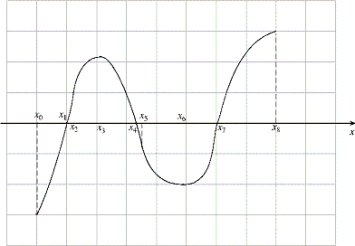 (a) On what intervals is f increasing? Explain.(b) At what values of x does f have a local maximum and local minimum? Explain.(c) On what intervals is f concave up? concave down? Explain
(d) Where are the coordinates of the inflection points of f? Explain
(a) On what intervals is f increasing? Explain.(b) At what values of x does f have a local maximum and local minimum? Explain.(c) On what intervals is f concave up? concave down? Explain
(d) Where are the coordinates of the inflection points of f? Explain (Essay)
5.0/5  (94)
(94) While driving through a certain state, a tourist passed through a turnpike toll booth and got a ticket punched for 2:10 p.m. Down the road 74 miles, the tourist exited the turnpike and handed in his ticket which was punched at 3:05 p.m. In addition to the toll amount, he was handed a speeding ticket for driving in excess of 80 miles per hour in a 65 mph zone. Is the speeding ticket justifiable? Explain.
(Essay)
4.8/5 (85)
(85) A large, closed shipping container with a square base is to be made from 1000 square feet of fiberboard. Find the dimensions of the container with the greatest volume.
(Essay)
4.8/5 (81)
(81) A custard pie is thrown vertically up from the ground with velocity 48 ft/s. Find the greatest height that it attains.
(Short Answer)
4.9/5 (68)
(68) A hot air balloon is rising vertically. An observer on the ground is 2000 meters from the point where the balloon took off. The angle between the ground and the observer's line of sight increases at a rate of when the balloon reaches a height of 3000 meters. How fast is the balloon rising at that moment?
(Short Answer)
4.8/5 (80)
(80) Sketch the graph of on the interval . Suppose that Newton's method is used to approximate the positive root of f with initial approximation .(a) On your sketch, draw the tangent lines that you would use to find and , and estimate the numerical values of and .(b) To approximate the negative root of f, use as the starting approximation. As before, draw the tangent lines that you would use to find and , and estimate the numerical values of and .(c) Suppose that you had used as the starting point for approximating the negative root. Discuss what would happen.
(Essay)
4.9/5 (78)
(78) Find the critical number(s) (if any) and test them to determine if has a local maximum or local minimum or neither at each critical number.
(Essay)
4.8/5 (88)
(88) Find the value of the limit . Use L'Hospital's Rule, if applicable.
(Short Answer)
4.9/5 (80)
(80) Find the critical number(s) (if any) and test them to determine if has a local maximum or local minimum or neither at each critical number.
(Essay)
4.9/5 (83)
(83) Find the most general antiderivative of the function.(a) (b) (c) (d)
(Essay)
4.8/5 (81)
(81) A direction field for a function f is given below. Use this to sketch the antiderivative F that satisfies . 
(Essay)
4.7/5 (82)
(82) A company has cost function . Find:
(a) The average cost function.(b) The marginal cost function.(c) The production level x that will minimize the average cost.(d) The minimum average cost.
(Essay)
4.8/5 (84)
(84) A ladder 10 feet long is leaning against a wall. If the top of the ladder is sliding down the wall at 4 feet per second, how fast is the foot of the ladder being pulled away from the wall when the foot of the ladder is 8 feet away from the wall?
(Multiple Choice)
4.9/5 (77)
(77) Choose the correct statement: If f(x) is not continuous on [1, 3] then
(i) f(x) has no critical point over the interval.(ii) f(x) has no extreme value over the interval.(iii) f(x) might have extreme value over the interval.
(Short Answer)
4.9/5 (83)
(83) 
Filters
- Essay(0)
- Multiple Choice(0)
- Short Answer(0)
- True False(0)
- Matching(0)