



 Chat with AI
Exam 12: Compensation

Exam 1: An Introduction to Tax110 Questions
Exam 2: Tax Compliance, the Irs, and Tax Authorities111 Questions
Exam 3: Tax Planning Strategies and Related Limitations115 Questions
Exam 4: Individual Income Tax Overview, Exemptions, and Filing Status126 Questions
Exam 5: Gross Income and Exclusions131 Questions
Exam 6: Individual Deductions114 Questions
Exam 7: Investments76 Questions
Exam 8: Individual Income Tax Computation and Tax Credits157 Questions
Exam 9: Business Income, Deductions, and Accounting Methods99 Questions
Exam 10: Property Acquisition and Cost Recovery107 Questions
Exam 11: Property Dispositions110 Questions
Exam 12: Compensation102 Questions
Exam 13: Retirement Savings and Deferred Compensation115 Questions
Exam 14: Tax Consequences of Home Ownership112 Questions
Exam 15: Entities Overview70 Questions
Exam 16: Corporate Operations138 Questions
Exam 17: Accounting for Income Taxes100 Questions
Exam 18: Corporate Taxation: Nonliquidating Distributions100 Questions
Exam 19: Corporate Formation, Reorganization, and Liquidation100 Questions
Exam 20: Forming and Operating Partnerships100 Questions
Exam 21: Dispositions of Partnership Interests and Partnership Distributions100 Questions
Exam 22: S Corporations134 Questions
Exam 23: State and Local Taxes117 Questions
Exam 24: The Us Taxation of Multinational Transactions100 Questions
Exam 25: Transfer Taxes and Wealth Planning123 Questions
Select questions type


Employers always prefer to award incentive stock options rather than nonqualified stock options.
(True/False)
4.9/5  (77)
(77) An employer always receives a deduction for total compensation paid to a CEO.
(True/False)
4.8/5 (74)
(74) Current compensation is usually comprised of salary, wages, and bonuses.
(True/False)
4.8/5 (73)
(73) Which of the following is not a requirement of a "qualified employee discount"?
(Multiple Choice)
5.0/5 (73)
(73) Tasha receives reimbursement from her employer for dependent care expenses for up to $8,000. Tasha applies for and receives reimbursement of $6,000 for her 10 year old son. How much, if any, is includible in her income?
(Multiple Choice)
4.8/5 (82)
(82) Suzanne received 20 ISOs (each option gives her the right to purchase 20 shares of stock for $12 per share) at the time she started working when the stock price was $13 per share. Three years later, when the share price was $23 per share, she exercised all of her options. If Suzanne holds the shares for ten additional months and sells them when the market price is $30, how much gain will Suzanne recognize on the sale and how much tax will she pay assuming her marginal tax rate is 35 percent?
(Short Answer)
4.8/5 (79)
(79) Grace's employer is now offering group-term life insurance. The company will provide each employee with $200,000 of group-term life insurance. It costs Grace's employer $700 to provide this amount of insurance to Grace each year. Assuming that Grace is 43 years old, use the table to determine the monthly premium that Grace must include in income as a result of receiving the group-term life benefit. 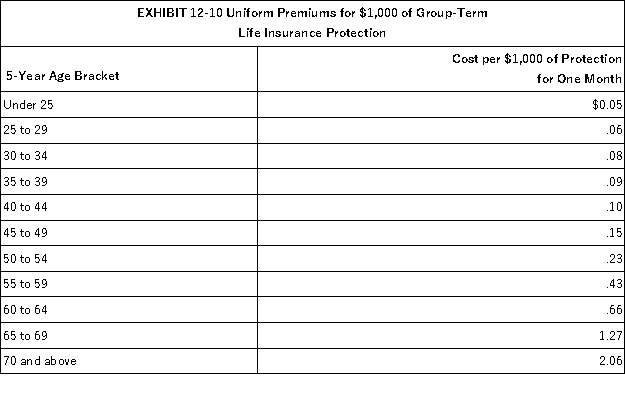
(Multiple Choice)
4.9/5 (58)
(58) One purpose of Form W-4 is to determine an employee's withholding.
(True/False)
4.8/5 (80)
(80) Hazel received 20 NQOs (each option gives her the right to purchase 10 shares of stock for $7 per share) at the time she started working when the stock price was $14 per share. Now that the share price is $20 per share, she intends to exercise all of her options. How much income will Hazel recognize on the exercise date and how much tax will she pay assuming her marginal tax rate is 25 percent?
(Short Answer)
4.7/5 (87)
(87) Rick recently received 500 shares of restricted stock from his employer, Crazy Corporation, when the share price was $5 per share. Rick's restricted shares vested three years later when the market price was $12. Rick held the shares for a little more than a year after vesting and sold them when the market price was $15. What is the amount of Rick's compensation income if Rick made an election under section 83(b) when the stock was granted? Assuming a marginal tax rate of 30 percent, what is the amount of Rick's ordinary income amount and tax liability at the time of the income inclusion?
(Short Answer)
4.7/5 (81)
(81) The date on which stock options are given to the employee is called the exercise date.
(True/False)
4.7/5 (76)
(76) Bonnie's employer provides her with an annual dinner club membership costing $5,000. Her marginal tax rate is 25 percent. Her employer has a marginal tax rate of 35 percent. What is Bonnie's after-tax benefit?
(Multiple Choice)
4.8/5 (84)
(84) Tanya's employer offers a cafeteria plan that allows employees to choose among a number of benefits. Each employee is allowed $6,000 in benefits. For 2016, Tanya selected $3,300 ($275 per month) of parking, $2,200 in 401(k) contributions, and $800 of cash. How much must Tanya include in taxable income?
(Multiple Choice)
4.8/5 (75)
(75) Rick recently received 500 shares of restricted stock from his employer, Crazy Corporation, when the share price was $5 per share. Rick's restricted shares vested three years later when the market price was $12. Rick held the shares for a little more than a year and sold them when the market price was $15. What is the amount of Rick's income on the sale of the stock? Assuming a marginal tax rate of 39.6 percent, what is Rick's tax on the sale of the stock?
(Short Answer)
4.8/5 (86)
(86) Corinne's employer offers a cafeteria plan that allows employees to choose among a number of benefits. Each employee is allowed $12,000 in benefits. For the current year, Corinne selected $4,500 of health insurance, $5,500 of dependent care, $1,000 in 401(k) contributions, and $1,000 of cash. How much must Corinne include in taxable income?
(Short Answer)
4.8/5 (72)
(72) Annika's employer provides only its executives with parking benefits. The fair market value of the annual parking benefit is $4,800 ($400 per month). What is the amount Annika must include into income with respect to her parking benefit in 2016?
(Short Answer)
4.7/5 (88)
(88) Stevie recently received 1,000 shares of restricted stock from her employer, Nicks Corporation, when the share price was $8 per share. Stevie's restricted shares vested three years later when the market price was $11. Stevie held the shares for a little more than a year and sold them when the market price was $16. Assuming Stevie made a section 83(b) election, what is the amount of Stevie's ordinary income with respect to the restricted stock?
(Multiple Choice)
4.9/5 (90)
(90) Up to $5,250 of educational benefits can be excluded from an employee's compensation.
(True/False)
4.8/5 (71)
(71) Which of the following is not an example of a taxable fringe benefit?
(Multiple Choice)
4.8/5 (70)
(70) 
Filters
- Essay(0)
- Multiple Choice(0)
- Short Answer(0)
- True False(0)
- Matching(0)