



 Chat with AI
Exam 15: Entities Overview

Exam 1: An Introduction to Tax110 Questions
Exam 2: Tax Compliance, the Irs, and Tax Authorities111 Questions
Exam 3: Tax Planning Strategies and Related Limitations115 Questions
Exam 4: Individual Income Tax Overview, Exemptions, and Filing Status126 Questions
Exam 5: Gross Income and Exclusions131 Questions
Exam 6: Individual Deductions114 Questions
Exam 7: Investments76 Questions
Exam 8: Individual Income Tax Computation and Tax Credits157 Questions
Exam 9: Business Income, Deductions, and Accounting Methods99 Questions
Exam 10: Property Acquisition and Cost Recovery107 Questions
Exam 11: Property Dispositions110 Questions
Exam 12: Compensation102 Questions
Exam 13: Retirement Savings and Deferred Compensation115 Questions
Exam 14: Tax Consequences of Home Ownership112 Questions
Exam 15: Entities Overview70 Questions
Exam 16: Corporate Operations138 Questions
Exam 17: Accounting for Income Taxes100 Questions
Exam 18: Corporate Taxation: Nonliquidating Distributions100 Questions
Exam 19: Corporate Formation, Reorganization, and Liquidation100 Questions
Exam 20: Forming and Operating Partnerships100 Questions
Exam 21: Dispositions of Partnership Interests and Partnership Distributions100 Questions
Exam 22: S Corporations134 Questions
Exam 23: State and Local Taxes117 Questions
Exam 24: The Us Taxation of Multinational Transactions100 Questions
Exam 25: Transfer Taxes and Wealth Planning123 Questions
Select questions type


From a tax perspective, which entity choice is preferred when a liquidating distribution occurs and the entity has appreciated assets?

Free
(Multiple Choice)
4.9/5  (82)
(82) Correct Answer: Verified
D
Rodger owns 100% of the shares in Trevor Inc., a C corporation. Assume the following for the current year:  Given these assumptions, how much cash does Rodger have from the dividend after all taxes have been paid?
Free
(Essay)
4.9/5 (65)
(65) Correct Answer:Verified
Verified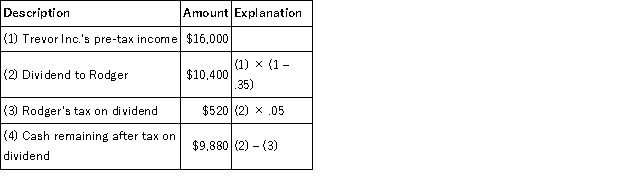
Taylor would like to organize DRK as either an LLC or as a C corporation generating a 13 percent annual before-tax rate of return on a $250,000 investment. Individual and corporate tax rates are both 30 percent and individual capital gains and dividends tax rates are 5 percent. DRK will distribute its earnings annually to either its members or shareholders.
a. Ignoring self-employment taxes, how much would Taylor keep after taxes if DRK is organized as either an LLC or as a C corporation?
b. Ignoring self-employment taxes, what are the overall (combined owner and entity level) tax rates if DRK is organized as either an LLC or as a C corporation?
Free
(Essay)
4.9/5 (87)
(87) Correct Answer:Verified
Verified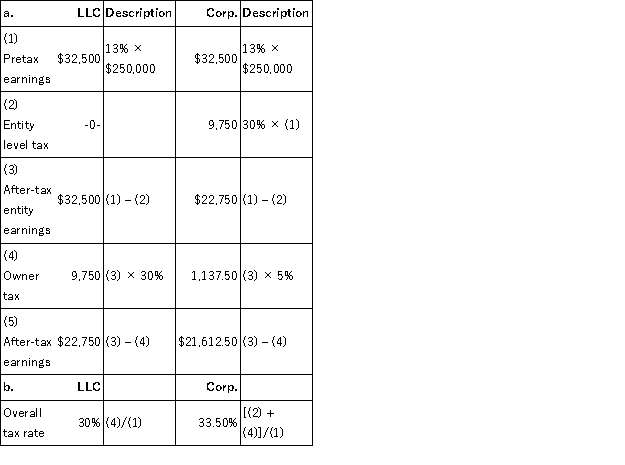
All unincorporated entities are generally treated as flow-through entities for tax purposes.
(True/False)
4.9/5 (65)
(65) When an employee/shareholder receives an income allocation from an S corporation, what taxes apply to the income allocation?
(Multiple Choice)
4.8/5 (71)
(71) Tuttle Corporation (a C corporation) projects that it will have taxable income for the year of $300,000 before incurring any interest expense. Assume Tuttle's tax rate is 35 percent.
a. What is the amount of the combined corporate and shareholder level tax on the $300,000 of pre-interest expense earnings if Ruth, Tuttle's sole shareholder, lends Tuttle Corporation $100,000 at the beginning of the year, Tuttle pays Ruth $10,000 of interest on the loan (interest is considered to be reasonable), and Tuttle distributes all of its after-tax earnings to Ruth? Assume her ordinary marginal rate is 33 percent and dividend tax rate is 15 percent.
b. Assume the same facts as in part a except that the IRS determines that the fair market value of the interest should be $8,000. What is the amount of the combined corporate and shareholder level tax on Tuttle Corporation's pre-interest expense earnings?
(Essay)
4.9/5 (89)
(89) Generally, which of the following flow-through entities can elect to be treated as a C corporation?
(Multiple Choice)
4.9/5 (77)
(77) Corporations are legally better suited for taking a business public compared with LLCs and general partnerships.
(True/False)
4.8/5 (76)
(76) Which of the following legal entities are generally classified as C corporations for tax purposes?
(Multiple Choice)
4.8/5 (86)
(86) From a tax perspective, which entity choice is preferred when a liquidating distribution occurs and the entity has assets that have declined in value?
(Multiple Choice)
4.9/5 (68)
(68) Roberto and Reagan are both 25 percent owner/managers for Bright Light Enterprises. Roberto runs the retail store in Sacramento, CA, and Reagan runs the retail store in San Francisco, CA. Bright Light generated a $125,000 profit companywide made up of a $75,000 profit from the Sacramento store, a ($25,000) loss from the San Francisco store, and a combined $75,000 profit from the remaining stores. If Bright Light is taxed as a partnership and decides that Roberto and Reagan will be allocated 70 percent of his own store's profit with the remaining profits allocated pro rata among all the owners, how much income will be allocated to Reagan?
(Multiple Choice)
4.9/5 (82)
(82) Which of the following legal entities file documents with the state to be formally recognized by the state?
(Multiple Choice)
4.9/5 (73)
(73) Crocker and Company, Inc. had taxable income of $550,000. At the end of the year, it distributes all its after-tax earnings to Jimmy, the company's sole shareholder. Jimmy's marginal ordinary tax rate is 34 percent and his marginal tax rate on dividends is 15 percent. What is the overall tax rate on Crocker and Company's pre-tax income?
(Multiple Choice)
4.7/5 (89)
(89) For the current year, Creative Designs Inc., a C corporation, reports taxable income of $300,000 before paying salary to Ben the sole shareholder of Creative Designs Inc. (CD). Ben's marginal tax rate on ordinary income is 28 percent and 15 percent on dividend income. Assume CD's tax rate is 39 percent.
a. How much total income tax will Creative Designs and Ben pay on the $300,000 taxable income for the year if CD doesn't pay any salary to Ben and instead distributes all of its after-tax income to Ben as a dividend?
b. How much total income tax will Creative Designs and Ben pay on the $300,000 of income if CD pays Ben a salary of $100,000 and distributes its remaining after-tax earnings to Ben as a dividend?
c. Compare your answer in part a. with your answer to part b. Explain why these numbers are different.
(Essay)
4.9/5 (85)
(85) On which form is income from a single member LLC with one corporate (C corporation) owner reported?
(Multiple Choice)
4.9/5 (88)
(88) Which legal entity is generally best suited for going public?
(Multiple Choice)
4.9/5 (83)
(83) S corporations have more restrictive ownership requirements than other entities.
(True/False)
4.8/5 (78)
(78) Sole proprietorships are not treated as legal entities separate from their individual owners.
(True/False)
4.7/5 (80)
(80) If PST Corporation is a shareholder of MNO Corporation, how many levels of tax is MNO's pre-tax income potentially exposed to?
(Multiple Choice)
4.7/5 (80)
(80) In its first year of existence, BYC Corporation (a C corporation) reported a loss for tax purposes of ($40,000). How much tax will BYC pay in year 2 if it reports taxable income from operations of $35,000 in year 2 before any loss carryovers?
(Essay)
5.0/5 (75)
(75) 
Filters
- Essay(0)
- Multiple Choice(0)
- Short Answer(0)
- True False(0)
- Matching(0)