



 Chat with AI
Exam 7: Investments

Exam 1: An Introduction to Tax110 Questions
Exam 2: Tax Compliance, the Irs, and Tax Authorities111 Questions
Exam 3: Tax Planning Strategies and Related Limitations115 Questions
Exam 4: Individual Income Tax Overview, Exemptions, and Filing Status126 Questions
Exam 5: Gross Income and Exclusions131 Questions
Exam 6: Individual Deductions114 Questions
Exam 7: Investments76 Questions
Exam 8: Individual Income Tax Computation and Tax Credits157 Questions
Exam 9: Business Income, Deductions, and Accounting Methods99 Questions
Exam 10: Property Acquisition and Cost Recovery107 Questions
Exam 11: Property Dispositions110 Questions
Exam 12: Compensation102 Questions
Exam 13: Retirement Savings and Deferred Compensation115 Questions
Exam 14: Tax Consequences of Home Ownership112 Questions
Exam 15: Entities Overview70 Questions
Exam 16: Corporate Operations138 Questions
Exam 17: Accounting for Income Taxes100 Questions
Exam 18: Corporate Taxation: Nonliquidating Distributions100 Questions
Exam 19: Corporate Formation, Reorganization, and Liquidation100 Questions
Exam 20: Forming and Operating Partnerships100 Questions
Exam 21: Dispositions of Partnership Interests and Partnership Distributions100 Questions
Exam 22: S Corporations134 Questions
Exam 23: State and Local Taxes117 Questions
Exam 24: The Us Taxation of Multinational Transactions100 Questions
Exam 25: Transfer Taxes and Wealth Planning123 Questions
Select questions type


What is the correct order of the loss limitation rules?

Free
(Multiple Choice)
4.8/5  (79)
(79) Correct Answer: Verified
A
John holds a taxable bond and a municipal bond. Which fees are considered part of John's investment expense?
Free
(Multiple Choice)
4.8/5 (80)
(80) Correct Answer:Verified
VerifiedB
Scott Bean is a computer programmer and incurred the following transactions last year. 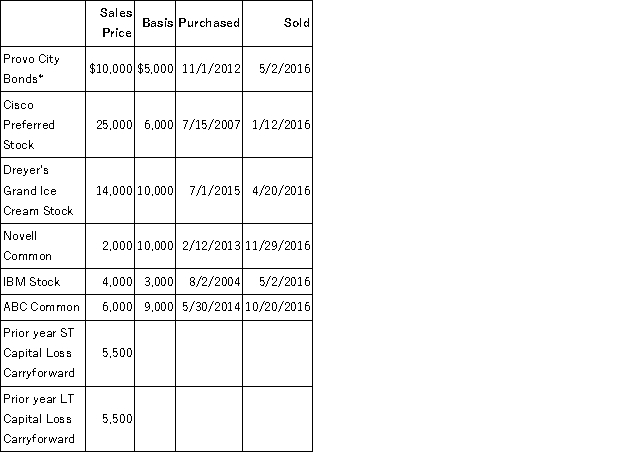 *Purchased when originally issued by Provo City
What is the Net Short-Term Capital Gain/Loss reported on the 2016 Schedule D? What is the Net Long-Term Capital Gain/Loss reported on the 2016 Schedule D? What amount of capital gain is subject to the preferential capital gains rate?
*Purchased when originally issued by Provo City
What is the Net Short-Term Capital Gain/Loss reported on the 2016 Schedule D? What is the Net Long-Term Capital Gain/Loss reported on the 2016 Schedule D? What amount of capital gain is subject to the preferential capital gains rate?Free
(Essay)
4.8/5 (92)
(92) Correct Answer:Verified
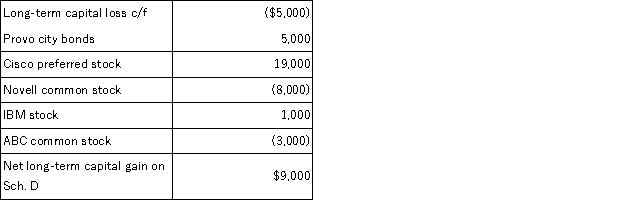
Verified$1,500 net short-term capital loss is reported on Schedule D, $9,000 net long-term capital gain is reported on Schedule D, and $7,500 of net capital gain is subject to the preferential capital gains rates.
Explanation: See calculations below: 

Ms. Fresh bought 1,000 shares of Ibis Corporation stock for $5,000 on January 15, 2014. On December 31, 2016 she sold all 1,000 shares of her Ibis stock for $4,500. Based on a hot tip from her friend, she bought 1,000 shares of Ibis stock on January 23, 2017 for $3,000. What is Ms. Fresh's recognized loss on her 2016 sale and what is her basis in her 1,000 shares purchased in 2017?
(Multiple Choice)
4.9/5 (81)
(81) Generally, interest income is taxed at preferential capital gains rates and dividend income is taxed at ordinary rates.
(True/False)
4.9/5 (88)
(88) Bob Brain files a single tax return and decides to itemize his deductions. Bob's income for the year consists of $75,000 of salary, $3,000 long-term capital gain, and $1,500 interest income. Bob's expenses for the year consists of $800 investment advice fees, $700 unreimbursed employee business expenses (a miscellaneous itemized deduction), and $250 tax return preparation fees. What is Bob's actual deduction for miscellaneous itemized deductions?
(Multiple Choice)
5.0/5 (80)
(80) Investment expenses treated as miscellaneous itemized deductions do not include:
(Multiple Choice)
4.7/5 (83)
(83) What is the tax treatment for qualified small business stock acquired in 2016 and held for more than five years and what is the tax treatment if held for less than five years?
(Essay)
4.8/5 (75)
(75) Kevin bought 200 shares of Intel stock on January 1, 2016 for $50 per share with a brokerage fee of $100. Then, Kevin sells all 200 shares for $75 per share on December 12, 2016. The brokerage fee on the sale was $150. What is the amount of the gain/loss Kevin must report on his 2016 tax return?
(Multiple Choice)
4.8/5 (69)
(69) Sue invested $5,000 in the ABC Limited Partnership and received a 10 percent interest in the partnership. The partnership had $20,000 of qualified nonrecourse debt and $20,000 of debt she is not responsible to repay because she is a limited partner. Sue is allocated a 10 percent share of both types of debt resulting in a tax basis of $9,000 and an at risk amount of $7,000. During the year, ABC LP generated a ($90,000) loss. How much of Sue's loss is disallowed due to her tax basis or at-risk amount?
(Multiple Choice)
4.8/5 (82)
(82) Which of the following is not a tax advantage of a Series EE Saving Bond?
(Multiple Choice)
4.8/5 (82)
(82) Cory recently sold his qualified small business stock (acquired in 2016) for $90,000 after holding it for ten years. His basis in the stock is $40,000. Assuming his marginal tax rate is 35 percent, how much tax will he owe on the sale?
(Multiple Choice)
4.8/5 (82)
(82) Kerri, a single taxpayer who itemizes deductions on Schedule A, incurs $15,000 of interest expense on funds borrowed to acquire taxable bonds. Kerri also has $20,000 of taxable interest income for the year. Assume Kerri is in a 30% marginal tax bracket. How much of the interest expense can she deduct? Assuming the same facts except that the $20,000 of investment income is a qualifying dividend rather than taxable interest income, what should Kerry do if she wants to minimize her current year tax liability?
(Essay)
4.8/5 (86)
(86) One primary difference between corporate and U.S. Treasury bonds is:
(Multiple Choice)
4.9/5 (88)
(88) Unrecaptured §1250 gain is taxed at the 28 percent preferential capital gains rate.
(True/False)
5.0/5 (79)
(79) When a taxable bond is issued at a premium, the taxpayer may elect to calculate and apply the yearly amortization amount to reduce a portion of the actual interest payments that taxpayers include in gross income.
(True/False)
4.9/5 (82)
(82) Two advantages of investing in capital assets are (1) gains are generally deferred and (2) gains are generally taxed at preferential rates.
(True/False)
4.9/5 (88)
(88) If an individual taxpayer's marginal tax rate is 35 percent and he holds the following assets for more than one year, which gain will be taxed at the highest rate at the time of sale?
(Multiple Choice)
4.9/5 (80)
(80) 
Filters
- Essay(0)
- Multiple Choice(0)
- Short Answer(0)
- True False(0)
- Matching(0)