



 Chat with AI
Exam 6: The CPA Profession

Exam 1: The Demand for Audit and Other Assurance Services47 Questions
Exam 2: The CPA Profession67 Questions
Exam 3: Audit Reports139 Questions
Exam 4: Professional Ethics114 Questions
Exam 5: Legal Liability113 Questions
Exam 6: The CPA Profession114 Questions
Exam 7: Audit Evidence94 Questions
Exam 8: Audit Planning and Analytical Procedures95 Questions
Exam 9: Materiality and Risk102 Questions
Exam 10: Section 404 Audits of Internal Control and Control Risk116 Questions
Exam 11: Fraud Auditing83 Questions
Exam 12: The Impact of Information Technology on the Audit Process106 Questions
Exam 13: Overall Audit Plan and Audit Program94 Questions
Exam 14: Audit of the Sales and Collection Cycle: Tests of Controls and Substantive Tests of Transactions108 Questions
Exam 15: Audit Sampling for Tests of Controls and Substantive Tests of Transactions117 Questions
Exam 16: Completing the Tests in the Sales and Collection Cycle: Accounts Receivable96 Questions
Exam 17: Audit Sampling for Tests of Details and Balances114 Questions
Exam 18: Audit of the Acquisition and Payment Cycle: Tests of Controls and Substantive Tests of Transactions, and Accounts Payable114 Questions
Exam 19: Completing the Tests in the Acquisition and Payment Cycle: Verification of Selected Accounts101 Questions
Exam 20: Audit of the Payroll and Personnel Cycle113 Questions
Exam 21: Audit of the Inventory and Warehousing Cycle115 Questions
Exam 22: Audit of the Capital Acquisition and Repayment Cycle91 Questions
Exam 23: Audit of Cash Balances92 Questions
Exam 24: Completing the Audit116 Questions
Exam 25: Other Assurance Services100 Questions
Exam 26: Internal and Governmental Financial Auditing and Operational Auditing73 Questions
Select questions type


The effect of a violation of the existence transaction-related audit objective for the sales account would be an overstatement of that account.
(True/False)
4.8/5  (84)
(84) Discuss the actions an auditor should take when the auditor discovers an illegal act.
(Essay)
4.9/5 (84)
(84) If the auditor were responsible for making certain that all of management's assertions in the financial statements were absolutely correct:
(Multiple Choice)
5.0/5 (87)
(87) The general balance-related audit objective that deals with determining that details in the account balance agree with related master file amounts, foot to the total in the account balance, and agree with the total in the general ledger is the detail tie-in objective.
(True/False)
4.7/5 (81)
(81) In the context of the audit of sales, distinguish between the existence and completeness transaction-related audit objectives. State the effect on the sales account (overstatement or understatement) of a violation of each objective.
(Essay)
4.8/5 (78)
(78) The auditor has no responsibility to plan and perform the audit to obtain reasonable assurance that misstatements, whether caused by errors or fraud, that are not ________ are detected.
(Multiple Choice)
4.9/5 (77)
(77) The detail tie-in is part of the ________ assertion for account balances.
(Multiple Choice)
4.8/5 (89)
(89) Which of the following statements is true regarding the distinction between general audit objectives and specific audit objectives for each account balance?
(Multiple Choice)
4.9/5 (69)
(69) Discuss three reasons why auditors are responsible for "reasonable" but not "absolute" assurance.
(Essay)
4.9/5 (79)
(79) Briefly explain each management assertion related to presentation and disclosure.
(Essay)
4.7/5 (83)
(83) Which of the following statements is correct with respect to the auditor's responsibilities relative to the detection of indirect-effect illegal acts?
(Multiple Choice)
4.8/5 (82)
(82) The cutoff objective, "transactions near the balance sheet date are recorded in the proper period," is a balance-related audit objective.
(True/False)
4.8/5 (90)
(90) When the auditor has reason to believe an illegal act has occurred, the auditor should:
(Multiple Choice)
5.0/5 (95)
(95) Tests of details of balances are specific audit procedures that are intended to:
(Multiple Choice)
5.0/5 (93)
(93) Below are five audit procedures, all of which are tests of balances associated with the audit of accounts receivable. Also below are the eight general balance-related audit objectives and the four management assertions. For each audit procedure, indicate (1) its audit objective, and (2) the management assertion being tested.
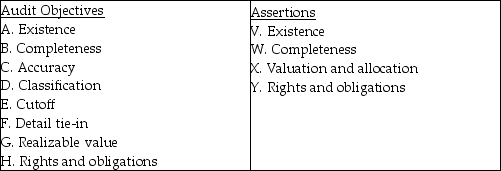 1. Obtain an aged listing of accounts receivable. For a sample of individual customers on the listing, agree the customer's name, amount, and other information with the corresponding information in the accounts receivable master file.
(1) ________.
(2) ________.
2. Examine details of sales for five days before and five days after year-end to determine whether sales have been recorded in the proper period.
(1) ________.
(2) ________.
3. Assess the reasonableness of the balance in the allowance for doubtful accounts.
(1) ________.
(2) ________.
4. Inquire as to whether any accounts receivable have been factored or sold during the period.
(1) ________.
(2) ________.
5. Inquire as to whether there are any receivables from related parties.
(1) ________.
(2) ________.
1. Obtain an aged listing of accounts receivable. For a sample of individual customers on the listing, agree the customer's name, amount, and other information with the corresponding information in the accounts receivable master file.
(1) ________.
(2) ________.
2. Examine details of sales for five days before and five days after year-end to determine whether sales have been recorded in the proper period.
(1) ________.
(2) ________.
3. Assess the reasonableness of the balance in the allowance for doubtful accounts.
(1) ________.
(2) ________.
4. Inquire as to whether any accounts receivable have been factored or sold during the period.
(1) ________.
(2) ________.
5. Inquire as to whether there are any receivables from related parties.
(1) ________.
(2) ________. (Essay)
4.9/5 (87)
(87) Discuss the differences between errors, frauds, and illegal acts. Give an example of each.
(Essay)
4.8/5 (67)
(67) Which of the following is not one of the three categories of assertions?
(Multiple Choice)
4.9/5 (83)
(83) Balance-related audit objectives are usually applied to the ending balance in income statement accounts; transaction-related audit objectives are usually applied to transactions reflected in balance sheet accounts.
(True/False)
4.8/5 (72)
(72) 
Filters
- Essay(0)
- Multiple Choice(0)
- Short Answer(0)
- True False(0)
- Matching(0)