



 Chat with AI
Exam 16: The Influence of Monetary and Fiscal Policy on Aggregate Demand

Exam 1: Ten Principles of Economics439 Questions
Exam 2: Thinking Like an Economist615 Questions
Exam 3: Interdependence and the Gains From Trade527 Questions
Exam 4: The Market Forces of Supply and Demand697 Questions
Exam 5: Measuring a Nations Income518 Questions
Exam 6: Measuring the Cost of Living543 Questions
Exam 7: Production and Growth507 Questions
Exam 8: Saving, Investment, and the Financial System565 Questions
Exam 9: The Basic Tools of Finance510 Questions
Exam 10: Unemployment and Its Natural Rate698 Questions
Exam 11: The Monetary System517 Questions
Exam 12: Money Growth and Inflation484 Questions
Exam 13: Open-Economy Macroeconomics: Basic Concepts520 Questions
Exam 14: A Macroeconomic Theory of the Open Economy478 Questions
Exam 15: Aggregate Demand and Aggregate Supply563 Questions
Exam 16: The Influence of Monetary and Fiscal Policy on Aggregate Demand510 Questions
Exam 17: The Short-Run Tradeoff Between Inflation and Unemployment516 Questions
Exam 18: Six Debates Over Macroeconomic Policy372 Questions
Select questions type


In principle, the government could increase the money supply or increase government expenditures to try to offset the effects of a wave of pessimism about the future of the economy.
(True/False)
4.9/5  (79)
(79) Which of the following illustrates how the investment accelerator works?
(Multiple Choice)
4.8/5 (73)
(73) The lag problem associated with monetary policy is due mostly to
(Multiple Choice)
4.8/5 (88)
(88) Which of the following is an example of an increase in government purchases?
(Multiple Choice)
4.8/5 (66)
(66) According to liquidity preference theory, the slope of the money demand curve is explained as follows:
(Multiple Choice)
4.8/5 (87)
(87) When the interest rate decreases, the opportunity cost of holding money
(Multiple Choice)
4.7/5 (82)
(82) The theory of _____ states that the _____ adjusts to bring money supply and money demand into balance.
(Short Answer)
5.0/5 (90)
(90) According to the theory of liquidity preference, which variable adjusts to balance the supply and demand for money?
(Multiple Choice)
4.8/5 (89)
(89) If the inflation rate is zero, then the nominal and real interest rate are the same.
(True/False)
4.8/5 (63)
(63) Figure 34-7 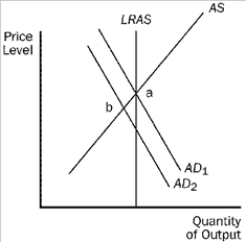 -Refer to Figure 34-7. The aggregate-demand curve could shift from AD1 to AD2 as a result of
 (Multiple Choice)
4.8/5 (79)
(79) When the Fed increases the money supply, the interest rate decreases. This decrease in the interest rate increases consumption and investment demand, so the aggregate-demand curve shifts to the right.
(True/False)
4.9/5 (71)
(71) Initially, the economy is in long-run equilibrium. The aggregate demand curve then shifts $50 billion to the left. The government wants to change its spending to offset this decrease in demand. The MPC is 0.80. Suppose the effect on aggregate demand from a change in taxes is 4/5 the size of the change from government expenditures. There is no crowding out and no accelerator effect. What should the government do if it wants to offset the decrease in aggregate demand?
(Multiple Choice)
4.9/5 (69)
(69) The theory of liquidity preference assumes that the nominal supply of money is determined by the
(Multiple Choice)
4.8/5 (79)
(79) Assume the following.
• The MPC has a value of 0.8.
• The relationship between the interest rate, r, and investment, I, is given by the equation,
I = 20,000 - br,
Where b is a positive constant.
• Government purchases, G, are increased by $1,000.
In which of the following cases would there be no crowding out?
(Multiple Choice)
4.8/5 (89)
(89) The additional shifts in aggregate demand that result when there is an increase in government spending is known as the _____.
(Short Answer)
4.8/5 (71)
(71) 
Filters
- Essay(0)
- Multiple Choice(0)
- Short Answer(0)
- True False(0)
- Matching(0)