



 Chat with AI
Exam 16: The Influence of Monetary and Fiscal Policy on Aggregate Demand

Exam 1: Ten Principles of Economics439 Questions
Exam 2: Thinking Like an Economist615 Questions
Exam 3: Interdependence and the Gains From Trade527 Questions
Exam 4: The Market Forces of Supply and Demand697 Questions
Exam 5: Measuring a Nations Income518 Questions
Exam 6: Measuring the Cost of Living543 Questions
Exam 7: Production and Growth507 Questions
Exam 8: Saving, Investment, and the Financial System565 Questions
Exam 9: The Basic Tools of Finance510 Questions
Exam 10: Unemployment and Its Natural Rate698 Questions
Exam 11: The Monetary System517 Questions
Exam 12: Money Growth and Inflation484 Questions
Exam 13: Open-Economy Macroeconomics: Basic Concepts520 Questions
Exam 14: A Macroeconomic Theory of the Open Economy478 Questions
Exam 15: Aggregate Demand and Aggregate Supply563 Questions
Exam 16: The Influence of Monetary and Fiscal Policy on Aggregate Demand510 Questions
Exam 17: The Short-Run Tradeoff Between Inflation and Unemployment516 Questions
Exam 18: Six Debates Over Macroeconomic Policy372 Questions
Select questions type


Some economists, called supply-siders, argue that changes in the money supply exert a strong influence on aggregate supply.
(True/False)
4.8/5  (73)
(73) Other things the same, an increase in taxes shifts aggregate demand to the left. In the short run this makes output fall which makes the interest rate rise.
(True/False)
4.7/5 (76)
(76) The idea that a decrease in the price level raises the real value of households' money holdings, which increases consumer spending and the quantity of goods and services demanded is known as
(Multiple Choice)
4.9/5 (84)
(84) Marcus is of the opinion that the theory of liquidity preference explains the determination of the interest rate very well. Most economists would say that Marcus's opinion is
(Multiple Choice)
4.8/5 (75)
(75) Explain why the interest rate is the opportunity cost of holding currency. What is the benefit of holding currency?
(Essay)
4.9/5 (70)
(70) Figure 34-4. On the figure, MS represents money supply and MD represents money demand. 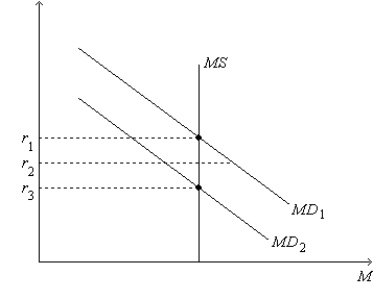 -Refer to Figure 34-4. Suppose the current equilibrium interest rate is r1. Which of the following events would cause the equilibrium interest rate to increase?
 (Multiple Choice)
4.9/5 (80)
(80) If, at some interest rate, the quantity of money demanded is less than the quantity of money supplied, people will desire to
(Multiple Choice)
4.8/5 (77)
(77) The positive feedback from aggregate demand to investment is called
(Multiple Choice)
4.7/5 (81)
(81) Open-market purchases cause an) in interest rates and an) in real GDP in the short run.
(Short Answer)
4.9/5 (66)
(66) If the Federal Reserve's goal is to stabilize aggregate demand, then it will the money supply in response to a stock market boom. This causes interest rates to .
(Short Answer)
4.8/5 (81)
(81) Figure 34-2. On the left-hand graph, MS represents the supply of money and MD represents the demand for money; on the right-hand graph, AD represents aggregate demand. The usual quantities are measured along the axes of both graphs.
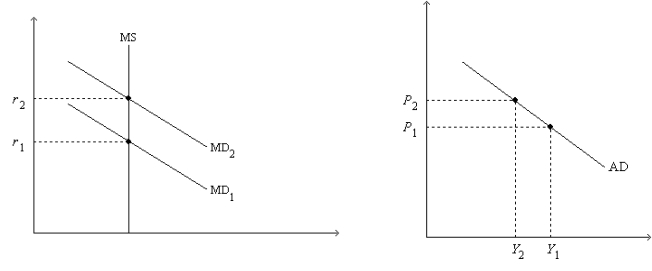 -Refer to Figure 34-2. Assume the money market is always in equilibrium. Under the assumptions of the model,
 (Multiple Choice)
4.7/5 (85)
(85) People are likely to want to hold more money if the interest rate
(Multiple Choice)
4.9/5 (73)
(73) In which of the following cases would the quantity of money demanded be smallest?
(Multiple Choice)
4.9/5 (83)
(83) According to liquidity preference theory, a decrease in the price level shifts the
(Multiple Choice)
4.8/5 (74)
(74) The potential positive feedback that government spending may have on investment is known as the _____. The potential negative effect that government spending may have on investment is known as the _____ effect.
(Short Answer)
4.9/5 (65)
(65) According to liquidity preference theory, if the price level
(Multiple Choice)
4.8/5 (79)
(79) 
Filters
- Essay(0)
- Multiple Choice(0)
- Short Answer(0)
- True False(0)
- Matching(0)