



 Chat with AI
Exam 16: The Influence of Monetary and Fiscal Policy on Aggregate Demand

Exam 1: Ten Principles of Economics439 Questions
Exam 2: Thinking Like an Economist615 Questions
Exam 3: Interdependence and the Gains From Trade527 Questions
Exam 4: The Market Forces of Supply and Demand697 Questions
Exam 5: Measuring a Nations Income518 Questions
Exam 6: Measuring the Cost of Living543 Questions
Exam 7: Production and Growth507 Questions
Exam 8: Saving, Investment, and the Financial System565 Questions
Exam 9: The Basic Tools of Finance510 Questions
Exam 10: Unemployment and Its Natural Rate698 Questions
Exam 11: The Monetary System517 Questions
Exam 12: Money Growth and Inflation484 Questions
Exam 13: Open-Economy Macroeconomics: Basic Concepts520 Questions
Exam 14: A Macroeconomic Theory of the Open Economy478 Questions
Exam 15: Aggregate Demand and Aggregate Supply563 Questions
Exam 16: The Influence of Monetary and Fiscal Policy on Aggregate Demand510 Questions
Exam 17: The Short-Run Tradeoff Between Inflation and Unemployment516 Questions
Exam 18: Six Debates Over Macroeconomic Policy372 Questions
Select questions type


Which U.S. president, when asked why he had proposed a tax cut, responded by saying "To stimulate the economy. Don't you remember your Economics 101?"
(Multiple Choice)
4.9/5  (74)
(74) If expected inflation is constant, then when the nominal interest rate increases, the real interest rate
(Multiple Choice)
4.7/5 (87)
(87) With respect to their impact on aggregate demand for the U.S. economy, which of the following represents the correct ordering of the wealth effect, interest-rate effect, and exchange-rate effect from most important to least important?
(Multiple Choice)
4.9/5 (88)
(88) A significant lag for monetary policy is the time it takes to for a change in the money supply to change the economy. A significant lag for fiscal policy is the time it takes to pass legislation authorizing it.
(True/False)
4.7/5 (80)
(80) Other things equal, the higher the price level, the higher is the real wealth of households.
(True/False)
4.9/5 (83)
(83) Supply-side economists believe that a reduction in the tax rate
(Multiple Choice)
4.9/5 (78)
(78) According to the theory of liquidity preference, an increase in the price level causes the
(Multiple Choice)
4.8/5 (86)
(86) A reduction in personal income taxes increases Aggregate Demand through
(Multiple Choice)
4.8/5 (79)
(79) Figure 34-14 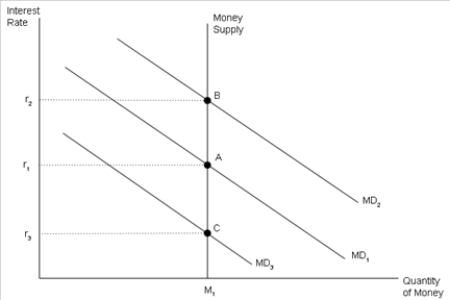 -Refer to Figure 34-14. Households' desired money holdings are given by MD1. If the current rate of interest is r3, then there is excess _____. Households will _____ interest-earning assets, which causes the interest rate to _____.
 (Short Answer)
4.8/5 (67)
(67) Which of the following policy alternatives would be an appropriate response to a sharp increase in investment spending, assuming policymakers want to stabilize output?
(Multiple Choice)
4.9/5 (78)
(78) If the Federal Reserve increases the money supply, then initially there is a
(Multiple Choice)
4.9/5 (94)
(94) According to the liquidity preference theory, an increase in the overall price level of 10 percent
(Multiple Choice)
4.9/5 (79)
(79) Which of the following shifts aggregate demand to the right?
(Multiple Choice)
4.8/5 (84)
(84) Scenario 34-2. The following facts apply to a small, imaginary economy.
• Consumption spending is $6,720 when income is $8,000.
• Consumption spending is $7,040 when income is $8,500.
-Refer to Scenario 34-2. The multiplier for this economy is
(Multiple Choice)
4.9/5 (73)
(73) Changes in the interest rate bring the money market into equilibrium according to
(Multiple Choice)
4.8/5 (89)
(89) An increase in government spending initially and primarily shifts
(Multiple Choice)
4.7/5 (75)
(75) Suppose households attempt to increase their money holdings. To stabilize output by countering this increase in money demand, the Federal Reserve would
(Multiple Choice)
5.0/5 (73)
(73) 
Filters
- Essay(0)
- Multiple Choice(0)
- Short Answer(0)
- True False(0)
- Matching(0)