



 Chat with AI
Exam 9: The Basic Tools of Finance

Exam 1: Ten Principles of Economics439 Questions
Exam 2: Thinking Like an Economist615 Questions
Exam 3: Interdependence and the Gains From Trade527 Questions
Exam 4: The Market Forces of Supply and Demand697 Questions
Exam 5: Measuring a Nations Income518 Questions
Exam 6: Measuring the Cost of Living543 Questions
Exam 7: Production and Growth507 Questions
Exam 8: Saving, Investment, and the Financial System565 Questions
Exam 9: The Basic Tools of Finance510 Questions
Exam 10: Unemployment and Its Natural Rate698 Questions
Exam 11: The Monetary System517 Questions
Exam 12: Money Growth and Inflation484 Questions
Exam 13: Open-Economy Macroeconomics: Basic Concepts520 Questions
Exam 14: A Macroeconomic Theory of the Open Economy478 Questions
Exam 15: Aggregate Demand and Aggregate Supply563 Questions
Exam 16: The Influence of Monetary and Fiscal Policy on Aggregate Demand510 Questions
Exam 17: The Short-Run Tradeoff Between Inflation and Unemployment516 Questions
Exam 18: Six Debates Over Macroeconomic Policy372 Questions
Select questions type


Write the formula to find the present value of $750 to be paid in 5 years if the interest rate is 3 percent.
(Short Answer)
4.8/5  (81)
(81) Which of the following is the correct way to compute the future value of $X that earns r percent interest for N years?
(Multiple Choice)
4.9/5 (80)
(80) A manufacturing company is thinking about building a new factory. The factory, if built, will yield the company $300 million in 7 years, and it would cost $220 million today to build. The company will decide to build the factory if the interest rate is
(Multiple Choice)
4.8/5 (77)
(77) Fourteen years ago William put money in his account at First National Bank. William decides to cash in his account and is told that his money has quadrupled. According to the rule of 70, what rate of interest did Alfred earn?
(Multiple Choice)
4.8/5 (65)
(65) Will is risk averse and has $1,000 with which to make a financial investment. He has three options. Option A is a risk-free government bond that pays 5 percent interest each year for two years. Option B is a low-risk stock that analysts expect to be worth about $1,102.50 in two years. Option C is a high-risk stock that is expected to be worth about $1,200 in four years. Will should choose
(Multiple Choice)
4.9/5 (66)
(66) Suppose you win a small lottery and you are given the following choice: You can 1) receive an immediate payment of $10,000 or 2) three annual payments, each in the amount of $3,600, with the first payment coming one year from now, the second two years from now, and the third three years from now. You would choose to take the three annual payments if the interest rate is
(Multiple Choice)
5.0/5 (84)
(84) List three different ways that a risk-averse person can reduce financial risk.
(Essay)
4.9/5 (84)
(84) Figure 27-1. The figure shows a utility function.  -Refer to Figure 27-1. The properties exhibited by this utility function help to explain various things we observe in the economy, including
 (Multiple Choice)
4.8/5 (83)
(83) You are expecting to receive $3,500 at some time in the future. Which of the following would unambiguously increase the present value of this future payment?
(Multiple Choice)
4.8/5 (79)
(79) The rule of 70 applies to a growing savings account but not to a growing economy.
(True/False)
4.8/5 (88)
(88) What is the future value of $750 one year from today if the interest rate is 2.5 percent?
(Multiple Choice)
4.8/5 (74)
(74) Scenario 27-1
Lisa has a utility function  where W is Lisa's wealth in millions of dollars and U is the utility she obtains.
-Refer to Scenario 27-1. Suppose Lisa is faced with a choice between two options. With option A Lisa receives a guaranteed $9 million. With option B Lisa faces a lottery that pays $16 million with probability P and pays $4 million with probability 1-P). Given Lisa's utility function, how high does P need to be before Lisa will prefer option B?
where W is Lisa's wealth in millions of dollars and U is the utility she obtains.
-Refer to Scenario 27-1. Suppose Lisa is faced with a choice between two options. With option A Lisa receives a guaranteed $9 million. With option B Lisa faces a lottery that pays $16 million with probability P and pays $4 million with probability 1-P). Given Lisa's utility function, how high does P need to be before Lisa will prefer option B? (Essay)
4.8/5 (83)
(83) From the standpoint of the economy as a whole, the role of
(Multiple Choice)
4.9/5 (99)
(99) Figure 27-5. The figure shows a utility function for Dexter. 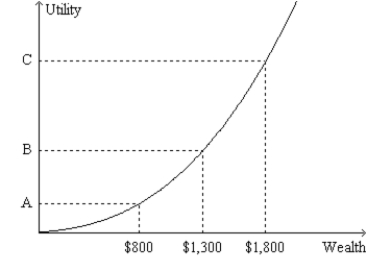 -Refer to Figure 27-5. In what ways does the graph differ from the usual case?
 (Multiple Choice)
4.9/5 (82)
(82) Lucretia puts $400 into an account when the interest rate is 10 percent. Later she checks her balance and finds it's worth about $708.62. How many years did she wait to check her balance?
(Multiple Choice)
4.9/5 (82)
(82) A bank might make mortgages to people in different regions of the country. By doing so
(Multiple Choice)
4.7/5 (74)
(74) At an annual interest rate of 10 percent, about how many years will it take $100 to double in value?
(Multiple Choice)
4.9/5 (73)
(73) 
Filters
- Essay(0)
- Multiple Choice(0)
- Short Answer(0)
- True False(0)
- Matching(0)