



 Chat with AI
Exam 9: The Basic Tools of Finance

Exam 1: Ten Principles of Economics439 Questions
Exam 2: Thinking Like an Economist615 Questions
Exam 3: Interdependence and the Gains From Trade527 Questions
Exam 4: The Market Forces of Supply and Demand697 Questions
Exam 5: Measuring a Nations Income518 Questions
Exam 6: Measuring the Cost of Living543 Questions
Exam 7: Production and Growth507 Questions
Exam 8: Saving, Investment, and the Financial System565 Questions
Exam 9: The Basic Tools of Finance510 Questions
Exam 10: Unemployment and Its Natural Rate698 Questions
Exam 11: The Monetary System517 Questions
Exam 12: Money Growth and Inflation484 Questions
Exam 13: Open-Economy Macroeconomics: Basic Concepts520 Questions
Exam 14: A Macroeconomic Theory of the Open Economy478 Questions
Exam 15: Aggregate Demand and Aggregate Supply563 Questions
Exam 16: The Influence of Monetary and Fiscal Policy on Aggregate Demand510 Questions
Exam 17: The Short-Run Tradeoff Between Inflation and Unemployment516 Questions
Exam 18: Six Debates Over Macroeconomic Policy372 Questions
Select questions type


A company that can build a project that will cost $50,000, but returns $52,000 in one year would make a good decision by turning this project down if the interest rate were 3 percent.
(True/False)
4.9/5  (84)
(84) Suppose that Thom experiences a greater loss in utility if he loses $50 than he would gain in utility if he wins $50.
This implies that Thom's
(Multiple Choice)
4.9/5 (75)
(75) Other things the same, an increase in the interest rate makes the quantity of loanable funds supplied
(Multiple Choice)
5.0/5 (87)
(87) Twenty years ago, Dr. Montgomery borrowed money from her parents to pay her tuition at graduate school. Now she wants to pay them back. She gives them double what they gave her. According to the rule of 70, what interest rate would have given her parents the same amount of money if they had put it in the bank rather than lending it to their daughter?
(Multiple Choice)
4.8/5 (82)
(82) If the interest rate is 4 percent, then you would be equally happy if you received a gift of either $100 today or a gift of
(Multiple Choice)
4.8/5 (81)
(81) Which of the following games might a risk-averse person play?
(Multiple Choice)
4.9/5 (85)
(85) Two years ago Darryl put $3,000 into an account paying 3 percent interest. How much does he have in the account today?
(Multiple Choice)
4.9/5 (68)
(68) Jarrod says that the future value of $250 saved for one year at 6 percent interest is less than the future value of $250 saved for two years at 3 percent interest. Simon says that the present value of a $250 payment to be received in one year when the interest rate is 6 percent is less than the value of a $250 payment to be received in two years when the interest rate is 3 percent.
(Multiple Choice)
5.0/5 (89)
(89) Suppose you are deciding whether or not to buy a particular bond for $5,980.17. If you buy the bond and hold it for 5 years, then at that time you will receive a payment of $10,000. You will buy the bond today if the interest rate is
(Multiple Choice)
4.8/5 (75)
(75) If the interest rate is 5 percent, then what is the present value of $2,000 to be received in three years?
(Short Answer)
4.9/5 (84)
(84) Jorge deposited $1,000 into an account three years ago. The first two years he earned 5 percent interest; the third year he earned 6 percent interest. How much money does Jorge have in his account today?
(Multiple Choice)
4.8/5 (80)
(80) Suppose you will receive $500 at some point in the future. If the annual interest rate is 7.5 percent, then the present value of the $500 is
(Multiple Choice)
4.8/5 (71)
(71) From the standpoint of the economy as a whole, the role of insurance is
(Multiple Choice)
4.8/5 (86)
(86) Which of the following is not consistent with the efficient market hypothesis?
(Multiple Choice)
4.9/5 (68)
(68) Figure 27-2. The figure shows a utility function for Britney. 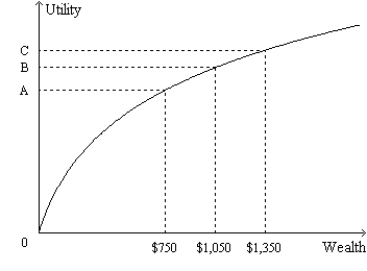 -Refer to Figure 27-2. From the appearance of the utility function, we know that
 (Multiple Choice)
4.8/5 (85)
(85) 
Filters
- Essay(0)
- Multiple Choice(0)
- Short Answer(0)
- True False(0)
- Matching(0)