



 Chat with AI
Exam 9: The Basic Tools of Finance

Exam 1: Ten Principles of Economics439 Questions
Exam 2: Thinking Like an Economist615 Questions
Exam 3: Interdependence and the Gains From Trade527 Questions
Exam 4: The Market Forces of Supply and Demand697 Questions
Exam 5: Measuring a Nations Income518 Questions
Exam 6: Measuring the Cost of Living543 Questions
Exam 7: Production and Growth507 Questions
Exam 8: Saving, Investment, and the Financial System565 Questions
Exam 9: The Basic Tools of Finance510 Questions
Exam 10: Unemployment and Its Natural Rate698 Questions
Exam 11: The Monetary System517 Questions
Exam 12: Money Growth and Inflation484 Questions
Exam 13: Open-Economy Macroeconomics: Basic Concepts520 Questions
Exam 14: A Macroeconomic Theory of the Open Economy478 Questions
Exam 15: Aggregate Demand and Aggregate Supply563 Questions
Exam 16: The Influence of Monetary and Fiscal Policy on Aggregate Demand510 Questions
Exam 17: The Short-Run Tradeoff Between Inflation and Unemployment516 Questions
Exam 18: Six Debates Over Macroeconomic Policy372 Questions
Select questions type


Imagine that two years ago you inherited $20,000 and put it into an account paying a fixed 8 percent annual interest rate. How much money do you have in your account now?
(Multiple Choice)
4.7/5  (74)
(74) Scenario 27-2
Suppose Dave has a utility function  where W is his wealth in millions of dollars and U is the utility he obtains.
-Refer to Scenario 27-2. Suppose Dave is faced with a choice between two options. With option A Dave receives a guaranteed $2 million. With option B Dave faces a lottery that pays $0 with probability 0.8 and pays $10 million with probability 0.2. Given Dave's utility function, will he prefer option A or option B? Provide evidence to support your answer.
where W is his wealth in millions of dollars and U is the utility he obtains.
-Refer to Scenario 27-2. Suppose Dave is faced with a choice between two options. With option A Dave receives a guaranteed $2 million. With option B Dave faces a lottery that pays $0 with probability 0.8 and pays $10 million with probability 0.2. Given Dave's utility function, will he prefer option A or option B? Provide evidence to support your answer. (Essay)
4.8/5 (70)
(70) James offers you $1,000 today or $X in 7 years. If the interest rate is 4.5 percent, then you would prefer to take the $1,000 today if and only if
(Multiple Choice)
4.8/5 (86)
(86) Figure 27-6. On the graph, x represents risk and y represents return. 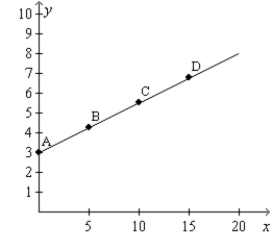 -Refer to Figure 27-6. Point A represents a situation in which
 (Multiple Choice)
4.9/5 (69)
(69) Writing in the Wall Street Journal in 2009, economist Jeremy Siegel argued that, in the years leading up to the financial crisis of 2008-2009,
(Multiple Choice)
5.0/5 (91)
(91) Available evidence indicates that stock prices, even if not exactly a random walk, are very close to a random walk.
(True/False)
4.8/5 (87)
(87) Whenever the price of an asset rises above what appears to be its fundamental value, the market is said to be experiencing a
(Multiple Choice)
4.8/5 (80)
(80) A payment of $10,000 is to be made in the future. The interest rate 3%. Is this payment worth more if it is paid in 5 years or 10 years? How much more is it worth?
(Essay)
4.7/5 (72)
(72) Which of the following actions best illustrates moral hazard?
(Multiple Choice)
4.9/5 (88)
(88) The price of a bond is equal to the sum of the present values of its future payments. Suppose a certain bond pays $50 one year from today and $1,050 two years from today. What is the price of the bond if the interest rate is 5 percent?
(Multiple Choice)
4.8/5 (75)
(75) What is the present value of a payment of $150 one year from today if the interest rate is 6 percent?
(Multiple Choice)
5.0/5 (80)
(80) If you presently have $50,000 saved and earn 15 percent interest per year, about how many years will it take for your investment to triple?
(Multiple Choice)
4.8/5 (78)
(78) According to the rule of 70, if a person's saving doubles in 10 years, what interest rate were they earning?
(Multiple Choice)
5.0/5 (86)
(86) Your financial advisor tells you that if you earn the historical rate of return on a certain mutual fund, then in three years your $20,000 will grow to $23,152.50. What rate of interest does your financial advisor expect you to earn?
(Multiple Choice)
4.8/5 (87)
(87) PZX Corporation has the opportunity to undertake an investment project that will cost $10,000 today and yield the company $13,310 in 3 years. PZX will forgo the project if the interest rate is higher than 10 percent.
(True/False)
5.0/5 (84)
(84) You have a bond that entitles you to a one-time payment of $10,000 one year from now. The interest rate is 10 percent per year. How much is the bond worth today?
(Multiple Choice)
4.9/5 (72)
(72) Actively managed mutual funds usually fail to outperform index funds, and this fact provides evidence in favor of the efficient markets hypothesis.
(True/False)
4.9/5 (74)
(74) Write the formula to find the present value of $x to be paid in n years.
(Short Answer)
4.8/5 (74)
(74) 
Filters
- Essay(0)
- Multiple Choice(0)
- Short Answer(0)
- True False(0)
- Matching(0)