



 Chat with AI
Exam 9: Profit Planning

Exam 1: Managerial Accounting and the Business Environment25 Questions
Exam 2: Managerial Accounting and Cost Concepts148 Questions
Exam 3: Systems Design: Job-Order Costing163 Questions
Exam 4: Systems Design: Process Costing106 Questions
Exam 5: Cost Behavior Analysis and Use119 Questions
Exam 6: Cost-Volume-Profit Relationship213 Questions
Exam 7: Variable Costing: a Tool for Management136 Questions
Exam 8: Activity Based Costing: a Tool to Aid Decision-Making77 Questions
Exam 9: Profit Planning144 Questions
Exam 10: Flexible Budgets and Performance Analysis294 Questions
Exam 11: Standard Costs and Operating Performance Measures163 Questions
Exam 12: Segment Reporting, Decentralization, and the Balanced Scorecard99 Questions
Exam 13: Relevant Costs for Decision Making131 Questions
Exam 14: Capital Budgeting Decisions138 Questions
Exam 15: How Well Am I Doing Statement of Cash Flows103 Questions
Exam 16: How Well Am I Doing Financial Statement Analysis207 Questions
Exam 17: Pricing Products and Services61 Questions
Exam 18: Profitability Analysis72 Questions
Exam 19: Further Classification of Labor Costs18 Questions
Exam 20: Cost of Quality24 Questions
Exam 21: the Predetermined Overhead Rate and Capacity25 Questions
Exam 22: Fifo Method72 Questions
Exam 23: Service Department Allocations51 Questions
Exam 24: Least-Squares Regression Computations14 Questions
Exam 25: Abc Action Analysis14 Questions
Exam 26: Using a Modified Form of Activity-Based Costing to17 Questions
Exam 27: Predetermined Overhead Rates and Overhead Analysis88 Questions
Exam 28: Journal Entries to Record Variances46 Questions
Exam 29: Transfer Pricing20 Questions
Exam 30: Service Department Charges34 Questions
Exam 31: The Concept of Present Value14 Questions
Exam 32: Income Taxes in Capital Budgeting Decisions33 Questions
Exam 33: The Direct Method of Determining the Net Cash Provided by42 Questions
Select questions type


Dilom Farm Supply is located in a small town in the rural west. Data regarding the store's operations follow:
Sales are budgeted at $260,000 for November, $230,000 for December, and $210,000 for January.
Collections are expected to be 55% in the month of sale, 40% in the month following the sale, and 5% uncollectible.
The cost of goods sold is 80% of sales.
The company purchases 50% of its merchandise in the month prior to the month of sale and 50% in the month of sale. Payment for merchandise is made in the month following the purchase.
Other monthly expenses to be paid in cash are $21,700.
Monthly depreciation is $17,000.
Ignore taxes. 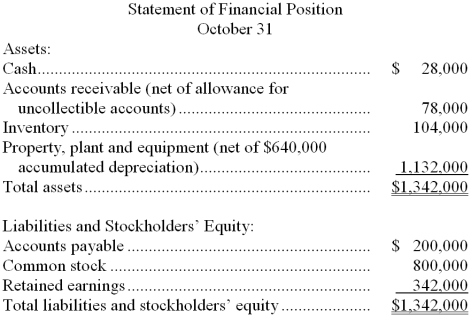 -Retained earnings at the end of December would be:
 (Multiple Choice)
4.9/5  (77)
(77) Self-imposed budgets are those that are prepared by top management and then assigned to other managers within the organization.
(True/False)
4.8/5 (90)
(90) The budget or schedule that provides necessary input data for the direct labor budget is the:
(Multiple Choice)
4.9/5 (91)
(91) Which of the following budgets are prepared before the sales budget? 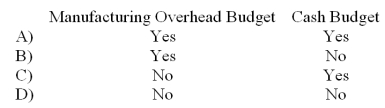
(Multiple Choice)
4.9/5 (91)
(91) Justin's Plant Store, a retailer, started operations on January 1. On that date, the only assets were $16,000 in cash and $3,500 in merchandise inventory. For purposes of budget preparation, assume that the company's cost of goods sold is 60% of sales. Expected sales for the first four months appear below. 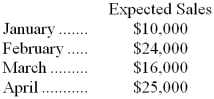 The company desires that the merchandise inventory on hand at the end of each month be equal to 50% of the next month's merchandise sales (stated at cost). All purchases of merchandise inventory must be paid in the month of purchase. Sixty percent of all sales should be for cash; the balance will be on credit. Seventy-five percent of the credit sales should be collected in the month following the month of sale, with the balance collected in the following month. Variable selling and administrative expenses should be 10% of sales and fixed expenses (all depreciation) should be $3,000 per month. Cash payments for the variable selling and administrative expenses are made during the month the expenses are incurred.
-In a budgeted balance sheet, the Merchandise Inventory on February 28:
The company desires that the merchandise inventory on hand at the end of each month be equal to 50% of the next month's merchandise sales (stated at cost). All purchases of merchandise inventory must be paid in the month of purchase. Sixty percent of all sales should be for cash; the balance will be on credit. Seventy-five percent of the credit sales should be collected in the month following the month of sale, with the balance collected in the following month. Variable selling and administrative expenses should be 10% of sales and fixed expenses (all depreciation) should be $3,000 per month. Cash payments for the variable selling and administrative expenses are made during the month the expenses are incurred.
-In a budgeted balance sheet, the Merchandise Inventory on February 28: (Multiple Choice)
4.9/5 (83)
(83) Friden Company has budgeted sales and production over the next quarter as follows:  The company has 20,000 units of product on hand at April 1. A minimum of 20% of the next month's sales needs in units must be on hand at the end of each month. July sales are expected to be 140,000 units. Budgeted sales for June would be (in units):
 (Multiple Choice)
4.7/5 (72)
(72) Justin's Plant Store, a retailer, started operations on January 1. On that date, the only assets were $16,000 in cash and $3,500 in merchandise inventory. For purposes of budget preparation, assume that the company's cost of goods sold is 60% of sales. Expected sales for the first four months appear below. The company desires that the merchandise inventory on hand at the end of each month be equal to 50% of the next month's merchandise sales (stated at cost). All purchases of merchandise inventory must be paid in the month of purchase. Sixty percent of all sales should be for cash; the balance will be on credit. Seventy-five percent of the credit sales should be collected in the month following the month of sale, with the balance collected in the following month. Variable selling and administrative expenses should be 10% of sales and fixed expenses (all depreciation) should be $3,000 per month. Cash payments for the variable selling and administrative expenses are made during the month the expenses are incurred.
-In a budgeted income statement for the month of February, net income would be:
The company desires that the merchandise inventory on hand at the end of each month be equal to 50% of the next month's merchandise sales (stated at cost). All purchases of merchandise inventory must be paid in the month of purchase. Sixty percent of all sales should be for cash; the balance will be on credit. Seventy-five percent of the credit sales should be collected in the month following the month of sale, with the balance collected in the following month. Variable selling and administrative expenses should be 10% of sales and fixed expenses (all depreciation) should be $3,000 per month. Cash payments for the variable selling and administrative expenses are made during the month the expenses are incurred.
-In a budgeted income statement for the month of February, net income would be: (Multiple Choice)
4.8/5 (85)
(85) Justin's Plant Store, a retailer, started operations on January 1. On that date, the only assets were $16,000 in cash and $3,500 in merchandise inventory. For purposes of budget preparation, assume that the company's cost of goods sold is 60% of sales. Expected sales for the first four months appear below. The company desires that the merchandise inventory on hand at the end of each month be equal to 50% of the next month's merchandise sales (stated at cost). All purchases of merchandise inventory must be paid in the month of purchase. Sixty percent of all sales should be for cash; the balance will be on credit. Seventy-five percent of the credit sales should be collected in the month following the month of sale, with the balance collected in the following month. Variable selling and administrative expenses should be 10% of sales and fixed expenses (all depreciation) should be $3,000 per month. Cash payments for the variable selling and administrative expenses are made during the month the expenses are incurred.
-The Accounts Receivable balance that would appear in the March 31 budgeted balance sheet would be:
The company desires that the merchandise inventory on hand at the end of each month be equal to 50% of the next month's merchandise sales (stated at cost). All purchases of merchandise inventory must be paid in the month of purchase. Sixty percent of all sales should be for cash; the balance will be on credit. Seventy-five percent of the credit sales should be collected in the month following the month of sale, with the balance collected in the following month. Variable selling and administrative expenses should be 10% of sales and fixed expenses (all depreciation) should be $3,000 per month. Cash payments for the variable selling and administrative expenses are made during the month the expenses are incurred.
-The Accounts Receivable balance that would appear in the March 31 budgeted balance sheet would be: (Multiple Choice)
4.7/5 (80)
(80) If the expected level of activity is appreciably above or below the company's present capacity, it may be desirable to adjust fixed costs in the budget.
(True/False)
4.8/5 (77)
(77) The manufacturing overhead budget at Waycaster Corporation is based on budgeted direct labor-hours. The direct labor budget indicates that 6,000 direct labor-hours will be required in February. The variable overhead rate is $3.40 per direct labor-hour. The company's budgeted fixed manufacturing overhead is $81,600 per month, which includes depreciation of $18,000. All other fixed manufacturing overhead costs represent current cash flows.
-The February cash disbursements for manufacturing overhead on the manufacturing overhead budget should be:
(Multiple Choice)
4.9/5 (73)
(73) Coles Company, Inc. makes and sells a single product, Product R. Three yards of Material K are needed to make one unit of Product R. Budgeted production of Product R for the next five months is as follows:  The company wants to maintain monthly ending inventories of Material K equal to 20% of the following month's production needs. On July 31, this requirement was not met since only 2,500 yards of Material K were on hand. The cost of Material K is $0.85 per yard. The company wants to prepare a Direct Materials Purchase Budget for the rest of the year.
-The total needs (i.e., production requirements plus desired ending inventory) of Material K for the month of November are:
The company wants to maintain monthly ending inventories of Material K equal to 20% of the following month's production needs. On July 31, this requirement was not met since only 2,500 yards of Material K were on hand. The cost of Material K is $0.85 per yard. The company wants to prepare a Direct Materials Purchase Budget for the rest of the year.
-The total needs (i.e., production requirements plus desired ending inventory) of Material K for the month of November are: (Multiple Choice)
4.8/5 (74)
(74) Glinski Corporation is working on its direct labor budget for the next two months. Each unit of output requires 0.29 direct labor-hours. The direct labor rate is $7.00 per direct labor-hour. The production budget calls for producing 5,600 units in June and 6,100 units in July.
Required:
Construct the direct labor budget for the next two months, assuming that the direct labor work force is fully adjusted to the total direct labor-hours needed each month.
(Essay)
4.8/5 (85)
(85) Dilom Farm Supply is located in a small town in the rural west. Data regarding the store's operations follow:
Sales are budgeted at $260,000 for November, $230,000 for December, and $210,000 for January.
Collections are expected to be 55% in the month of sale, 40% in the month following the sale, and 5% uncollectible.
The cost of goods sold is 80% of sales.
The company purchases 50% of its merchandise in the month prior to the month of sale and 50% in the month of sale. Payment for merchandise is made in the month following the purchase.
Other monthly expenses to be paid in cash are $21,700.
Monthly depreciation is $17,000.
Ignore taxes.
-Accounts payable at the end of December would be:
-Accounts payable at the end of December would be: (Multiple Choice)
4.8/5 (76)
(76) The Charade Company is preparing its Manufacturing Overhead budget for the fourth quarter of the year. The budgeted variable factory overhead is $5.00 per direct labor-hour; the budgeted fixed factory overhead is $75,000 per month, of which $15,000 is factory depreciation.
-If the budgeted cash disbursements for factory overhead for December total $105,000, then the budgeted direct labor-hours for December must be:
(Multiple Choice)
4.9/5 (70)
(70) Fairmont Inc. uses an accounting system that charges costs to the manager who has been delegated the authority to make decisions concerning the costs. For example, if the sales manager accepts a rush order that will result in higher than normal manufacturing costs, these additional costs are charged to the sales manager because the authority to accept or decline the rush order was given to the sales manager. This type of accounting system is known as:
(Multiple Choice)
4.9/5 (86)
(86) Richards Company has the following budgeted sales for the first half of next year: 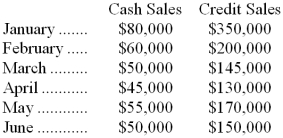 The company is in the process of preparing a cash budget and must determine the expected cash collections by month. To this end, the following information has been assembled:
Collections on credit sales:
60% in month of sale
30% in month following sale
10% in second month following sale
-Assume that the accounts receivable balance on January 1 is $70,000. Of this amount, $60,000 represents uncollected December sales and $10,000 represents uncollected November sales. Given these data, the total cash collected during January would be:
The company is in the process of preparing a cash budget and must determine the expected cash collections by month. To this end, the following information has been assembled:
Collections on credit sales:
60% in month of sale
30% in month following sale
10% in second month following sale
-Assume that the accounts receivable balance on January 1 is $70,000. Of this amount, $60,000 represents uncollected December sales and $10,000 represents uncollected November sales. Given these data, the total cash collected during January would be: (Multiple Choice)
5.0/5 (72)
(72) Sarrazin Corporation is in the process of preparing its annual budget. The following beginning and ending inventory levels are planned for the year.  Each unit of finished goods requires 8 grams of raw material.
-If the company plans to sell 640,000 units during the year, the number of units it would have to manufacture during the year would be:
Each unit of finished goods requires 8 grams of raw material.
-If the company plans to sell 640,000 units during the year, the number of units it would have to manufacture during the year would be: (Multiple Choice)
4.9/5 (82)
(82) Orion Corporation is preparing a cash budget for the six months beginning January 1. Shown below are the company's expected collection pattern and the budgeted sales for the period.
Expected collection pattern:
65% collected in the month of sale
20% collected in the month after sale
10% collected in the second month after sale
4% collected in the third month after sale
1% uncollectible
Budgeted sales: 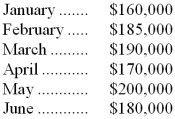 The estimated total cash collections during April from sales and accounts receivables would be:
 (Multiple Choice)
4.9/5 (74)
(74) The Culver Company is preparing its Manufacturing Overhead Budget for the third quarter of the year. Budgeted variable factory overhead is $3.00 per unit produced; budgeted fixed factory overhead is $75,000 per month, with $16,000 of this amount being factory depreciation.
-If the budgeted production for August is 5,000 units, then the total budgeted factory overhead per unit is:
(Multiple Choice)
4.8/5 (78)
(78) 
Filters
- Essay(0)
- Multiple Choice(0)
- Short Answer(0)
- True False(0)
- Matching(0)