



 Chat with AI
Exam 32: Income Taxes in Capital Budgeting Decisions

Exam 1: Managerial Accounting and the Business Environment25 Questions
Exam 2: Managerial Accounting and Cost Concepts148 Questions
Exam 3: Systems Design: Job-Order Costing163 Questions
Exam 4: Systems Design: Process Costing106 Questions
Exam 5: Cost Behavior Analysis and Use119 Questions
Exam 6: Cost-Volume-Profit Relationship213 Questions
Exam 7: Variable Costing: a Tool for Management136 Questions
Exam 8: Activity Based Costing: a Tool to Aid Decision-Making77 Questions
Exam 9: Profit Planning144 Questions
Exam 10: Flexible Budgets and Performance Analysis294 Questions
Exam 11: Standard Costs and Operating Performance Measures163 Questions
Exam 12: Segment Reporting, Decentralization, and the Balanced Scorecard99 Questions
Exam 13: Relevant Costs for Decision Making131 Questions
Exam 14: Capital Budgeting Decisions138 Questions
Exam 15: How Well Am I Doing Statement of Cash Flows103 Questions
Exam 16: How Well Am I Doing Financial Statement Analysis207 Questions
Exam 17: Pricing Products and Services61 Questions
Exam 18: Profitability Analysis72 Questions
Exam 19: Further Classification of Labor Costs18 Questions
Exam 20: Cost of Quality24 Questions
Exam 21: the Predetermined Overhead Rate and Capacity25 Questions
Exam 22: Fifo Method72 Questions
Exam 23: Service Department Allocations51 Questions
Exam 24: Least-Squares Regression Computations14 Questions
Exam 25: Abc Action Analysis14 Questions
Exam 26: Using a Modified Form of Activity-Based Costing to17 Questions
Exam 27: Predetermined Overhead Rates and Overhead Analysis88 Questions
Exam 28: Journal Entries to Record Variances46 Questions
Exam 29: Transfer Pricing20 Questions
Exam 30: Service Department Charges34 Questions
Exam 31: The Concept of Present Value14 Questions
Exam 32: Income Taxes in Capital Budgeting Decisions33 Questions
Exam 33: The Direct Method of Determining the Net Cash Provided by42 Questions
Select questions type


Wable Inc. has provided the following data to be used in evaluating a proposed investment project:  For tax purposes, the entire initial investment without any reduction for salvage value will be depreciated over 5 years. The company uses a discount rate of 16%.
-When computing the net present value of the project, what is the after-tax cash flow from the salvage value in the final year?
For tax purposes, the entire initial investment without any reduction for salvage value will be depreciated over 5 years. The company uses a discount rate of 16%.
-When computing the net present value of the project, what is the after-tax cash flow from the salvage value in the final year?
Free
(Multiple Choice)
5.0/5  (76)
(76) Correct Answer: Verified
B
Wable Inc. has provided the following data to be used in evaluating a proposed investment project: For tax purposes, the entire initial investment without any reduction for salvage value will be depreciated over 5 years. The company uses a discount rate of 16%.
-The net present value of the project is closest to:
For tax purposes, the entire initial investment without any reduction for salvage value will be depreciated over 5 years. The company uses a discount rate of 16%.
-The net present value of the project is closest to:Free
(Multiple Choice)
4.9/5 (92)
(92) Correct Answer:Verified
VerifiedD
Aardvik Corporation is considering renting a new building at an annual rent of $10,000. At a tax rate of 40%, the after-tax cost of the proposed rent would be:
Free
(Multiple Choice)
4.9/5 (72)
(72) Correct Answer:Verified
VerifiedB
Uzzle Corporation uses a discount rate of 10% and has a tax rate of 30%. The following cash flows occur in the last year of an 8-year equipment selection investment project:  The assumed salvage value was zero when the depreciation deductions were computed for tax purposes. The total after-tax present value of the cash flows above is closest to:
 (Multiple Choice)
4.8/5 (72)
(72) Demirjian Inc. is considering an investment project that would require an initial investment of $290,000 and that would last for 8 years. The annual cash receipts from the project would be $189,000 and the annual cash expenses would be $85,000. The equipment used in the project could be sold at the end of the project for a salvage value of $29,000. The company's tax rate is 30%. For tax purposes, the entire initial investment will be depreciated over 7 years without any reduction for salvage value. The company uses a discount rate of 13%.
-When computing the net present value of the project, what are the annual after-tax cash receipts?
(Multiple Choice)
4.8/5 (84)
(84) Management is considering purchasing an asset for $30,000 that would have a useful life of 5 years and no salvage value. For tax purposes, the entire original cost of the asset would be depreciated over 5 years using the straight-line method. The asset would generate annual net cash inflows of $18,000 throughout its useful life. The project would require additional working capital of $8,000, which would be released at the end of the project. The company's tax rate is 30% and its discount rate is 14%.
Required:
What is the net present value of the asset?
(Essay)
4.8/5 (76)
(76) A company anticipates a taxable cash receipt of $20,000 in year 4 of a project. The company's tax rate is 30% and its discount rate is 14%. The present value of this future cash flow is closest to:
(Multiple Choice)
4.8/5 (71)
(71) Bauerkemper Inc. is considering a project that would require an initial investment of $924,000 and would have a useful life of 7 years. The annual cash receipts would be $693,000 and the annual cash expenses would be $347,000. The salvage value of the assets used in the project would be $92,000. The company's tax rate is 30%. For tax purposes, the entire initial investment without any reduction for salvage value will be depreciated over 5 years. The company uses a discount rate of 17%.
Required:
Compute the net present value of the project.
(Essay)
4.9/5 (97)
(97) If a company operates at a profit, the after-tax cost of a tax-deductible cash expense is determined by multiplying the cash expense by one minus the tax rate.
(True/False)
4.8/5 (80)
(80) A company anticipates a taxable cash expense of $50,000 in year 2 of a project. The company's tax rate is 30% and its discount rate is 14%. The present value of this future cash flow is closest to:
(Multiple Choice)
4.7/5 (89)
(89) Littau Inc. has provided the following data concerning an investment project that has been proposed: 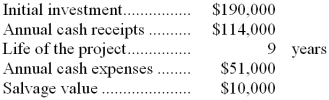 The company's tax rate is 30%. For tax purposes, the entire initial investment will be depreciated over 7 years without any reduction for salvage value. The company uses a discount rate of 19%.
-When computing the net present value of the project, what is the after-tax cash flow from the salvage value in the final year?
The company's tax rate is 30%. For tax purposes, the entire initial investment will be depreciated over 7 years without any reduction for salvage value. The company uses a discount rate of 19%.
-When computing the net present value of the project, what is the after-tax cash flow from the salvage value in the final year? (Multiple Choice)
4.9/5 (75)
(75) Wable Inc. has provided the following data to be used in evaluating a proposed investment project: For tax purposes, the entire initial investment without any reduction for salvage value will be depreciated over 5 years. The company uses a discount rate of 16%.
-When computing the net present value of the project, what are the annual after-tax cash receipts?
For tax purposes, the entire initial investment without any reduction for salvage value will be depreciated over 5 years. The company uses a discount rate of 16%.
-When computing the net present value of the project, what are the annual after-tax cash receipts? (Multiple Choice)
4.8/5 (77)
(77) Suppose a machine that costs $80,000 has a useful life of 10 years. Also suppose that depreciation on the machine is $8,000 for tax purposes in year 4. The tax rate is 40%. The tax savings from the depreciation tax shield in year 4 would be:
(Multiple Choice)
4.9/5 (74)
(74) A company needs an increase in working capital of $30,000 in a project that will last 2 years. The company's tax rate is 30% and its discount rate is 14%. The present value of the release of the working capital at the end of the project is closest to:
(Multiple Choice)
4.9/5 (67)
(67) Demirjian Inc. is considering an investment project that would require an initial investment of $290,000 and that would last for 8 years. The annual cash receipts from the project would be $189,000 and the annual cash expenses would be $85,000. The equipment used in the project could be sold at the end of the project for a salvage value of $29,000. The company's tax rate is 30%. For tax purposes, the entire initial investment will be depreciated over 7 years without any reduction for salvage value. The company uses a discount rate of 13%.
-The net present value of the project is closest to:
(Multiple Choice)
4.9/5 (80)
(80) In a net present value analysis of an equipment upgrade using a 30% tax rate, what amount of cash savings would have the same present value as a $168,000 depreciation deduction?
(Multiple Choice)
4.8/5 (84)
(84) An investment of $180,000 made now will yield an annual net after-tax cash operating inflow of $24,000 for each of the next ten years. The tax rate is 40%. The annual net before-tax cash operating inflow is:
(Multiple Choice)
4.8/5 (80)
(80) Littau Inc. has provided the following data concerning an investment project that has been proposed: The company's tax rate is 30%. For tax purposes, the entire initial investment will be depreciated over 7 years without any reduction for salvage value. The company uses a discount rate of 19%.
-The net present value of the project is closest to:
The company's tax rate is 30%. For tax purposes, the entire initial investment will be depreciated over 7 years without any reduction for salvage value. The company uses a discount rate of 19%.
-The net present value of the project is closest to: (Multiple Choice)
4.9/5 (76)
(76) Salomone Inc. has provided the following data concerning a proposed investment project: 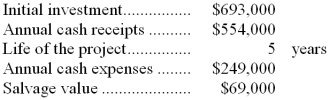 The company's tax rate is 30%. For tax purposes, the entire initial investment without any reduction for salvage value will be depreciated over 3 years. The company uses a discount rate of 13%.
Required:
Compute the net present value of the project.
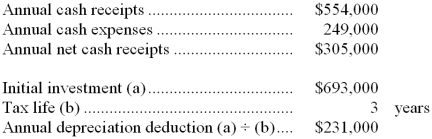
The company's tax rate is 30%. For tax purposes, the entire initial investment without any reduction for salvage value will be depreciated over 3 years. The company uses a discount rate of 13%.
Required:
Compute the net present value of the project. (Essay)
4.9/5 (86)
(86) To determine the effect of income taxes on a project, multiply the net present value of the project by one minus the tax rate.
(True/False)
4.8/5 (80)
(80) 
Filters
- Essay(0)
- Multiple Choice(0)
- Short Answer(0)
- True False(0)
- Matching(0)