



 Chat with AI
Exam 9: Profit Planning

Exam 1: Managerial Accounting and the Business Environment25 Questions
Exam 2: Managerial Accounting and Cost Concepts148 Questions
Exam 3: Systems Design: Job-Order Costing163 Questions
Exam 4: Systems Design: Process Costing106 Questions
Exam 5: Cost Behavior Analysis and Use119 Questions
Exam 6: Cost-Volume-Profit Relationship213 Questions
Exam 7: Variable Costing: a Tool for Management136 Questions
Exam 8: Activity Based Costing: a Tool to Aid Decision-Making77 Questions
Exam 9: Profit Planning144 Questions
Exam 10: Flexible Budgets and Performance Analysis294 Questions
Exam 11: Standard Costs and Operating Performance Measures163 Questions
Exam 12: Segment Reporting, Decentralization, and the Balanced Scorecard99 Questions
Exam 13: Relevant Costs for Decision Making131 Questions
Exam 14: Capital Budgeting Decisions138 Questions
Exam 15: How Well Am I Doing Statement of Cash Flows103 Questions
Exam 16: How Well Am I Doing Financial Statement Analysis207 Questions
Exam 17: Pricing Products and Services61 Questions
Exam 18: Profitability Analysis72 Questions
Exam 19: Further Classification of Labor Costs18 Questions
Exam 20: Cost of Quality24 Questions
Exam 21: the Predetermined Overhead Rate and Capacity25 Questions
Exam 22: Fifo Method72 Questions
Exam 23: Service Department Allocations51 Questions
Exam 24: Least-Squares Regression Computations14 Questions
Exam 25: Abc Action Analysis14 Questions
Exam 26: Using a Modified Form of Activity-Based Costing to17 Questions
Exam 27: Predetermined Overhead Rates and Overhead Analysis88 Questions
Exam 28: Journal Entries to Record Variances46 Questions
Exam 29: Transfer Pricing20 Questions
Exam 30: Service Department Charges34 Questions
Exam 31: The Concept of Present Value14 Questions
Exam 32: Income Taxes in Capital Budgeting Decisions33 Questions
Exam 33: The Direct Method of Determining the Net Cash Provided by42 Questions
Select questions type


Davie Corporation is preparing its Manufacturing Overhead Budget for the fourth quarter of the year. The budgeted variable factory overhead rate is $6.00 per direct labor-hour; the budgeted fixed factory overhead is $92,000 per month, of which $16,000 is factory depreciation.
-If the budgeted direct labor time for December is 4,000 hours, then the predetermined factory overhead per direct labor-hour for December would be:
(Multiple Choice)
4.8/5  (69)
(69) The selling and administrative expense budget of Spurlock Corporation is based on budgeted unit sales, which are 6,300 units for February. The variable selling and administrative expense is $9.30 per unit. The budgeted fixed selling and administrative expense is $118,440 per month, which includes depreciation of $19,530 per month. The remainder of the fixed selling and administrative expense represents current cash flows. The cash disbursements for selling and administrative expenses on the February selling and administrative expense budget should be:
(Multiple Choice)
4.8/5 (76)
(76) Super Drive is a computer hard drive manufacturer. The company's balance sheet for the fiscal year ended on November 30 appears below:
 Additional information regarding Super Drive's operations appear below:
• Sales are budgeted at $520,000 for December and $500,000 for January.
• Collections are expected to be 60% in the month of sale and 40% in the month following sale. There are no bad debts.
• 80% of the disk drive components are purchased in the month prior to the month of the sale, and 20% are purchased in the month of the sale. Purchased components comprise 40% of the cost of goods sold.
• Payment for components purchased is made in the month following the purchase.
• Assume that the cost of goods sold is 80% of sales.
-Expected cash collections in December are:
Additional information regarding Super Drive's operations appear below:
• Sales are budgeted at $520,000 for December and $500,000 for January.
• Collections are expected to be 60% in the month of sale and 40% in the month following sale. There are no bad debts.
• 80% of the disk drive components are purchased in the month prior to the month of the sale, and 20% are purchased in the month of the sale. Purchased components comprise 40% of the cost of goods sold.
• Payment for components purchased is made in the month following the purchase.
• Assume that the cost of goods sold is 80% of sales.
-Expected cash collections in December are: (Multiple Choice)
4.7/5 (84)
(84) The manufacturing overhead budget of Inch Corporation is based on budgeted direct labor-hours. The September direct labor budget indicates that 4,400 direct labor-hours will be required in that month. The variable overhead rate is $5.00 per direct labor-hour. The company's budgeted fixed manufacturing overhead is $59,400 per month, which includes depreciation of $10,560. All other fixed manufacturing overhead costs represent current cash flows.
Required:
a. Determine the cash disbursement for manufacturing overhead for September. Show your work!
b. Determine the predetermined overhead rate for September. Show your work!
(Essay)
5.0/5 (78)
(78) Dilom Farm Supply is located in a small town in the rural west. Data regarding the store's operations follow:
Sales are budgeted at $260,000 for November, $230,000 for December, and $210,000 for January.
Collections are expected to be 55% in the month of sale, 40% in the month following the sale, and 5% uncollectible.
The cost of goods sold is 80% of sales.
The company purchases 50% of its merchandise in the month prior to the month of sale and 50% in the month of sale. Payment for merchandise is made in the month following the purchase.
Other monthly expenses to be paid in cash are $21,700.
Monthly depreciation is $17,000.
Ignore taxes.  -December cash disbursements for merchandise purchases would be:
 (Multiple Choice)
4.9/5 (83)
(83) Roberts Enterprises has budgeted sales in units for the next five months as follows:  Past experience has shown that the ending inventory for each month must be equal to 10% of the next month's sales in units. The inventory on May 31 contained 410 units. The company needs to prepare a production budget for the second quarter of the year.
-The beginning inventory in units for September is:
Past experience has shown that the ending inventory for each month must be equal to 10% of the next month's sales in units. The inventory on May 31 contained 410 units. The company needs to prepare a production budget for the second quarter of the year.
-The beginning inventory in units for September is: (Multiple Choice)
5.0/5 (84)
(84) Tolla Company is estimating the following sales for the first six months of next year:  Sales at Tolla are normally collected as 70% in the month of sale, 25% in the month following the sale, and the remaining 5% being uncollectible. Also, those customers paying in the month of sale are given a 2% discount. Based on this information, how much cash should Tolla expect to collect during the month of April?
 (Multiple Choice)
4.9/5 (60)
(60) A self-imposed budget can be a very effective control device in an organization.
(True/False)
4.8/5 (85)
(85) In the merchandise purchases budget, the required purchases (in units) for a period can be determined by subtracting the beginning merchandise inventory (in units) from the budgeted sales (in units).
(True/False)
4.9/5 (87)
(87) Justin's Plant Store, a retailer, started operations on January 1. On that date, the only assets were $16,000 in cash and $3,500 in merchandise inventory. For purposes of budget preparation, assume that the company's cost of goods sold is 60% of sales. Expected sales for the first four months appear below.  The company desires that the merchandise inventory on hand at the end of each month be equal to 50% of the next month's merchandise sales (stated at cost). All purchases of merchandise inventory must be paid in the month of purchase. Sixty percent of all sales should be for cash; the balance will be on credit. Seventy-five percent of the credit sales should be collected in the month following the month of sale, with the balance collected in the following month. Variable selling and administrative expenses should be 10% of sales and fixed expenses (all depreciation) should be $3,000 per month. Cash payments for the variable selling and administrative expenses are made during the month the expenses are incurred.
-In a cash budget for March, the total cash disbursements would be:
The company desires that the merchandise inventory on hand at the end of each month be equal to 50% of the next month's merchandise sales (stated at cost). All purchases of merchandise inventory must be paid in the month of purchase. Sixty percent of all sales should be for cash; the balance will be on credit. Seventy-five percent of the credit sales should be collected in the month following the month of sale, with the balance collected in the following month. Variable selling and administrative expenses should be 10% of sales and fixed expenses (all depreciation) should be $3,000 per month. Cash payments for the variable selling and administrative expenses are made during the month the expenses are incurred.
-In a cash budget for March, the total cash disbursements would be: (Multiple Choice)
4.8/5 (82)
(82) Dilom Farm Supply is located in a small town in the rural west. Data regarding the store's operations follow:
Sales are budgeted at $260,000 for November, $230,000 for December, and $210,000 for January.
Collections are expected to be 55% in the month of sale, 40% in the month following the sale, and 5% uncollectible.
The cost of goods sold is 80% of sales.
The company purchases 50% of its merchandise in the month prior to the month of sale and 50% in the month of sale. Payment for merchandise is made in the month following the purchase.
Other monthly expenses to be paid in cash are $21,700.
Monthly depreciation is $17,000.
Ignore taxes.
-The accounts receivable balance, net of uncollectible accounts, at the end of December would be:
-The accounts receivable balance, net of uncollectible accounts, at the end of December would be: (Multiple Choice)
4.8/5 (75)
(75) Carner Lumber sells lumber and general building supplies to building contractors in a medium-sized town in Montana. Data regarding the store's operations follow:
Sales are budgeted at $370,000 for November, $360,000 for December, and $340,000 for January.
Collections are expected to be 85% in the month of sale, 13% in the month following the sale, and 2% uncollectible.
The cost of goods sold is 70% of sales.
The company purchases 30% of its merchandise in the month prior to the month of sale and 70% in the month of sale. Payment for merchandise is made in the month following the purchase.
Other monthly expenses to be paid in cash are $24,600.
Monthly depreciation is $17,000.
Ignore taxes.  -The accounts receivable balance, net of uncollectible accounts, at the end of December would be:
 (Multiple Choice)
4.9/5 (77)
(77) Coles Company, Inc. makes and sells a single product, Product R. Three yards of Material K are needed to make one unit of Product R. Budgeted production of Product R for the next five months is as follows:  The company wants to maintain monthly ending inventories of Material K equal to 20% of the following month's production needs. On July 31, this requirement was not met since only 2,500 yards of Material K were on hand. The cost of Material K is $0.85 per yard. The company wants to prepare a Direct Materials Purchase Budget for the rest of the year.
-The desired ending inventory of Material K for the month of September is:
The company wants to maintain monthly ending inventories of Material K equal to 20% of the following month's production needs. On July 31, this requirement was not met since only 2,500 yards of Material K were on hand. The cost of Material K is $0.85 per yard. The company wants to prepare a Direct Materials Purchase Budget for the rest of the year.
-The desired ending inventory of Material K for the month of September is: (Multiple Choice)
4.9/5 (84)
(84) TabComp Inc. is a retail distributor for MZB-33 computer hardware and related software. TabComp prepares annual sales forecasts of which the first six months of the coming year are presented below. 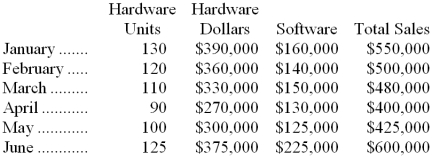 Cash sales account for 25% of TabComp's total sales, 30% of the total sales are paid by bank credit card, and the remaining 45% are on open account (TabComp's own charge accounts). The cash and bank credit card sale payments are received in the month of the sale. Bank credit card sales are subject to a 4 % discount which is deducted immediately. The cash receipts for sales on open account are 70% in the month following the sale, 28% in the second month following the sale, and the remaining are uncollectible.
TabComp's month-end inventory requirements for computer hardware units are 30% of the next month's sales. The units must be ordered two months in advance due to long lead times quoted by the manufacturer.
Required:
a. Calculate the cash that TabComp can expect to collect during April. Show all of your calculations.
b. Determine the number of computer hardware units that should be ordered in January. Show all of your calculations.
Cash sales account for 25% of TabComp's total sales, 30% of the total sales are paid by bank credit card, and the remaining 45% are on open account (TabComp's own charge accounts). The cash and bank credit card sale payments are received in the month of the sale. Bank credit card sales are subject to a 4 % discount which is deducted immediately. The cash receipts for sales on open account are 70% in the month following the sale, 28% in the second month following the sale, and the remaining are uncollectible.
TabComp's month-end inventory requirements for computer hardware units are 30% of the next month's sales. The units must be ordered two months in advance due to long lead times quoted by the manufacturer.
Required:
a. Calculate the cash that TabComp can expect to collect during April. Show all of your calculations.
b. Determine the number of computer hardware units that should be ordered in January. Show all of your calculations. (Essay)
4.8/5 (81)
(81) In companies that have "no lay-off" policies, the total direct labor cost for a budget period is computed by multiplying the total direct labor hours needed to make the budgeted output of completed units by the direct labor wage rate.
(True/False)
4.9/5 (83)
(83) Parlee Company's sales are 30% in cash and 70% on credit. Sixty % of the credit sales are collected in the month of sale, 25% in the month following sale, and 12% in the second month following sale. The remainder are uncollectible. The following are budgeted sales data:  Total cash receipts in April would be budgeted to be:
 (Multiple Choice)
4.9/5 (75)
(75) Pardise Company plans the following beginning and ending inventory levels (in units) for July:
 Two units of raw material are needed to produce each unit of finished product.
-The total cash collected during January by LaGrange Company would be:
Two units of raw material are needed to produce each unit of finished product.
-The total cash collected during January by LaGrange Company would be: (Multiple Choice)
4.9/5 (89)
(89) The cash budget must be prepared before you can complete the:
(Multiple Choice)
4.8/5 (68)
(68) Dilom Farm Supply is located in a small town in the rural west. Data regarding the store's operations follow:
Sales are budgeted at $260,000 for November, $230,000 for December, and $210,000 for January.
Collections are expected to be 55% in the month of sale, 40% in the month following the sale, and 5% uncollectible.
The cost of goods sold is 80% of sales.
The company purchases 50% of its merchandise in the month prior to the month of sale and 50% in the month of sale. Payment for merchandise is made in the month following the purchase.
Other monthly expenses to be paid in cash are $21,700.
Monthly depreciation is $17,000.
Ignore taxes.
-The excess (deficiency) of cash available over disbursements for December would be:
-The excess (deficiency) of cash available over disbursements for December would be: (Multiple Choice)
5.0/5 (75)
(75) 
Filters
- Essay(0)
- Multiple Choice(0)
- Short Answer(0)
- True False(0)
- Matching(0)